Global equities faced fresh challenges in the first quarter of 2025 amid growing trade-war concerns and developments in artificial intelligence (AI).
Q1 earnings season is about to kick off amidst what some might consider to be the most uncertain environment for US corporations since the COVID-19 pandemic.
Last week President Trump announced tariffs on nearly all US trading partners, a move that far exceeded the most pessimistic expectations of market participants.
Given the abundance of market uncertainty, it may be best to adhere to Treasuries, or for additional yield, to municipal bonds.
With the financial markets still wrestling with the tariff announcements from last week, one thing is still certain: uncertainty remains an integral part of the investment landscape.
Social Security is at the center of the fiscal emergency that threatens the US. Yet Washington is always reluctant to grapple with it honestly, partly because the issue is misunderstood.
US inflation cooled broadly in March, indicating some relief for consumers prior to widespread tariffs that risk contributing to price pressures.
Federal Reserve officials are prepared to hold their policy rate steady to minimize the risk that President Donald Trump’s tariffs trigger a persistent rise in inflation, even if the labor market softens further.
Shorter-term Treasuries gained after an unexpected ebb in US inflation last month calmed bond traders shaken by President Donald Trump’s evolving trade policy.
To understand the origin of the free-trade excesses that created record trade deficits and set in motion President Donald Trump’s tariff storm, consider the so-called de minimis exemption.
The month of March featured a varied mix of articles among Advisor Perspectives’ top 10 most-read list, including book reviews, analysis of current events and primers on different subjects among its ranks.
Members of Congress from both parties were among the many caught off guard by last week's Rose Garden tariff announcement.
In an era when a select group of tech behemoths has dominated market returns, investors are growing increasingly wary of the concentration risk it poses.
Markets were jolted last week after President Trump announced sweeping tariffs, including steep increases on China, Japan, and the EU, leading to a 10.5% drop in the S&P 500 over two days—an event seen only during major crises in the past 75 years.
The fifth edition of our annual “Voice of the American Workplace” survey, conducted by The Harris Poll on behalf of Franklin Templeton, includes the perspectives of both employers and workers. The 2025 survey found US workers are prioritizing work-life balance and their mental health. Employers are listening and strengthening their focus on improving benefits and communication. In this piece, our Jacque Reardon shares findings from the survey and potential implications for employers.
A Wall Street axiom states that the stock markets lead the economy by about six months. While not a perfect predictor, the stock market reacts to investor expectations about future corporate earnings, economic activity, interest rates, and inflation.
With uncertainty in abundance, we think investors should avoid drastic moves.
Callable bonds make up a large share of the bond market—and introduce one more variable into the bond-investing process.
The April 2 “reciprocal” tariff announcement has introduced a considerable amount of uncertainty and confusion about the path ahead and the end game for President Trump.
How might the recently announced US trade measures translate into economic reality?
VettaFi addresses common questions on midstream/MLPs, oil prices, recessions, and tariffs following last week’s equity sell-off.
With a number of factors at play, the short-term pullback in gold will likely meet resistance to the long-term, unchanged fundamentals,
Market valuation indicators are used by investors and analysts to gauge whether markets are overvalued, undervalued, or fairly valued relative to historical norms. Here is a summary of the four market valuation indicators we update monthly.
Join Nate Conrad, Head of LifeX at Stone Ridge Asset Management for an educational webcast unpacking how to deploy a bond ladder strategy effectively.
Join the experts at SS&C ALPS Advisors for a product spotlight on their dynamic commodities strategy that could help your portfolio better navigate inflation and uncertainty.
This article provides information on the history and more recent developments of trust law and the corporate trustee industry. This information will help advisors to make informed decisions on clients’ generational planning choices, and to attract and retain assets.
When you define your “who” and “how,” marketing stops feeling random and starts feeling strategic. Instead of trying to be everywhere, you’ll focus on what actually works — showing up in the right places with the right message for the right people.
Many people who are not interested in seeing anything about their own behavior that is causing a problem. They either have over-developed egos, or a lack of confidence so deep it is threatening to find an area of opportunity for change.
DoubleLine Global Bond Portfolio Manager Bill Campbell shares DoubleLine’s outlook for risk markets, the U.S. Treasury curve, inflation, growth and Federal Reserve policy in light of Washington’s reciprocal tariffs and reactions of U.S. trade partners.
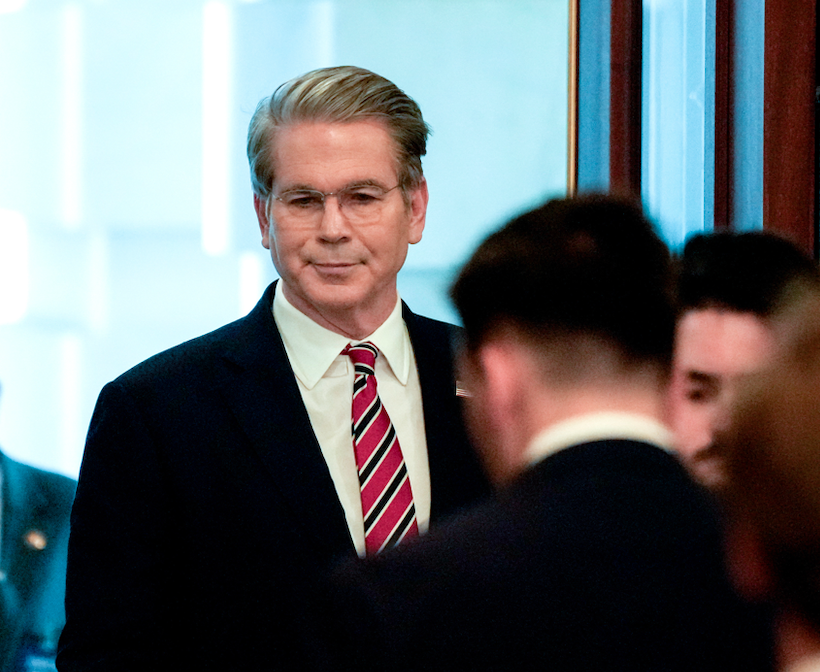
Treasury Secretary Scott Bessent played down a selloff in US Treasuries, saying that there was nothing systemic at play, and also served warning against China not to attempt to devalue its exchange rate in retaliation for American tariff hikes.
Citadel Securities’ proposal to process trades for a swath of banks is taking shape behind the scenes, focusing on products across fixed-income markets.
Private equity firms are trying to regain some control after investors took advantage of one of the toughest fundraising environments in years.
Last week’s employment report offered what may be the last clear picture of the US job market before President Donald Trump’s tariff shock. Overall, it looked pretty healthy, with a 4.2% unemployment rate, 80.4% of the prime-age population employed and 1.9 million nonfarm payroll jobs added over the past 12 months.
When it’s finally completed seven years from now, Citadel LLC’s New York tower will be the second tallest building in the city, after the World Trade Center. It will also loom over the headquarters of JPMorgan Chase & Co. just a few hundred yards south along Park Avenue.
An enduring image from 2024 will be the capture of the SpaceX booster rocket by the Mechazilla robot arms on its return to Earth.
While there are no absolute winners in a trade war, there may be relative winners in the global stock market for investors to consider.
Lost in the focus on the bludgeoning that tariff policy has had on equity markets, is the impact on global currencies. From the end of February through April 3rd, the U.S. Dollar is down 5.1% relative to other developed market currencies (DXY). In addition, we’ve also seen a violent unwinding of the popular currency carry trade.
At the start of last week, the S&P 500 rallied three days in a row, with investors believing that the tariffs announced on Wednesday would be targeted.
Tariff Turbulence. The President’s long-anticipated tariff announcement on April 2 has come and gone. Our hopes for some clarity, so the uncertainty weighing on confidence and the equity market could subside, were dashed after we heard the breadth and magnitude of the administration’s tariff plan.
We’re adjusting our stance in response to rising risk while maintaining a disciplined view on long-term strategy.
While the path may have twists and turns, the destination seems clear; higher U.S. tariffs.
The recent market drawdown highlights risks of a concentrated S&P 500—and the case for diversification now.
Many of us came into the year with highly concentrated portfolios, which now were faced with changing market conditions.
The book’s title derives from the author’s criticism of young, self-absorbed Silicon Valley types unconcerned by the public good — the “hollow republic” — as opposed to those focused on the commonwealth, the “technological republic.”
Let’s get straight to the heart of the matter: if you’re relying on a multi-step sales process to win clients, you’re unknowingly eroding your authority.
Even the best financial plans sometimes hit an unexpected sour note: an investment seemingly doesn’t work out, an emergency expense appears to throw off a budget, or an impulsive splurge leaves us with a case of buyer’s remorse. When this happens, we need to improvise as we respond to the financial twists and turns.
A sharp selloff in shares of Apple Inc. illustrates investor skepticism about its ability to navigate President Donald Trump’s tariffs on China, Vietnam and India — countries all critical to the iPhone maker’s supply chain.
That would be my advice for the Brazilian government on how to approach US President Donald Trump’s tariff-palooza.
MFS, which pioneered the first mutual fund in 1924, recently entered the ETF arena with the launch of five actively managed products. MFS’s Emily Dupre discusses the firm’s decision-making process around launching ETFs, their investment capabilities, and the role active management plays in a portfolio. Plus, VettaFi’s Roxanna Islam assesses the ETF impact of the recent tariffs announcement.
US Treasuries tentatively resumed their gains on Tuesday after the wildest day for bond traders since the height of the pandemic in March 2020.