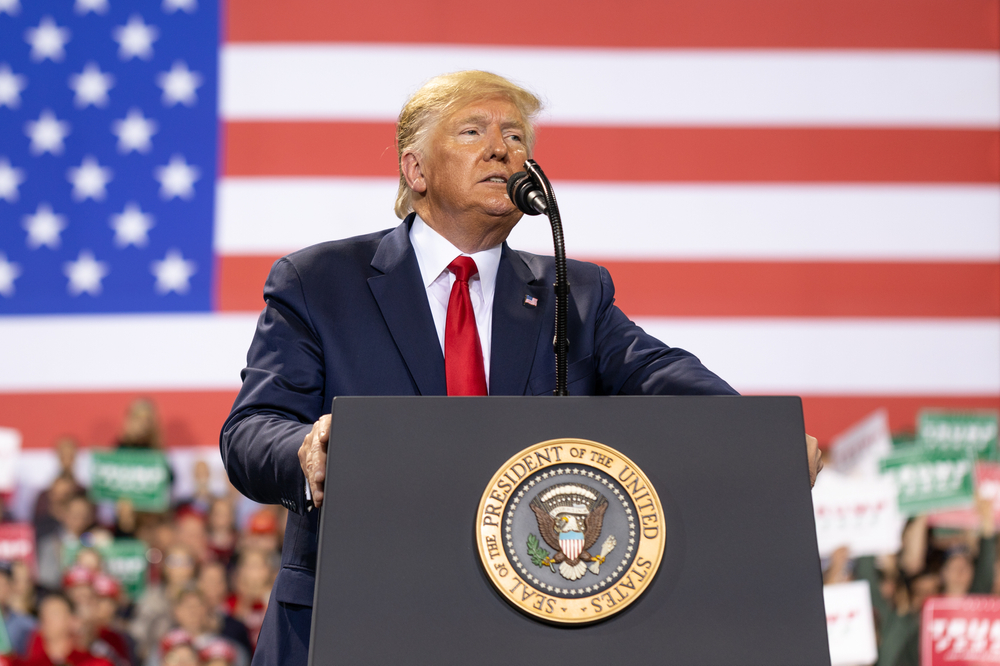
Wall Street on Monday finally caught a respite from the deep selloffs and unusually sharp swings that have raced through markets ever since President Donald Trump unleashed his global trade war.
Bitcoin and its peers are speculative assets. They have value because enough people believe they do, not because they’re backed by a central authority or tied to any intrinsic utility.
This month’s roller-coaster ride through the markets has been more frightening than exhilarating for many Americans, who have more than $44 trillion invested in retirement accounts.
Portfolio rebalancing helps advisors uncover a new investment plan of action that aligns with a client's long-term financial milestones. It also considers how the current market will impact asset diversification.
A new cryptocurrency aims to occupy the final frontier of investor safety — cash that doesn’t lose purchasing power to inflation.
Some of the reasons, but not the only ones, why our trade deficits are so large is because government expenditures are too high and/or we are not collecting enough taxes.
Between raising and lowering tariffs on imported goods, President Donald Trump made time last week to sign an executive order aimed at reviving America’s “beautiful clean coal industry.”
The American consumer is tapped out. The savings buffer is gone, wage growth is declining, and credit costs are rising. Corporate America is already adjusting to this new reality, with companies issuing cautious guidance for 2025.
On Monday, April 7, the S&P 500 dropped as much as 4.7% at the session low before whiplashing higher on reports of a potential tariff delay—closing the day up 3.4% from Friday’s close.
We think it’s important for the Fed to move gradually. The US dollar has weakened lately, and, as a result, there is little case for a drastic loosening of monetary policy. The Fed could let up somewhat on bank regulations and capital requirements, which would help the struggling bond market.
Significant government policy shifts, particularly in tariffs and regulatory restructuring, have created uncertainty and volatility. We continue monitoring potential risks like inflation and recession while remaining focused on identifying profitable investment opportunities amidst these changes.
Commodity markets face uncertainty from tariffs, global growth risks and geopolitics, but may show resilience. Tight supply and global stimulus support a constructive long-term outlook.
Swap spreads measure the difference between the interest rate on a swap and the yield on a Treasury bond with the same maturity.
On the evening before his presentation at the Exchange Conference last week, I sat down with Rob Arnott to discuss whether now is the time for smart beta to shine. Arnott is the founder and chair of Research Affiliates and is known as the “godfather of smart beta.”
In a tumultuous environment, investors increasingly turned to actively managed bond ETFs this year according to JPMAM research.
If Trump is successful in ending — or at least significantly changing — the current global economic structure, the economy and geopolitics will change dramatically. Initially, this will be highly challenging from an investment perspective.
This may be the beginning of the long-awaited U.S. stock market crash, but even if it isn’t those near retirement need to protect themselves from sequence-of-return risk that can ruin the rest of their lives.
As with all decisions involving uncertainty, we want to find the answer which maximizes your expected risk-adjusted return, not your base-case or expected return. This means that we have to go beyond the industry standard and explicitly account for risk in our analysis.
You probably noticed we are having one of those “weeks when decades happen.” Notice also, however, that we are still here. Your investments and businesses may be bruised but you’re still in the game.
Yield spreads are critical to understanding market sentiment and predicting potential stock market downturns. While yield spreads have widened, they remain well below the long-term averages. However, if recession risks increase due to tariffs, sentiment, or illiquidity, those yield spreads will widen further.
Meta Platforms Inc. heads to court on Monday to defend claims it is an illegal monopoly and should be broken up. The Federal Trade Commission, even without former President Joe Biden’s antitrust hawk, Lina Khan, at the helm, seems to be going full steam ahead — despite Chief Executive Officer Mark Zuckerberg’s attempts to wine and dine the president into a change of heart.
The world’s two biggest economies are headed for a divorce that will likely play out for the rest of this year and beyond, after a month that saw a huge spurt in China’s exports and its overall trade surplus hit near $103 billion.
President Donald Trump pledged he will still apply tariffs to phones, computers and popular consumer electronics, downplaying a weekend exemption as a procedural step in his overall push to remake US trade.
Goldman Sachs Group Inc. and UBS Group AG issued another round of bullish calls for gold, with stronger-than-expected central bank demand and the metal’s role as a hedge against recession and geopolitical risks underpinning expectations for even higher prices in 2025.
Four of the nine indexes on our emerging markets watch list have posted gains through April 11, 2025. Chile's IPSA is in the top spot with a year to date gain of 11.2%. Brazil's IBOVESPA is in second with a year to date gain of 6.3% while Mexico's BMV IPC is in third with a year to date gain of 3.5%.
Credit investors are looking to pounce on new opportunities resulting from the wild swings in global financial markets triggered by the US-China trade war.
Last week’s data can be summarized by a volatile market reacting to tariff news and a backwards-looking inflation reprieve.
After sparking the steepest plunge in financial markets since the global pandemic five years ago, President Donald Trump’s administration made another dramatic pivot in its trade war strategy on April 9: It paused for 90 days the “reciprocal” tariffs that had been in effect for less than 24 hours.
GMO has posted a new 7-Year asset class forecast as of 1Q 2025.
After starting the year on a high note with the S&P 500 index of U.S. Large Cap stocks posting an all-time high on February 19th, equities retreated during the second half of the quarter, officially falling into correction territory (down 10 percent) on March 13.
Another period of heightened volatility in the markets reminds us why tax management can be such an essential part of fixed income investing.
It was a wild week on Wall Street after President Donald Trump announced a broad new tariff policy that went beyond what most analysts had anticipated, spurring a plunge in both stock and bond markets.
On 9 April, President Donald Trump announced a 90-day pause on the higher “add-on” reciprocal tariffs on 50-plus countries that had been announced the previous week, precipitating a historic equity market rally and showing that there was seemingly a limit to how far he would go to move forward with his trade agenda.
Spending cuts, tariffs and recession risk—Jan van Eck’s latest outlook breaks down what to watch and why he’s focused on gold, bitcoin, semiconductors and India.
Vanguard head of U.S. ETF Capital Markets Bill Coleman discussed the growing role that active ETFs are playing in portfolios.
Bonds have gained as investors sought shelter amid growing fears around a tariff-driven global economic slowdown.
Morgan Stanley’s stock-traders delivered first-quarter revenue that exceeded analyst predictions, as Wall Street’s biggest banks continue to benefit from turbulence ignited by President Donald Trump’s policies.
Berkshire Hathaway Inc. sold ¥90 billion ($628 million) of bonds on Friday in its smallest yen deal ever in a market rocked by an escalating trade war.
Getting into Donald Trump’s head is no easy task. And to the extent his economic intentions are decipherable and coherent, can Trump impose his economic will on other countries? As tariffs go into place, albeit with a partial pause, that remains to be seen.
US wholesale prices fell in March by the most since October 2023, restrained by energy costs and adding to evidence of muted inflation ahead of the Trump administration’s tariffs on US trading partners.
JPMorgan Chase & Co.’s stock traders took in a record haul in the first quarter, boosted by chaotic market moves set off by President Donald Trump’s policy announcements after he took office in January.
Morgan Stanley’s willingness to stick it out with Elon Musk is giving its first-quarter results a healthy boost.
Earnings season begins with companies adjusting on the fly to tariffs. This could give investors insight into strategies firms are taking and how businesses might be affected.
Taxpayers plan to use their tax refunds for essentials and debt repayment, as well as savings strategies. Bill Cass shares ideas and strategies to consider this year.
The markets are in the middle of a historic decline. Not so much in the magnitude—while we are approaching a bear market, these happen fairly regularly—but in the speed of the drop.
On 2 April, the Trump administration announced sweeping tariffs that were more aggressive than many had expected. Then on 9 April, the administration announced a 90-day pause on most of the new country-specific “reciprocal tariffs.”
After several weeks of steep selloffs, the major averages roared back on Wednesday as the Trump administration announced a 90-day pause on its reciprocal tariffs.
President Donald Trump announced on April 9 that he was pausing the majority of the “reciprocal” tariffs scheduled to go into effect the same day.
Markets responded swiftly to President Trump’s recent announcement of sweeping reciprocal tariffs, with the S&P 500 falling more than 3% in a single day.
Concerns about a trade war have rattled markets so far in 2025, but we believe fixed income investors need to be patient, stay defensive, and see how things evolve before making any big decisions.