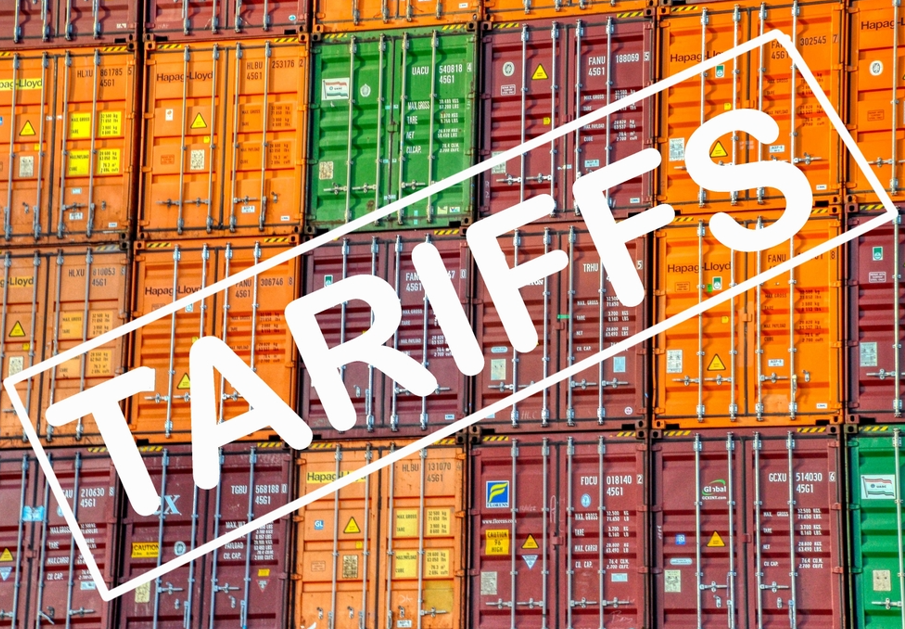
India’s exporters are bracing for President Donald Trump’s tariffs. Some are confident that whatever is announced on Wednesday will not hurt them; others are genuinely uncertain how to manage if they can’t export to the US.
A duo of emerging-market bond veterans at Jeffrey Gundlach’s DoubleLine Capital is taking no chances as Donald Trump rolls out his trade agenda.
Investors are fretting that a year-long rally in global credit is papering over the risk that US policy uncertainty tips the world’s largest economy into a recession.
Amid a market correction and heightened policy, inflation and growth concerns, valuations are back in the spotlight.
Investors just can’t get enough of ETFs, and issuers are more than happy to oblige. Through the middle of last week—still with a handful of days left in the quarter—208 new U.S. ETFs were launched in Q1, according to Wall Street Horizon data.
In the current installment of The Roundup, Oaktree experts explore various investment risks and opportunities, including the heightened demand for mezzanine financing, potential entry points for special situations investors, the limited competition for unrated asset-backed finance investments, and the growing need for specialized life sciences lenders.
Following the latest Federal Reserve meeting, there was a massive surge in media headlines stating “stagflation.” The media’s stagflation panic is unsurprising as it elicits memories of the late 1970s during the Arab oil embargo.
We call upon an expert for the latest on foreign exchange markets.
During the ten years prior to COVID, PCE inflation, the Fed’s preferred measure, averaged about 1.5% per year. Jerome Powell said it was too low and he wanted inflation to “average” 2% over time.
Markets sold off sharply Friday and in the early Monday hours, and I do not believe inflation data was the culprit.
Economic activity hit a soft patch in the first quarter—whether it was fueled by the big pullback in confidence or one-off factors such as cold weather, a harsh flu season and an acceleration of imports ahead of pre- announced tariffs, our economist expects the slowdown will prove short-lived.
CNBC Senior Markets Correspondent Bob Pisani and Research Affiliates Founder and Chairman Rob Arnott talked value at Exchange.
Dr. David Kelly, chief global market strategist, J.P. Morgan Asset Management, provided insight on current opportunities at Exchange.
On this week’s episode of “ETF of the Week,” Chuck Jaffe of “Money Life” discussed the Invesco CEF Income Composite ETF (PCEF) with Roxanna Islam, head of sector and industry research at VettaFi. The pair discussed several topics related to the fund to give investors a deeper understanding of the ETF overall.
In a recent piece, I analyzed the construction of downside-protected strategies. Here, I propose a measure of the relative attractiveness of these strategies over time and examine their historical performance.
The energy sector has pulled off a rare feat: It’s the only industry group in the S&P 500 Index to rise in the month of March.
If a dividend is not a gain, then what is it? Here is my irony-drenched-but-accurate definition
This article explores the GDPNow and Nowcast models to understand the recent forecast divergences. A better understanding of the two models helps us appreciate the current state of the economy and, therefore, better estimate the first quarter GDP.
Last week's economic reports painted a stark picture of rising inflationary pressures and plummeting consumer confidence.
The US stock market is about to conclude its worst quarter compared to the rest of the world since the 1980s.
BlackRock Inc. Chief Executive Officer Larry Fink pledged to open up private markets to millions of everyday investors, not just the wealthy few, contending individuals should share more of the gains from economic growth.
A standoff between homebuyers and sellers played out in much of the country over the past two years, and particularly in internal migration destinations such as Florida and Texas. The number of homes on the market rose as poor affordability constrained would-be buyers, but sellers rejected offers significantly below the 2022 peaks.
Primark — the fast-growing “cheap chic” clothing brand owned Associated British Foods Plc. — faces a muscular Chinese rival in the form of Shein. The last thing it needs is turmoil in its top ranks.
Today I’ll try to cut through some of this fog and look at why the US has a trade deficit. As you’ll see, it is a built-in, necessary feature of our money. Plus, it is time to start watching for a recession. Let’s jump in.
We were in the camp that the new administration was using the threat of tariffs as an instrument to negotiate deals with other countries, especially with our largest trading partners, Canada and Mexico.
The substantial shift in U.S. trade policy will put a significant dent in growth in major markets.
On the latest edition of Market Week in Review, Senior Investment Strategist and Head of Canadian Strategy, BeiChen Lin, discussed the latest tariff developments. He also revealed key watchpoints for upcoming U.S. and Canadian employment reports and finished with a preview of U.S. first-quarter earnings season.
On March 18, 2025, Jensen Huang stepped onto the stage at Nvidia's GPU Technology Conference (GTC) in San Jose with the presence of a man who knows he's about to redefine the trajectory of an industry—again. His message was clear: AI has hit an inflection point, and if you're not paying attention, you're already behind.
Uncertainty dominates the day, with market volatility sparking investor questions not seen in years. With this in mind, we’ve put together a concise cheat sheet covering key topics on everyone’s radar.
As investors have flocked to defined outcome funds or buffered outcome ETFs, certain questions have arisen, principally around buffered ETF performance and pricing.
History suggests a rebound could be in order.
One reason Apple Inc.’s brand is so valuable is that for decades, it had a reputation for only making promises it could keep.
Britain’s property-transaction tax, known as stamp duty, is set to rise sharply. Currently, first-time buyers pay no tax on properties worth up to £425,000 ($550,000). Starting next month, that threshold drops to £300,000, which will result in a charge of £6,250 on a £425,000 purchase.
It’s not just America and Europe that fear the competitive threat from Chinese clean technology. China itself is scared.
Longtime Investor Alert readers have often seen me say that government policy is a precursor to change. What this means is that, when policymakers act—whether through subsidies, sanctions, tariffs or regulations—markets can sometimes respond swiftly and dramatically. We’re seeing that play out right now in real time, especially in the copper market.
As shares of Elon Musk’s Tesla Inc. rally on Thursday, the jump in the size of the company dwarfed the decline in the value of its US rivals as the stocks responded to President Donald Trump’s latest tariff announcements.
Czech chemicals company Draslovka AS is expanding into the growing US battery industry to mitigate risks from trade tensions and volatile prices for energy and materials.
EQT AB has raised €21.5 billion ($23.2 billion) for its latest infrastructure fund — a sum a top executive for the Swedish investment firm says underscores how the energy sector’s funding needs trump an uncertain market for deals.
The world’s largest asset manager is betting big on a growing breed of derivatives-powered ETFs that’s shaking up the art of active portfolio management.
With the pause button pressed on this year’s huge AI rally in Chinese tech stocks, clarity on global economic policies and concrete signs of core business improvement may be required to get things rolling again.
From New York to London and Hong Kong, investors are cutting back risk ahead of next week’s tariff announcements, while keeping cash ready to pounce the moment opportunities arise.
Long-maturity Treasury yields reached the highest levels in a month Thursday as investors demand compensation for the risk that tariffs will spur US inflation.
One is known as the Oracle of Omaha, the other as Superman. Warren Buffett and Li Ka-shing are the two most revered investors in the West and East.
If you log onto Chinese social media these days, you may encounter many young people expressing the “involution” or neijuan mentality. It’s become a buzzword for a generation of college students and recent graduates beaten down by society’s relentless competition, and roughly translates to rolling inwards.
A Columbia University student recently shone a light on a disturbing corner of today’s job market. Roy Lee, 21, was fed up with the antiquated way that large tech firms were testing job candidates with computer coding riddles you had to memorize, so he created a tool that his peers could use to beat the system.
When UBS Group AG acquired Credit Suisse in March 2023, its board of directors thought they were doing their duty.
In this video, Chuck Carnevale, Co-Founder of FAST Graphs, aka Mr. Valuation will compare Home Depot (HD) and Lowes (LOW). We are going to decide which one is the better one for your portfolio.
US President Donald Trump’s focus on “reciprocal tariffs,” rather than balanced trade, does not suggest that his administration intends to use tariffs strategically to cut the country’s chronic trade deficit. But Democrats must stop dismissing outright a policy tool that they themselves embraced under Biden.
How recent market volatility has contributed to a sharp reversal in global equities.
We’ve written quite a bit on tariffs already this year, and appropriately so. Developments on this front have been significant and are of global consequence.