Applications for US unemployment benefits fell last week and returned to muted levels seen at the start of the year, offering some relief after other reports pointed to worsening labor-market conditions.
Euro-area bond yields inevitably leapt like a salmon as Germany unleashed a fiscal bazooka, but compared to previous fixed-income tantrums, it’s not the stuff of all-night summits.
In the week ending March 1st, initial jobless claims were at a seasonally adjusted level of 221,000. This represents a decrease of 21,000 from the previous week's figure. The latest reading was lower than the 234,000 forecast.
Opportunities have increased significantly in frontier markets debt as more countries have made a conscious effort to open their capital markets to international investors and currencies have become more fairly valued.
Treasury yields have been falling for weeks. Yet inflation expectations remain high and recent growth data have been fairly strong—not a traditional backdrop for declining yields. What's happening?
Though the new US policy focus is on oil and gas, wider opportunities still beckon.
One of the most referenced valuation measures is Dr. Robert Shiller’s Cyclically Adjusted Price-Earnings Ratio, known as CAPE.
Many ASEAN members punch above their economic weight in international trade. But their power may also make them targets in the mounting global trade battle.
As daily headlines drive volatility, the market has avoided overreacting thus far.
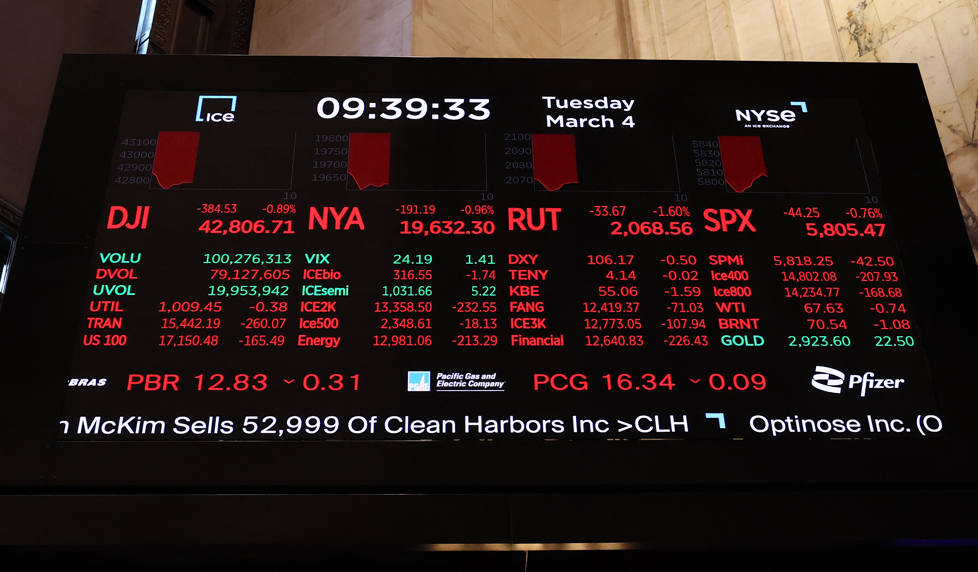
With U.S. tariffs on Mexican and Canadian imports now in effect, yesterday’s risk-off market mood continued today. Both Canadian and U.S. equities modestly sold off.
High fiscal deficits from tax cuts and tariffs raised concerns about inflation. However, markets have since shifted their focus.
We view quarterly earnings season as a critical checkup on how markets are handling current challenges.
Join the experts at Ultimus Fund Solutions and ETC for a free educational webcast to learn more.
Builder confidence fell sharply in February due to concerns on tariffs, elevated mortgage rates, and high housing costs. The National Association of Home Builders (NAHB) Housing Market Index (HMI) dropped to 42 this month, down five points from January. The latest reading was below the 46 forecast.
I recommend you hold what I call an “obstacles session.” This is when you ideally have a third party in to ask your team what success would look like to them, and what obstacles are getting in the way of achieving this success.
Imagine having a reliable, automated system that consistently brings high-quality leads to you – without the need for constant hustle.
Understanding copyright compliance rules can help you protect your business and confidently share content that aligns with both legal and ethical standards. Let’s clear up some common myths to keep your financial marketing on the right track.
One of the fastest and easiest ways to unravel your financial security is to have the wrong person gain control of your money.
We manage risk tactically over the short-term by investing across a broad array of themes and asset classes including cash.
The notion of a US recession seemed remote just a few months ago, a mere blip on the radar of economic possibilities. More recently, however, that picture has started to change.
US stocks have been on a wild ride this week, and options traders expect more of that to come as traders assess the latest tariff developments and brace for Friday’s monthly jobs report.
Hiring at US companies slowed in February to the lowest pace since July, led by job cuts in the service sector and in regions of the US that were hit by severe weather.
Germany’s extraordinary spending plans are shaking up the region’s markets, powering European equities past US peers this year and reviving the euro from the brink of parity with the dollar.
President Donald Trump is set to announce changes to the tariffs on Canada and Mexico he slapped on earlier this week, with potential relief for automobiles and other sectors, Commerce Secretary Howard Lutnick said Wednesday.
Unlike most of the rest of the world, I will attempt to minimize all there is to say about the beginning of the next 4 years, as the persistent yack and what to make of it reverberates in all corners of the financial globe.
According to Research Affiliates’ Asset Allocation Interactive (AAI) online capital market expectations tool, U.S. large-cap equities are expected to yield 3.4% annually over the next 10 years compared to 9.1% for EM equities and 7% for REITs. This left many webinar participants wondering, How does this extra return square with these assets having similar betas?
A holistic approach may help insurance investors navigate an expansive opportunity set.
In this primer we define small cap growth funds, provide practical suggestions on how to invest in them, and explain why we believe they are a strategically important asset class.
Differing sales tax regimes can appear unfair.
While investors were fixated on inflation data Friday, the most significant surprise came from the advanced trade balance, which posted an unprecedented $37 billion deterioration
February’s market turbulence saw investors pivot toward defensive strategies as policy uncertainty intensified, driving a broad market rotation from mega-cap tech stocks to bonds, gold, and international equities.
With Morningstar’s recent categorization of these funds, having a firm understanding of how they work and how to differentiate them is critical for investors. Join the experts at Swan Global for an educational exploration of options-based investing.
We detail some key factors driving the recent market volatility and provide our perspective on how we believe these events may unfold and impact the economy and financial markets.
Heightened economic uncertainty—propelled mainly by trade policy—has unearthed weakness in the equity market, with most pain felt under the market's surface.
Ultra-wealthy investors have unique needs and goals. While a typical high net worth client is focused on the next dozen years, these more deep-pocketed clients – like their institutional counterparts – have a much longer time horizon.
President Trump’s nomination of Paul Atkins as the next SEC Chair signals a potential sea change in regulatory approach, one that could dramatically reshape the landscape of alternative investments.
Pause and ask yourself a question: If I was not bound by the obsolete routines of the dinosaur age of assembly-line manufacturing, how would I structure my work to be the best investor I could be?
Many major stocks connected to artificial intelligence have lost their luster of late, but perhaps none more so than Microsoft Corp.
US Treasuries are now outperforming stocks since Donald Trump was elected President, and some strategists say there’s room for those gains to run.
Traders added to bets on interest-rate cuts from the Federal Reserve amid concern about the impact of US trade tariffs on global economic growth.
The Chinese artificial intelligence startup that rocked global markets earlier this year with its low-cost and high-performance AI models has outlined a potential path to major profitability.
Alternative investments including hedge funds and real estate will disappear from the portfolios of pension funds and endowments over the next 10 to 20 years, well-known institutional investment consultant Richard Ennis concludes in a recent report.
We wrote in last month's letter that the U.S. stock market had to meet lofty earnings expectations to maintain its strong performance relative to global benchmarks, while the latter had a lower bar because of considerably cheaper valuation multiples and higher dividend yields.
Russ Koesterich discusses the risk of higher interest rates and the potential impact (both positive and negative) such a move could have on markets.
The AI breakthrough spotlights some of China’s distinctive features that deserve closer attention from investors.
It’s not U.S. tariffs we need to be fixated on to gauge China’s economic growth trajectory but the ability of its leadership to rebuild confidence among entrepreneurs and consumers.
Eggs add to perceptions of high inflation.
Just recently, S&P Global released its 2026 earnings estimates, which, for lack of a better word, have gone parabolic. Such should not be surprising given the ongoing exuberance on Wall Street. Unsurprisingly, rationalizations justify illogic when too much money is chasing too few assets.
Is the US already in recession? Probably not. But in the first quarter, real GDP is very likely to have a minus sign in front of it. Yes, a negative reading for real growth!
After a record year for fixed income ETFs in 2024, investors are turning to ultra-short bond ETFs, the safest fixed income ETFs available.