Rising rates in today's fixed-income markets have led to more attractive bond prices and higher yields, alleviating some of the challenges facing income investors.
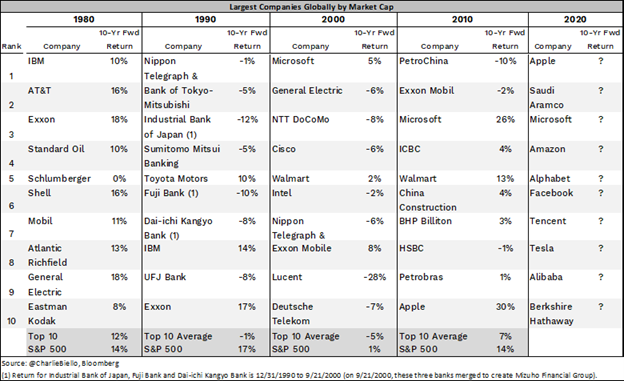
The paradox that this marriage potential created at the college was that the odds are good, but the goods are odd. This is the statement that can be made for common stock investing today.
Muni investors have more reasons for optimism than concern as California tackles a projected $31.5 billion budget deficit.
What's on the menu? Heading into a profits recession, there are many things to consider when building a portfolio. Here's a sneak peek at what we are serving up.
The future of money is uncertain, and speculation about what comes next is all over the place. The Federal Reserve note "dollar" is the world's reserve currency, but its seat on that throne is no longer secure.
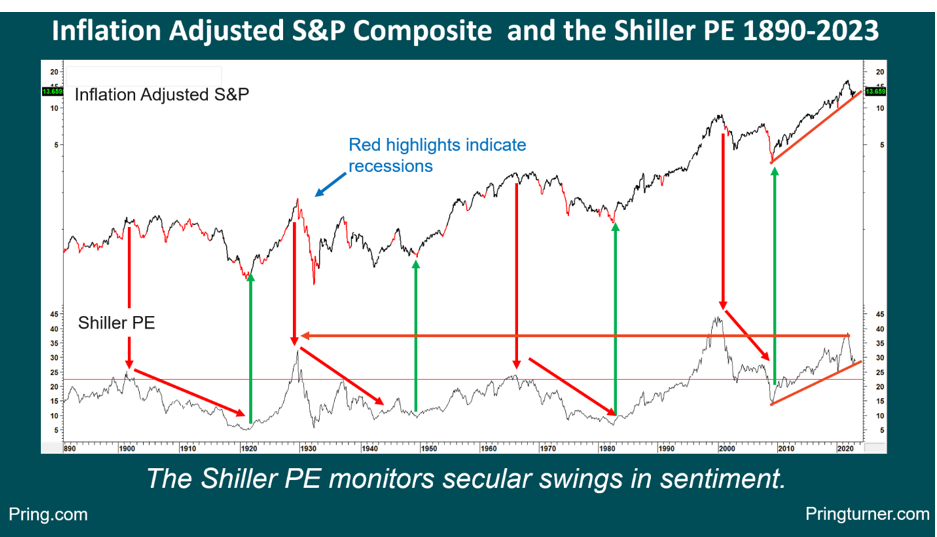
If 2022 was the zenith of the post financial crisis bull market, the intervening year and a quarter is a relatively short period from which to conclude that a turn in the secular tide has taken place. That said, several indicators have already begun to signal a change in trend.
When an exchange traded fund (ETF) is associated with high or low beta, what exactly does that entail? It all boils down to risk and how much an investor is willing to accept, which is different for everybody.
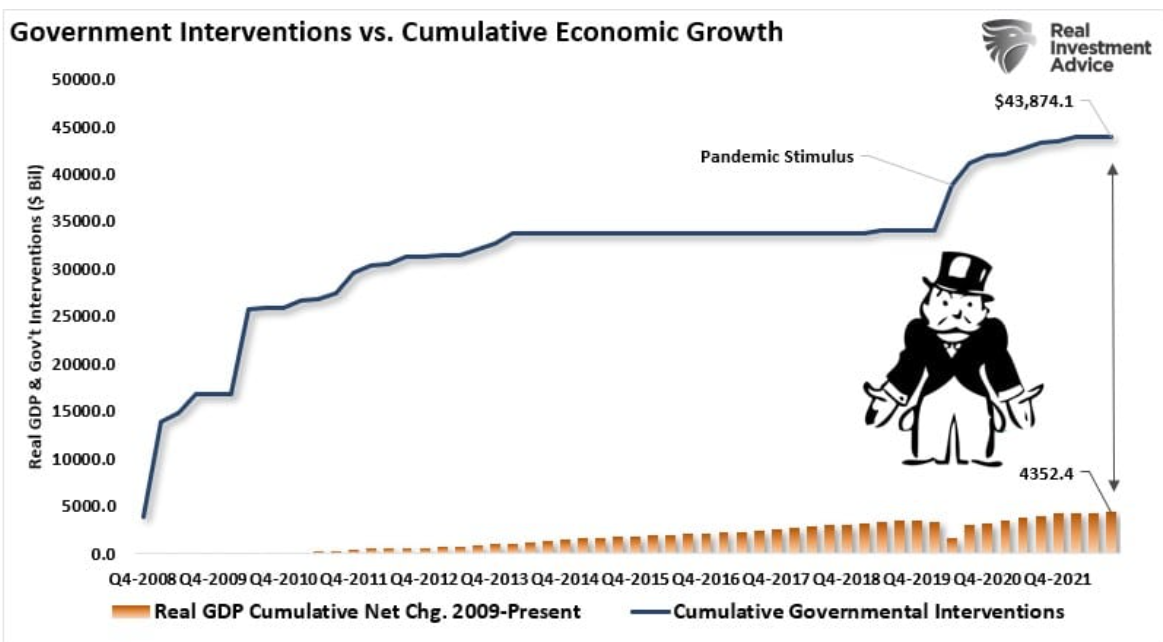
Profit margins have remained elevated in the U.S. for a decade, and in a new white paper, GMO’s James Montier examines why that has been the case, ultimately finding the culprit in fiscal deficits.
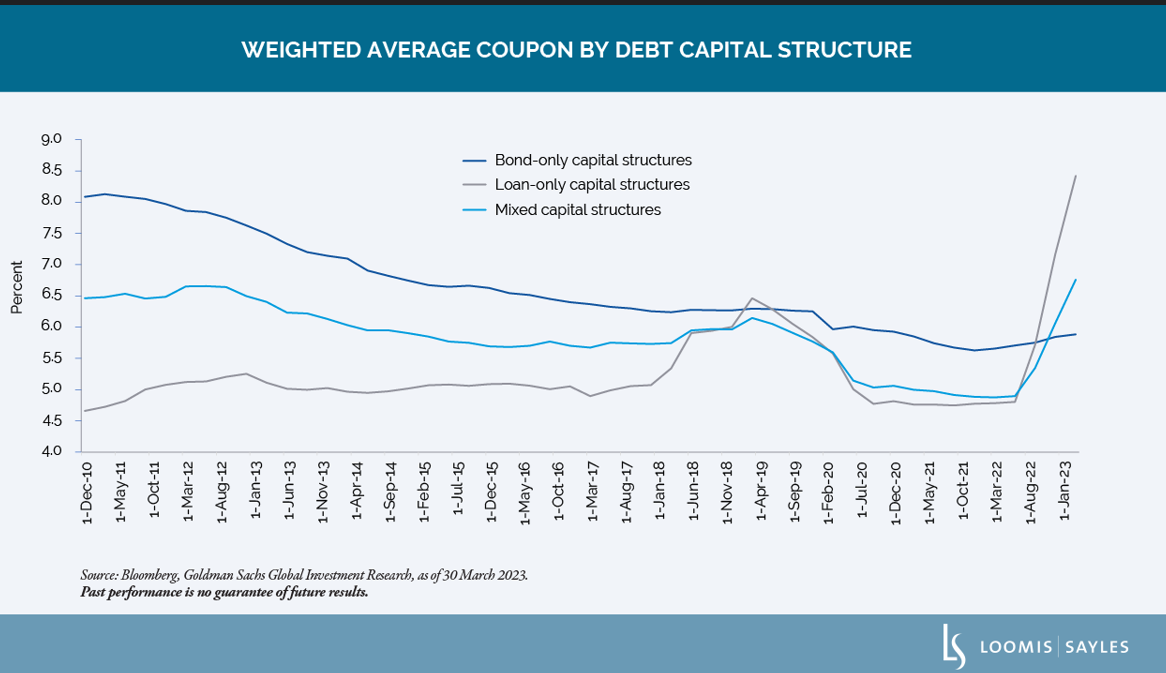
Rising interest costs have sparked speculation about whether companies with loan-only capital structures might be vulnerable. Investment Director Cheryl Stober puts rising interest costs, debt service capacity and capital structures into context.
Analysis shows an extraordinary range of outcomes since the S&P 500's inception in 1928.
Doug Drabik discusses fixed-income market conditions and offers insight for bond investors.
Many investment strategists are forecasting that the U.S. economy could experience a recession in the next year or two.
As the US economy begins to feel the weight of the Federal Reserve’s rate hikes, investors have grown leery of US high-yield corporate bonds. On the surface, that makes sense. Historically, credit conditions soured when growth slowed.
Macroeconomic and geopolitical hurdles are slowing the full recovery of tourism.
What if I told you that future returns could approach zero? Such seems hard to believe, considering young investors piling back into the markets since the beginning of the year
One of my mentors once told me that "Hope is not a strategy" and since we can't predict the markets, I have decided to focus this blog on using Direct Indexing to attract new high net-worth clients.
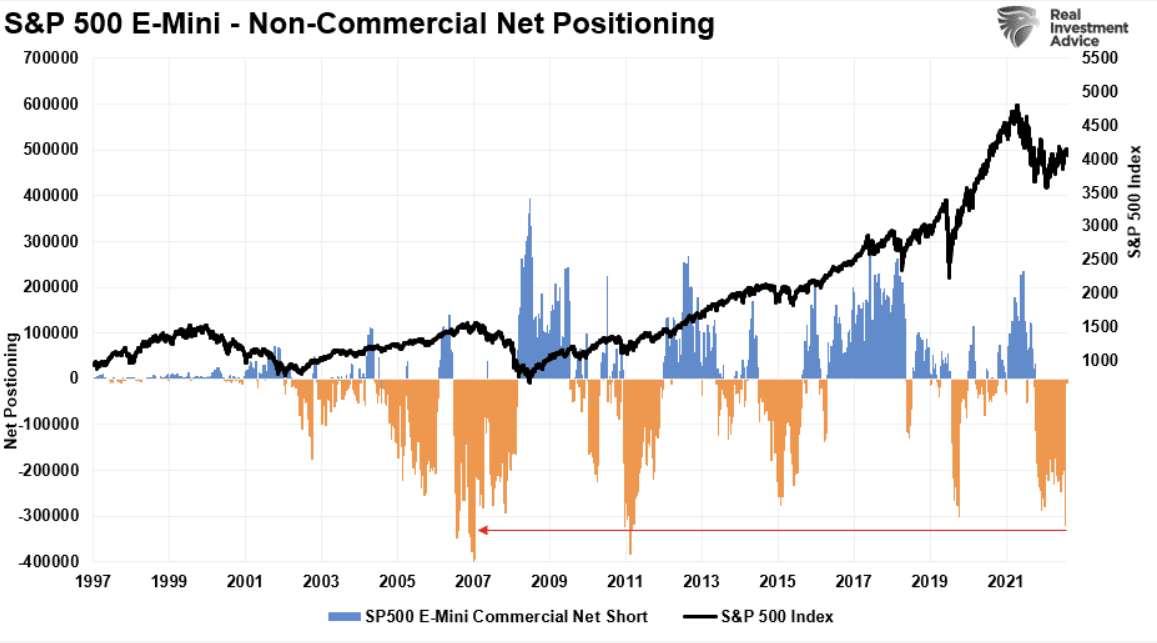
The COT (Commitment Of Traders) data, which is exceptionally important, is the sole source of the actual holdings of the three critical commodity-trading groups, namely: Commercial Traders, Non-Commercial Traders and Small Traders.
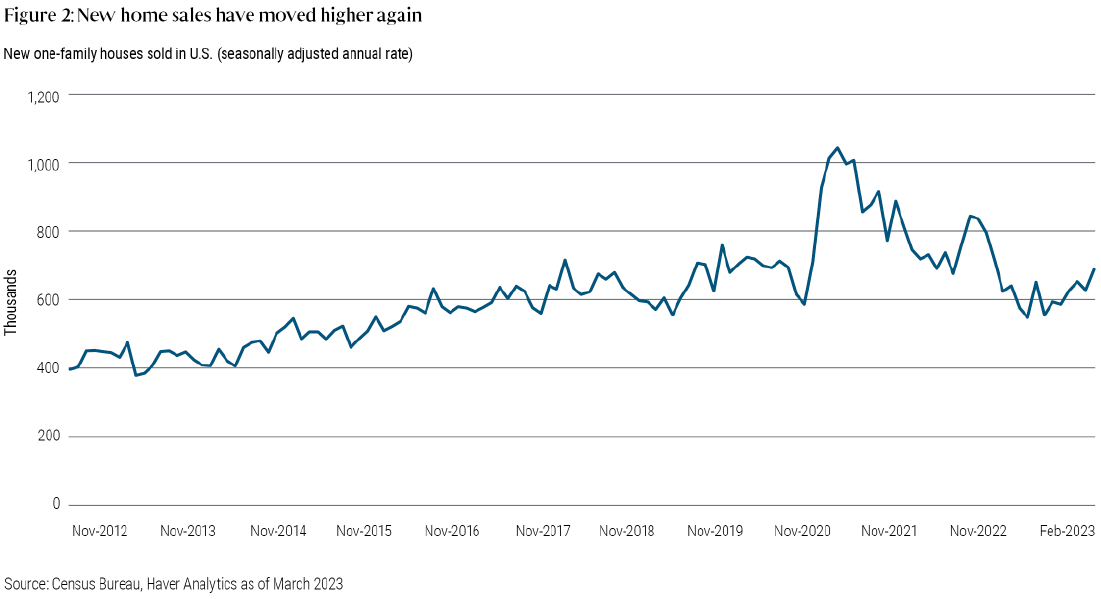
Although affordability remains an obstacle, recent data offer reasons to be more constructive as broader conditions still appear supportive of home prices.
Economic moats, also called business moats, are competitive advantages that help a company maintain long-term profits and market share over competitors.
We think the U.S. debt limit showdown will spark renewed volatility in markets. That risk reinforces why we stay invested and cautious by going up in quality.
What follows a technical default? We hope we will not need to find out.
As the credit market grows more stringent, investors should consider high-quality, longer-term bonds. Here are some fixed-income strategies.
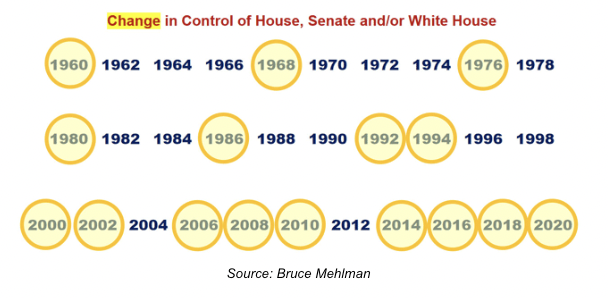
The economy co-exists and interacts with broader society, including government. Public policies—and the political processes that determine them—can change the economy in deep and lasting ways. We may not like them, but we can’t ignore them.
Review the latest Weekly Headings by CIO Larry Adam. Tighter lending standards still pose a risk. The debt ceiling issue will get resolved. The earnings outlook is improving.
This week’s inflation numbers were mostly positive and benign for the U.S. economy as well as for the Federal Reserve (Fed) and confirms our view that, at least for now, the Fed is done increasing interest rates for this monetary tightening cycle.
Political brinkmanship in Washington adds to concerns about the economy.
Review the latest portfolio strategy commentary from Mike Gibbs.
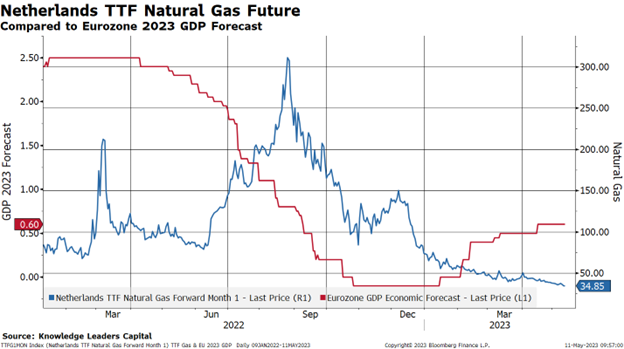
It would appear that the decline in European natural gas prices has contributed to an increase in Eurozone GDP estimates for the year. Once prices crossed below $50, GDP estimates began to rise, and now the consensus expects .6% GDP growth from the Eurozone this year.
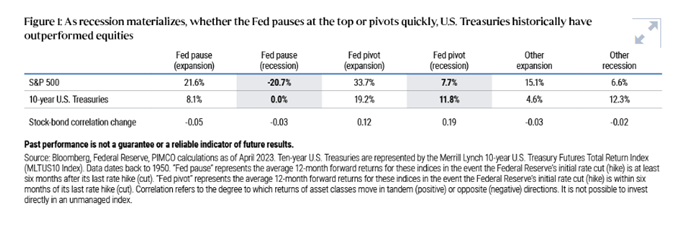
There is a disconnect between the Fed’s message regarding taking a pause in hiking interest rates this year and the market’s expectations of rate cuts.
The Banking emergency arising with mid-sized, regional banks is a direct consequence of policy decisions. Examine the causes of bank failures in 2023 and the potential for larger contagion.
A wage-price spiral isn't imminent in Europe, but inflation may take a while to descend.
Tom Hauser, Co-Head of Corporate Credit, discusses his current views on opportunity in leveraged credit. Economist Paul Dozier updates on the latest economic data.
Portfolio manager John Paul Lech explores the defining changes of the last three years. Here he explains how he is navigating the new era of rising interest rates and financial tightening.
Saving for college can be daunting. Many parents don’t know how prepared they will be for college costs in the future. Parents face the question of how much to save and which funding vehicles to use.
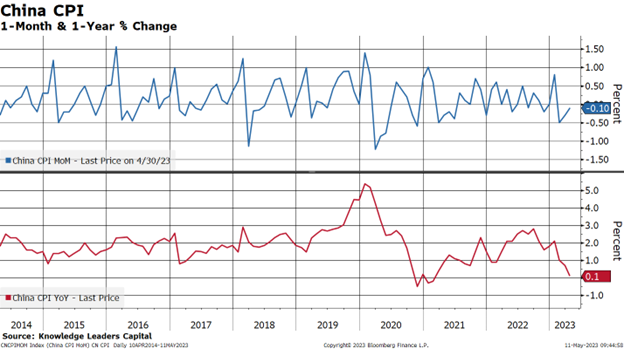
China reported year-over-year inflation last night at just 0.1%, 0.2% lower than expectations. Clearly, China’s reopening is not creating price pressures, which brings the strength of the reopening into question.
The longer-term risks of sticky inflation, monetary policy changes, and slowing economic growth continue to challenge the markets. Within this uncertain backdrop, Franklin Income Investors’ Ed Perks shares his latest outlook and the investment opportunities he sees across fixed income and equities.
The central bank likely won't have enough reason to hike rates again this cycle. In fact, we wouldn't be surprised to see one or two rate cuts later this year.
We are presented with this decision in finance a lot. There is a small probability of something bad happening and a large probability that everything will be fine. What do you do to insure yourself against something bad happening? Because there is no such thing as a free lunch.
U.S. Treasury debt is considered the closest debt in existence to having no default risk. The ongoing game of financial chicken between Congress and the White House puts this assumption in doubt.
This is part of a continuing series of analyze-out-loud videos prepared at the suggestion of subscribers to the FAST Graphs’ YouTube Channel on how to research stocks – and how to know when to buy or sell a stock.
Stock selection in a climate investing strategy takes more than just avoiding companies exposed to global warming risks. The process should intersect with an active search for diverse opportunities among companies helping to fight climate change, but with high-quality business models, too.
Markets want to believe policy interest rates will soon fall—but inflation and growth data tell a very different story, argues Franklin Templeton Fixed Income CIO Sonal Desai.
An allocation to fixed income may help investors navigate a potential recession as well as uncertainty around the Federal Reserve’s policy trajectory.
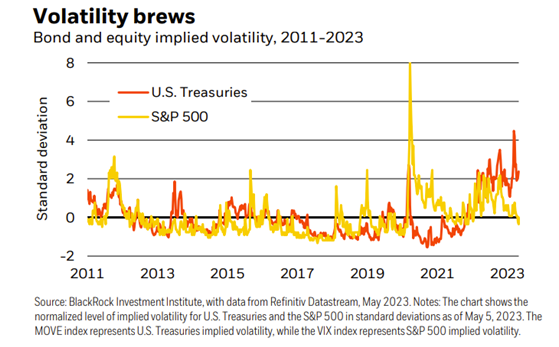
Fixed-income markets are likely to be volatile given macro-driven risks and the higher cost of borrowing.
The Cboe's new 1-Day Volatility Index, launched on April 24, and was built to measure the expected volatility of the S&P 500 over the next day of trading. VIX1D is a response to a surge in the use of extremely short-dated options.
Markets will likely get increasingly unsettled as the X-date approaches without resolution. Congress has about four weeks to hatch a deal. Chief Economist Brian Horrigan looks at five possible scenarios and relates important considerations for each.
Shifts in the labor market due to monetary policy tightening would see lagged effects that may not aid central banks' efforts to materially affect core inflation by year's end.
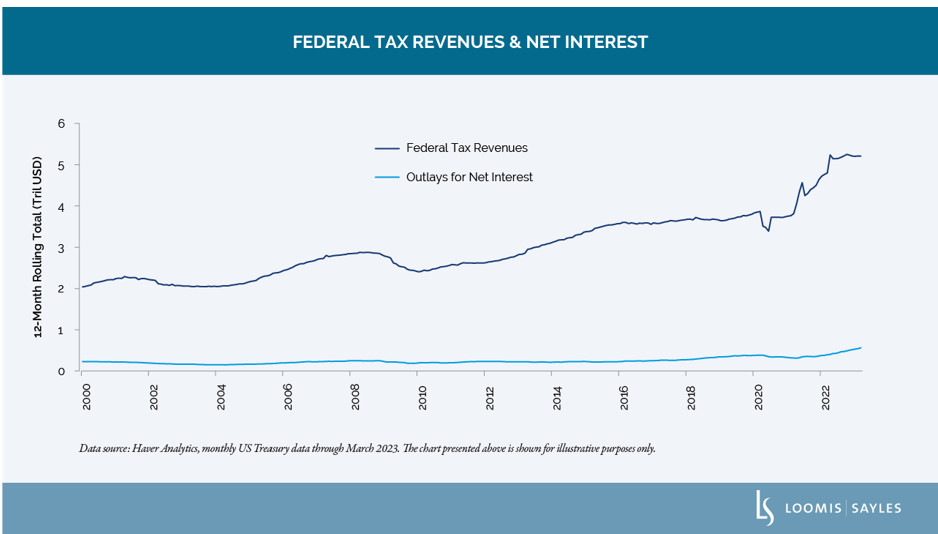
Lawmakers in Washington set government spending and revenue plans every fiscal year, usually producing a shortfall that many of us know as the federal budget deficit.
After moderate gains in March, markets continued to rally in April. U.S. markets were up by low single digits, while bond markets were moderately positive. International markets were mixed, with developed markets showing modest gains while emerging markets ticked down.
Pay attention to the bond diversification, resiliency quality stocks may offer, and current allocation to cash within portfolios in the wake of Fed action.