Tug Of War
Membership required
Membership is now required to use this feature. To learn more:
View Membership Benefits
The summer has once again brought a miasma of wildfire smoke across wide stretches of the nation, leading to hazy views and slower activity. The clouds in our outlook are not merely atmospheric. A failed ceasefire and renewed conflict in the Middle East have created new reasons to worry about economic performance.
Energy prices are ascending after a brief respite. Though energy markets have shown surprising resilience thus far, fuel costs will affect most households and businesses. While we maintain a forecast of growth, the balance of risks has shifted negatively. A renewed bout of inflation could lead to rate hikes, pushing against economic momentum.
The celestial haze will pass in time; residents of affected areas are advised to carry on with caution. We expect the U.S. economy will similarly carry on despite the challenges that obscure the horizon. Following are our thoughts on the outlook.
INFLUENCES ON THE FORECAST
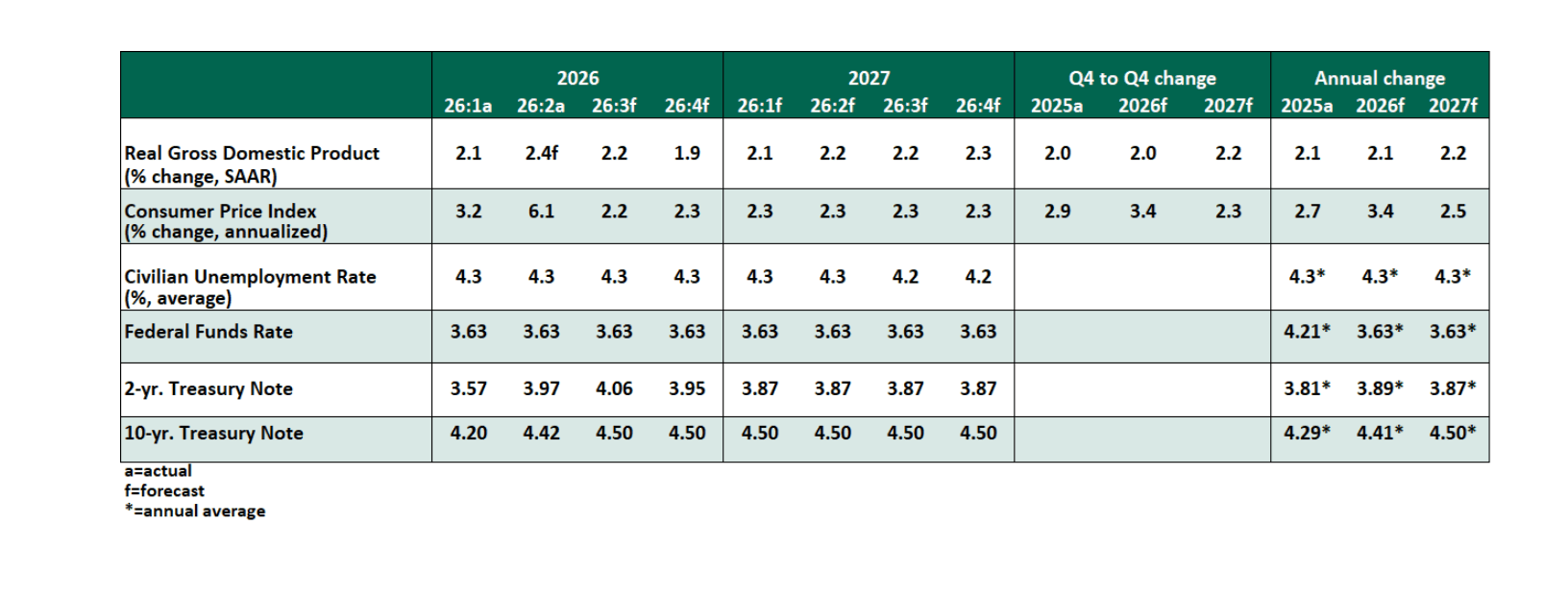
- The central risk to the U.S. outlook this year has been inflation, but the June consumer price index (CPI) offered a respite from these fears. Headline CPI cooled to 3.5% over the past year, from 4.2% in May. Falling energy costs led the decline, but core inflation (excluding food and energy) also stepped down three-tenths to 2.6%. Details of the report offered no evidence of pass-through of energy costs. With oil prices back on the rise, the relief may prove short-lived.
- Beyond energy market volatility, worries remain about the inflationary effect of AI investment and the persistent cost pressure of tariffs. High prices in specific categories like memory chips have immaterially small weights in the overall calculation, but they keep inflation on top of consumers’ minds.
- Following three months of upside surprises, the June employment report was temperate. Payrolls rose 57,000, offset by downward revisions totaling -74,000 to the hot reports in April and May. The unemployment rate fell by one tenth to 4.2%, driven by a lower estimate of the size of the labor force.
- The low response rates of both the establishment (54.4%) and household (66.2%) surveys create more opportunity for statistical noise and larger future revisions. Population models are not yet calibrated to an era of lower immigration. Single months of data may overstate strength and weakness alike. The three-month rolling average payroll gain of 111,000 jobs is consistent with a healthy labor market.
- While the outcome of the June Federal Open Market Committee (FOMC) meeting was announced with a starkly different tone, the meeting’s minutes showed that the committee remains focused on inflationary risks. If inflation were to remain elevated, “almost all” FOMC participants would support tightening policy. Though Chair Warsh has taken a stand against forward guidance, he has affirmed his focus on the price stability mandate, and his colleagues have given speeches elaborating on their view of risks. We forecast no rate movements through 2027, conditional on inflation remaining only modestly above target; the case for hikes may prevail if inflation runs hotter.
- Members of the Fed’s five task forces are generally well qualified and ideologically mixed. We will not speculate on potential reforms, but we expect their work product will be well-considered and could lead to some new approaches to policymaking.
- Consumer spending has not yet been deterred by gasoline prices. Retail sales for June showed continued growth, held down for the beneficial reason of lower spending on motor fuel. For the full second quarter, core retail sales (excluding automotive, gasoline stations and building materials) gained 2.2%, the highest quarterly gain in four years. Consumers appeared to offset their fuel costs by reaching into savings, with the saving rate also reaching a four-year low of 3.0%.
- Investment in AI remains a key economic driver, pushing up business investment in software and supporting the commercial construction sector through data center developments. Tech sector gains continue to generate wealth effects, fueling consumption. However, AI downsides and resource constraints are commanding greater attention.
- Near-term policy risks are stabilizing. Tariffs are moving toward a steady state akin to the rates seen in the second half of 2025, justified with new Section 301 tariffs. A government shutdown is unlikely ahead of the midterm elections, though the debt ceiling looms in the year ahead. Longer-run questions of fiscal sustainability have no ready solutions.
Information is not intended to be and should not be construed as an offer, solicitation or recommendation with respect to any transaction and should not be treated as legal advice, investment advice or tax advice. Under no circumstances should you rely upon this information as a substitute for obtaining specific legal or tax advice from your own professional legal or tax advisors. Information is subject to change based on market or other conditions and is not intended to influence your investment decisions.
© 2026 Northern Trust Corporation. Head Office: 50 South La Salle Street, Chicago, Illinois 60603 U.S.A. Incorporated with limited liability in the U.S. Products and services provided by subsidiaries of Northern Trust Corporation may vary in different markets and are offered in accordance with local regulation. For legal and regulatory information about individual market offices, visit northerntrust.com/terms-and-conditions.
A message from Advisor Perspectives and VettaFi: Discover something new! Click here to register for our upcoming webcasts.
Membership required
Membership is now required to use this feature. To learn more:
View Membership BenefitsSponsored Content
Upcoming Virtual Events View All












