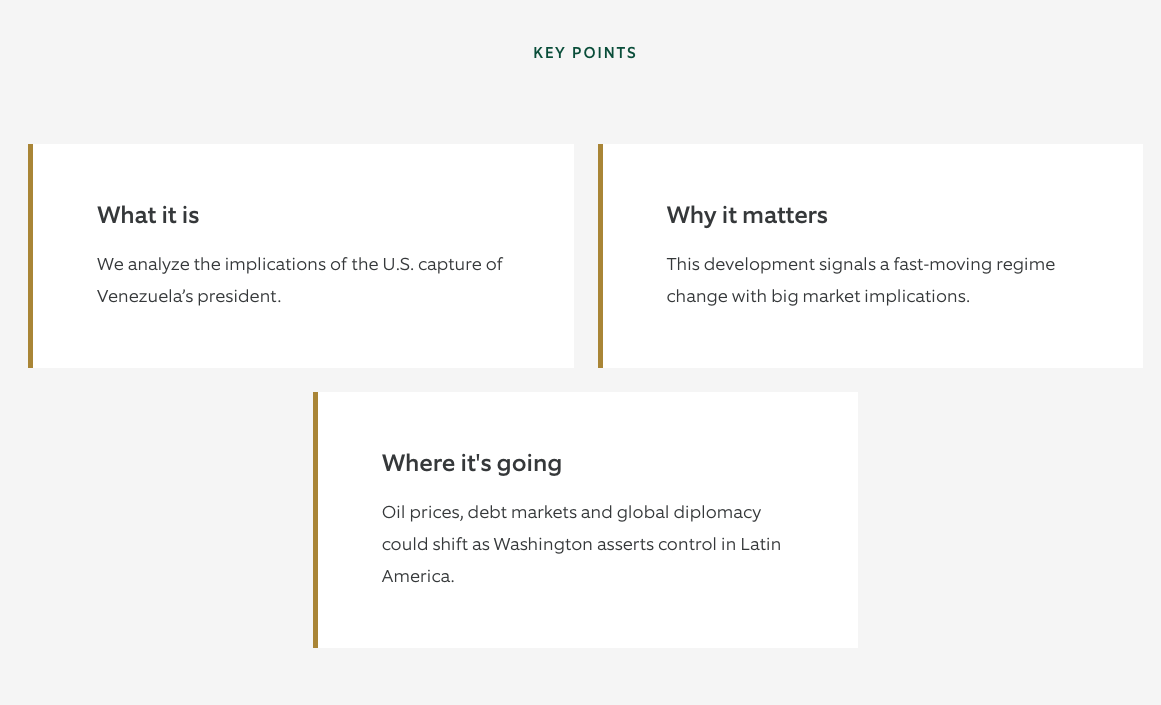
The U.S. conducted an overnight operation on January 3 to capture Venezuelan President Nicolás Maduro, who now faces criminal charges in the U.S. In a press briefing, U.S. President Donald Trump announced that the U.S. will oversee Venezuela until a “safe, proper and judicious transition” occurs. While the possibility of regime change had been widely discussed, the speed and manner of intervention came as a surprise to some investors. The audacious capture of Nicolás Maduro is more than a geopolitical thunderclap; it is the first definitive enforcement of the new U.S. National Security Strategy (NSS). Following the NSS pivot toward reasserting control in the Western Hemisphere, Washington has effectively introduced a “Trump Corollary” to the 1823 Monroe Doctrine.
The message is clear: The U.S. is actively reclaiming preeminence in its “backyard.”
This move follows escalating U.S. actions. Over the past several months, the U.S. had been building a presence in the area. In March, the U.S. imposed an additional tariff of 25% on countries that import Venezuelan oil. A couple of weeks ago, President Trump announced a blockade of all sanctioned oil tankers going into and out of Venezuela, which lowered Venezuelan oil exports to about half of the 950,000 barrels per day shipped in November. These steps signaled growing U.S. involvement, but the overnight seizure marks a significant escalation with geopolitical and market implications.
From an investment perspective, the financial ramifications operate on two levels — direct and indirect effects. The most direct effect is visible in the distressed debt market. Bonds issued by PDVSA, Venezuela’s state-run oil company, remain in technical default but had already begun a sharp rally in mid-December. Investors, anticipating an increased likelihood of regime change, have now seen that thesis validated.
However, Washington’s muscle-flexing carries a steep diplomatic price. Chinese authorities, who have spent two decades acting as Caracas’s primary lender and cultivating an "all-weather strategic partnership," will be far from pleased. Being pushed out of Latin America — a region Beijing viewed as a vital source of energy and a cornerstone of its global influence — marks a significant setback for its Belt and Road ambitions. Expect icy rhetoric and potential economic retaliation.
The indirect effects, while slower to unfold, may prove more potent. Venezuela holds the world’s largest proven reserves — approximately 300 billion barrels — and U.S. investment could unlock production capacity while reduced sanctions help facilitate more exports. However, these developments will take time. PDVSA appears operational, and Venezuela accounts for only about 1% of global oil output, most of which is consumed domestically or exported to China. However, the prospect of competent foreign operators eventually exploiting these resources introduces a significant medium-term supply risk to global oil markets.
Lower oil prices generally support growth and ease inflationary pressures in the U.S. economy. Reduced energy costs free up household disposable income, bolstering consumption. While energy sector capex may soften, the net effect tends to be positive for growth. On inflation, lower oil prices reduce the headline Consumer Price Index and can modestly spill over into core categories. Additionally, falling gasoline prices often temper short-term inflation expectations.
Sustained downward pressure on oil prices could weigh on commodities broadly, but the growth and inflation benefits should support global equities. We see an upside case for emerging market debt, though Latin American sovereign bonds may see increased dispersion. An orderly transition could stabilize Venezuela and compress regional risk premiums. While Venezuelan bonds have already rallied toward recovery levels on regime change prospects, uncertainty around regional responses remains high.
Many critical questions still persist: Will Russia or China retaliate? Could the U.S. require further military action? How quickly will leadership stabilize, and what are the plans for foreign investment in Venezuelan oil? Beyond the immediate impact, this event could very well reshape global geopolitical dynamics. How would Russia respond to an environment of sustained low oil prices? Does this increase the odds of U.S. intervention elsewhere, such as in Cuba, Iran or with regard to Greenland?
Bottom Line: The Venezuela regime change presents both risks and opportunities. Headline risk is likely to remain elevated for now. We recommend maintaining a modest pro-risk tactical stance.
Peter Wilke, Senior Vice President – Head of Tactical Asset Allocation
IMPORTANT INFORMATION
Northern Trust Asset Management is composed of Northern Trust Investments, Inc., Northern Trust Global Investments Limited, Northern Trust Fund Managers (Ireland) Limited, Northern Trust Global Investments Japan, K.K., NT Global Advisors, Inc., 50 South Capital Advisors, LLC, Northern Trust Asset Management Australia Pty Ltd, and investment personnel of The Northern Trust Company of Hong Kong Limited and The Northern Trust Company.
Issued in the United Kingdom by Northern Trust Global Investments Limited, issued in the European Economic Association (“EEA”) by Northern Trust Fund Managers (Ireland) Limited, issued in Australia by Northern Trust Asset Management (Australia) Limited (ACN 648 476 019) which holds an Australian Financial Services Licence (License Number: 529895) and is regulated by the Australian Securities and Investments Commission (ASIC), and issued in Hong Kong by The Northern Trust Company of Hong Kong Limited which is regulated by the Hong Kong Securities and Futures Commission.
For Canada, Asia-Pacific (APAC) and Europe, Middle East and Africa (EMEA) markets, this information is directed to institutional, professional and wholesale clients or investors only and should not be relied upon by retail clients or investors. This information may not be edited, altered, revised, paraphrased, or otherwise modified without the prior written permission of NTAM. The information is not intended for distribution or use by any person in any jurisdiction where such distribution would be contrary to local law or regulation. NTAM may have positions in and may effect transactions in the markets, contracts and related investments different than described in this information. This information is obtained from sources believed to be reliable, its accuracy and completeness are not guaranteed, and is subject to change. Information does not constitute a recommendation of any investment strategy, is not intended as investment advice and does not take into account all the circumstances of each investor.
Unless otherwise noted, the statements expressed herein are solely opinions of Northern Trust. Northern Trust does not make any representation, assurance, or other promise as to the accuracy, impact, or potential occurrence of any events or outcomes expressed in such opinions.
This information is provided for informational purposes only and is not intended to be, and should not be construed as, an offer, solicitation or recommendation with respect to any transaction and should not be treated as legal advice, investment advice or tax advice. Recipients should not rely upon this information as a substitute for obtaining specific legal or tax advice from their own professional legal or tax advisors. References to specific securities and their issuers are for illustrative purposes only and are not intended and should not be interpreted as recommendations to purchase or sell such securities. Indices and trademarks are the property of their respective owners. Information is subject to change based on market or other conditions.
Forward-looking statements and assumptions are NTAM’s current estimates or expectations of future events or future results based upon proprietary research and should not be construed as an estimate or promise of results that a portfolio may achieve. Actual results could differ materially from the results indicated by this information.
A message from Advisor Perspectives and VettaFi: Discover something new! Click here to register for our upcoming webcasts.
© Northern Trust
Read more commentaries by Northern Trust