With the U.S. government shut down, the Labor Department was unable to release the monthly employment report on October 3. You could almost sense the economics community experiencing a kind of withdrawal, not sure of how to cope with the deprivation of data.
Fortunately, alternative measures of the labor market have emerged over the past decade. The payroll processor ADP has been releasing estimates of job creation since 2010. The outcomes track very closely with “official” figures produced by the Bureau of Labor Statistics (BLS).
The ADP report covers more firms than the BLS sample, but it does not capture government employment. The representation of smaller businesses, which may not use payroll services, is less comprehensive. ADP does not attempt to estimate the size of the labor force, and does not produce an alternative to the unemployment rate. It could not replace the establishment survey: ADP is only able to scale their trends to the national economy by using BLS data as a benchmark.
Online job portals like LinkedIn and Indeed provide time series on job postings and hiring which are comparable to the Job Openings and Labor Turnover Survey (JOLTS) report issued by the BLS. Directionally, these are aligned; however, sampling limitations are a factor, as they reflect only listings on their own platform.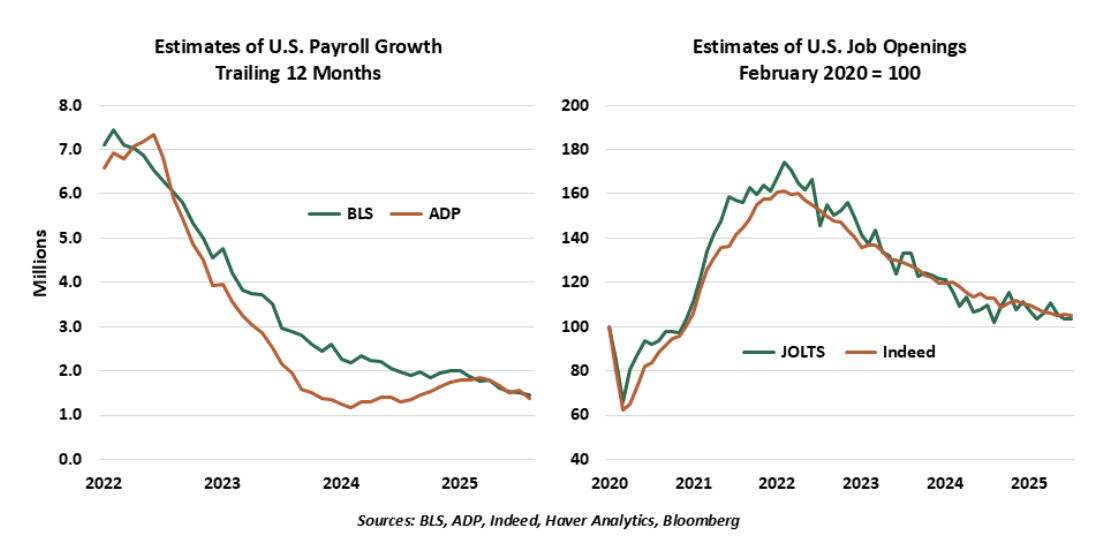
If the shutdown continues, we will also miss readings on consumer spending and inflation. The major credit card providers produce measures of sales that rival those produced by the Commerce Department. PriceStats prepares measures of inflation by aggregating online prices; many industry associations produce cost measures for their sectors. None of these sources does a particularly good job of covering services, which account for more than two-thirds of U.S. economic output.












