The Weekender is my bi-weekly take on macro shifts and emerging themes. It’s not investment advice — or even our firm’s official view. I aim simply to inform, challenge, and maybe entertain. If you’d like this in your inbox every other Saturday morning via Northern Trust, subscribe to The Weekender.
Staying Long Electrons — and the Things That Produce Them
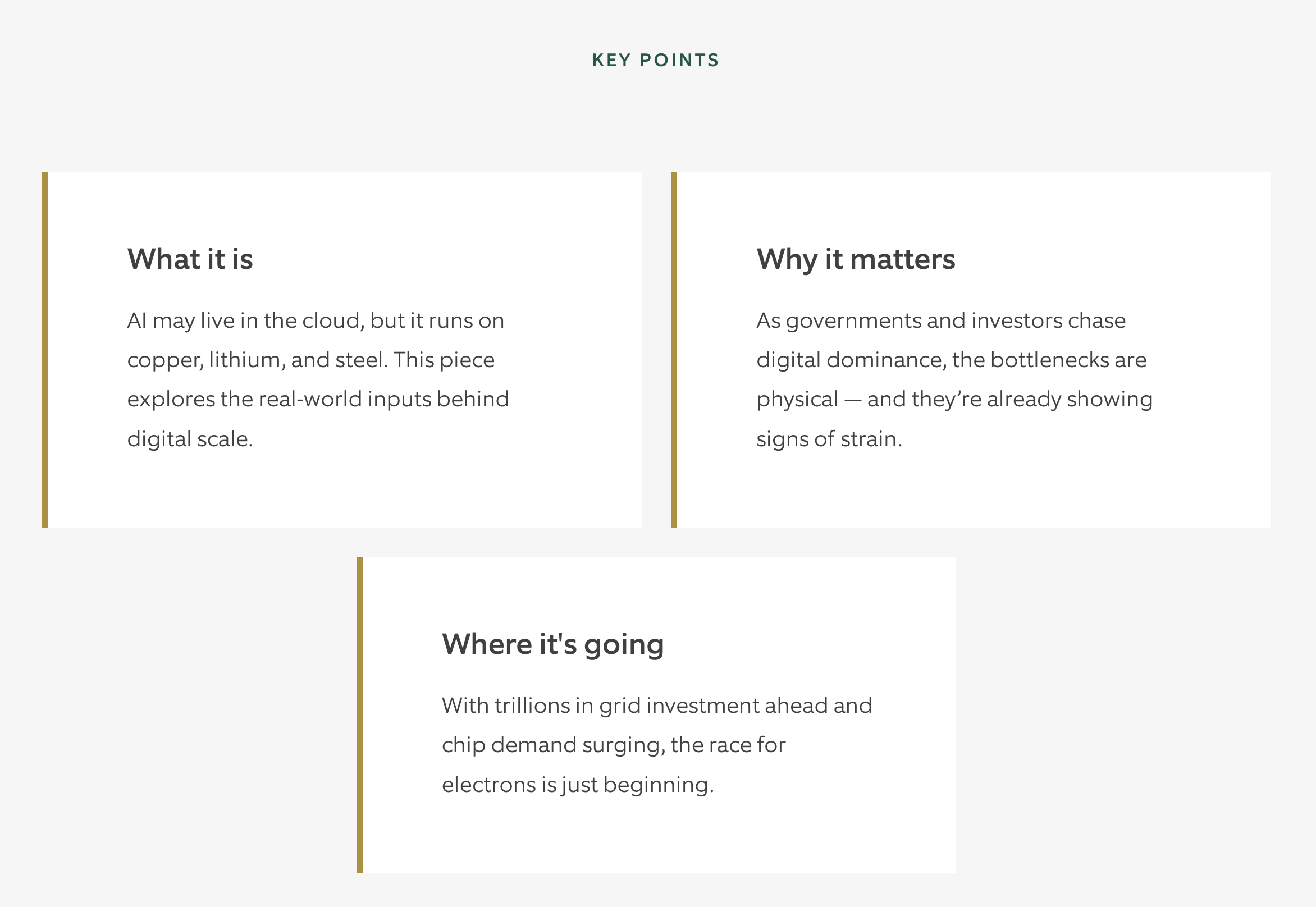
Sam Altman, CEO of OpenAI, reportedly wants the company to reach 250GW of compute capacity by 2033. That’s equivalent to 250 nuclear reactors — 2.5 times the number currently operating in the U.S. today. It’s roughly one-third of peak U.S. power consumption, or close to the total energy produced in India. It would also require 25 times the annual supply of Nvidia AI chips (if I’m counting correctly). Not bad — for one company. I won’t attempt to critique this. My mind works linearly — if it works at all — and tends to shut down around the fourth turn of the exponential function.
So I look for signal in the actions of others. Like the deep-pocketed, price-inelastic U.S. government, which recently backed Lithium Americas (up 120% last week).
A reminder: success in the ethereal realm demands extraordinary support — and supply — from the physical one. A world still priced on its past. Not its present. And certainly not its future.
The Race for Electrons
If AI is a race for electrons, China may be in the lead.
“China’s electricity capacity exceeds that of the U.S., the EU, and India combined.” — Mining Weekly
Bloomberg New Energy Finance (BNEF) projects $15.8 trillion in global grid investments ahead. That implies demand for mountains of uranium, natural gas, copper, aluminium, silver, lithium, and steel. Supply is already constrained (see Grasberg Outage), and now increasingly weaponized in a multi-polar world. Add a new inelastic, politically driven buyer to the mix and you have the potential for a perfect storm. The sector driving this demand currently trades at roughly seven times forward sales, compared to just 1.3 times for the S&P Metals and Mining Select Index. That kind of divergence raises a question: Is mean reversion still a thing?
Uncomfortably Long
The talk in London this week: a Financial Times article on legendary tech investor James Anderson turning cautious on AI and Nvidia. Cautious, yes — but still a holder. Like anyone who lived through the dotcom bust, he’s likely uneasy watching familiar patterns play out — eye-watering valuations for OpenAI, Anthropic, and vendor/circular financing channelled through Nvidia. Echoes of 2000, minus the nostalgia.
But there are also differences: Nvidia’s circular financing is backed by cash flow, not debt, and met by demand that reportedly outstrips capacity (25 times, if you believe Mr. Altman!). So zoom out, broaden the aperture, and search for counterfactuals — like Anderson’s other interview, in the same newspaper, on the same topic and company, suggesting Nvidia could reach a $50 trillion market cap within a decade. That’s a lot of zeroes. My head hurts. I’ve stopped counting.
The Upside to Regulation
Look at the Nasdaq chart from the 1990s. Inflection was 1995. Many credit Netscape’s late 1994 launch — the era’s ChatGPT moment — for democratizing the internet and making it accessible. But regulation played a bigger role than most recall. The 1996 Telecommunications Act gave firms clarity to invest in fiber and broadband, which rewired the world.
Are the GENIUS and CLARITY Acts today’s analogue? Could they do for tokenization and stablecoins what telecom regs did for digital infrastructure? Listening to the U.S. Securities and Exchange Commission’s (SEC) Chair Paul Aitkins, U.S. Treasury Secretary Scott Bessent, and U.S. Federal Reserve Governor Christopher Waller — all of whom have uttered variants of “finance is going on the blockchain” — suggests it’s possible.
The Fed on Going Digital
Here’s a summary of Fed Governor Waller’s Sibos speech:
“The proliferation of digital assets appears inevitable — a natural progression in financial innovation. As payments have evolved from paper to electronic, then real-time, distributed ledgers, tokenization, and AI now promise cost, speed, and efficiency. Stablecoins and tokenized assets meet demand for better payments, even as regulations ensure trust. With both public and private investment pouring in, digital assets look set to become a core part of the global financial system.”
Good news, it would seem, for T-Bills and Ethereum?
Change Is Constant — So Is the Language We Use to Frame It
Each economic and social transition brings new norms and metaphors. Consider “drill down,” born of the Industrial Age, evoking mining and manufacturing. Fast-forward to the Computer Age and we “double‑click” for the same intent.
Markets evolve in parallel. When the U.S. economy was dominated by manufacturing, transports were the pulse of aggregate demand, and Dow Theory codified that truth: where the rails went, the market followed. Apply that lens today and you’d be screaming “sell.” But the world has shifted. Computing, not cargo, drives growth. If rails once moved goods, wafers now move ideas. Follow the fabs — because semiconductors are the new transports, and they’re not (yet) signalling sell.
China’s Future Is Not in Its Past
As discussed, China is creating a new operating system — one no longer based on the debt-fuelled, property-led growth of the past. Instead, it’s shifting toward an AI-powered, consumption-driven demand model, where equities serve as a fast and efficient funding channel and the preferred transmission mechanism for wealth effects.
These structural changes are occurring at what could be a cyclical inflection point. Just last week, Chinese industrial profits surged 20% year-over-year after months of declines, potentially signalling a turning point for earnings. The next catalyst for Chinese stocks could be the outcome of trade-talks where the mood music seems positive, with some suggesting a deal announcement at the Asia-Pacific Economic Cooperation (APEC) meetings later this month.
China Ending Deflation
Among sectors suffering overcapacity and price deflation, property looms largest. Yet this week, Cushman & Wakefield noted that Tier 1 and 2 cities are experiencing a recovery in residential market demand, with transaction areas expanding and prices stabilizing. The China Index Academy also reported an 18% year-over-year increase in transaction area for first-tier cities, and 16% for second-tier cities, while third-tier cities declined 15% — highlighting that challenges remain.
These are encouraging signals that may reflect the early efforts of China’s official anti-deflation efforts.
Another potentially overlooked signal: Chinese government bond yields (CBGs). As local observers often note, CGBs tend to correlate with commodity prices. Their recent rally has coincided with movement in the Commodity Research Bureau Raw Industrials Index (CRB RIND) — which, for what it’s worth, remains pinned at the top of my Bloomberg screen — and may be starting to flash signals of reflation.
Filling Holes
Recently, I suggested Rachel Reeves, the U.K. Chancellor of the Exchequer, might look to plug the U.K. budget hole with North Sea oil and gas. Now, she’s quietly granted ministers power to reverse flagship climate policies and greenlight new fossil exploration. Ed Miliband, U.K. Secretary of State for Energy and Net Zero, once wind’s staunchest advocate, is now expected to approve ‘tie-backs’ — new fields via existing licenses, without breaking election pledges.
This may also answer how the U.K. will power the next wave of AI data centers. North Sea E&P stocks, having signalled this for months, have surged. A crude signal their rigs sit atop the molecules that create the electrons that power these new models. And while net-zero campaigners may not be happy, gilt investors might be?
Keep an Eye On…
During his Senate confirmation, U.S. Fed Governor Steven Miran, cited the Fed’s third mandate — “moderate long-term interest rates” — as per the U.S. Federal Reserve Reform Act of 1977 A third mandate — who knew!? In plain English: yield curve control.
The last time the Fed did this for a long stretch was amid World War II. Whether likely or not (probably not), it’s now a discussion point. So, might we expect rhetoric about “emergency measures” for key problems like housing affordability?
Anything is possible, although that particular market problem might soon solve itself: as Treasury yields fell recently, mortgage rates hit their lowest since October 2024, sparking a surge in refinance applications. Lower long-term rates — whether by policy or market dynamics — could ease housing affordability pressures on their own, without requiring intervention or technological solutions like AI.
Have a great weekend.
Gary Paulin is chief investment strategist, international for Northern Trust Asset Management. He is responsible for developing and communicating the firm’s investment outlook across asset classes as well as producing investment analysis and thought leadership for the broader marketplace globally. To build out economic and market views, Gary regularly collaborates with the firm’s investment teams in equities, fixed income, multi-asset and alternatives.
A message from Advisor Perspectives and VettaFi: Interested in learning more about how bond ETFs can help diversify your portfolio? Click here to read more.
Asia-Pacific Economic Cooperation (APEC): A regional economic forum of 21 member economies that promotes free trade, sustainable growth, and economic integration across the Asia-Pacific.
Bloomberg New Energy Finance (BNEF): A research division of Bloomberg that provides data, analysis, and insights on the energy transition, including clean energy, advanced transport, digital industry, and sustainable finance.
Commodity Research Bureau Raw Industrials Index (CRB RIND Index): A spot price index tracking raw industrial commodities like copper, cotton, and rubber — used as a leading indicator of economic activity and inflation trends.
Securities and Exchange Commission (SEC): A U.S. federal agency that regulates securities markets, enforces financial laws, and protects investors through oversight and disclosure requirements.
Stablecoins: Digital currencies designed to maintain a stable value by being pegged to assets like fiat currencies, commodities, or other financial instrument.
Opinions and forecasts discussed are those of the author, do not necessarily reflect the views of Northern Trust and are subject to change without notice.
This content may not be edited, altered, revised, paraphrased, or otherwise modified without the prior written permission of Northern Trust Asset Management (NTAM). The information contained herein is intended for use with current or prospective clients of Northern Trust Investments, Inc (NTI) or its affiliates. The information is not intended for distribution or use by any person in any jurisdiction where such distribution would be contrary to local law or regulation. NTAM and its affiliates may have positions in and may effect transactions in the markets, contracts and related investments different than described in this information. This information is obtained from sources believed to be reliable, its accuracy and completeness are not guaranteed, and is subject to change. Information does not constitute a recommendation of any investment strategy, is not intended as investment advice and does not take into account all the circumstances of each investor.
This report is provided for informational purposes only and is not intended to be, and should not be construed as, an offer, solicitation or recommendation with respect to any transaction and should not be treated as legal advice, investment advice or tax advice. Recipients should not rely upon this information as a substitute for obtaining specific legal or tax advice from their own professional legal or tax advisors. References to specific securities and their issuers are for illustrative purposes only and are not intended and should not be interpreted as recommendations to purchase or sell such securities. Indices and trademarks are the property of their respective owners. Information is subject to change based on market or other conditions.
All securities investing and trading activities risk the loss of capital. Each portfolio is subject to substantial risks including market risks, strategy risks, advisor risk, and risks with respect to its investment in other structures. There can be no assurance that any portfolio investment objectives will be achieved, or that any investment will achieve profits or avoid incurring substantial losses. No investment strategy or risk management technique can guarantee returns or eliminate risk in any market environment. Risk controls and models do not promise any level of performance or guarantee against loss of principal. Any discussion of risk management is intended to describe NTAM’s efforts to monitor and manage risk but does not imply low risk.
Past performance is not a guarantee of future results. Performance returns and the principal value of an investment will fluctuate. Performance returns contained herein are subject to revision by NTAM. Comparative indices shown are provided as an indication of the performance of a particular segment of the capital markets and/or alternative strategies in general. Index performance returns do not reflect any management fees, transaction costs or expenses. It is not possible to invest directly in any index. Net performance returns are reduced by investment management fees and other expenses relating to the management of the account. Gross performance returns contained herein include reinvestment of dividends and other earnings, transaction costs, and all fees and expenses other than investment management fees, unless indicated otherwise. For U.S. NTI prospects or clients, please refer to Part 2a of the Form ADV or consult an NTI representative for additional information on fees.
Forward-looking statements and assumptions are NTAM’s current estimates or expectations of future events or future results based upon proprietary research and should not be construed as an estimate or promise of results that a portfolio may achieve. Actual results could differ materially from the results indicated by this information.
Northern Trust Asset Management is composed of Northern Trust Investments, Inc., Northern Trust Global Investments Limited, Northern Trust Fund Managers (Ireland) Limited, Northern Trust Global Investments Japan, K.K., NT Global Advisors, Inc., 50 South Capital Advisors, LLC, Northern Trust Asset Management Australia Pty Ltd, and investment personnel of The Northern Trust Company of Hong Kong Limited and The Northern Trust Company.
Not FDIC insured | May lose value | No bank guarantee
© Northern Trust
Read more commentaries by Northern Trust