The Chinese economy is like the banyan tree. Its roots spread wide and run deep, with branches capable of becoming the roots of another tree. China’s economy has propagated itself through branches like trade, finance and infrastructure. But supply chains are where its roots have thickened into trunks, particularly across Southeast Asia.
China’s trading partners in the Association of Southeast Asian Nations (ASEAN) have become integral to its ongoing success, sometimes by concealing the Chinese origin of goods. Transshipment is the movement of products through a third country with the intent to obscure the true country of origin, often done to circumvent import tariffs. This practice typically entails limited value-addition or transformation of goods, relying instead on relabeling to exploit preferential trade agreements.
This intricate web of transnational manufacturing and rerouting is now the focus of intensified scrutiny by the United States. A 40% penalty tariff is now levied on products determined to have been rerouted to evade existing duties, marking a significant escalation in trade enforcement.
Transshipment has grown notably since the escalation of U.S.-China trade tensions in 2018, as firms have sought to reconfigure supply chains to preserve market access. Countries like Vietnam, Malaysia and Thailand have been key nodes in this rerouting.

As tariffs rise, so do the incentives for circumvention. In 2025 alone, U.S. Customs and Border Protection alleged over $400 million in duty evasion, with nearly two-thirds of the cases involving Chinese shell companies rerouting goods through ASEAN nations. This figure likely represents only the tip of the iceberg, given the opacity in trade reporting.
International trade organizations typically record origin and destination, omitting intermediate routing. The limited data often make transshipment indistinguishable from legitimate re-exports, which are accompanied by transparent documentation of origin and destination. In aggregate, indirect indicators such as sudden increases in flows of goods to and from intermediary economies can signal a rise in rerouting activity.
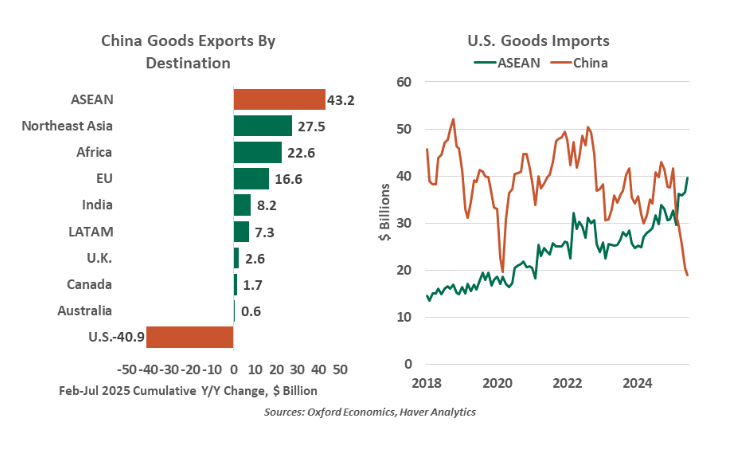
China’s shipments to the U.S. have been on a steady decline in recent years, with the trend accelerating sharply since the start of 2025. The share of Chinese products in total U.S. imports has fallen from around 21% in 2018 to just 8% in the second quarter of 2025. Over the same time period, ASEAN’s share has doubled from 7% to 14%, reflecting a significant reorientation of trade flows. Between February and July 2025, China’s goods exports to the U.S. fell by a cumulative 41% year over year, while supplies to ASEAN surged by 43%, enabling the Mainland to maintain its overall share of outbound trade.
For decades, ASEAN economies have relied heavily on exports as a primary engine of growth. The recent shift in U.S. foreign commerce policy, with its focus on curbing transshipment, poses a significant threat to ASEAN’s long-standing trade-led development model. These measures risk not only slowing economic growth but also triggering substantial job losses, especially in manufacturing-intensive countries like Vietnam.
A substantial share of ASEAN shipments to the U.S. consists of electronics, machinery, and consumer products, many of which rely on Chinese inputs such as semiconductors, batteries and components. Vietnam, Malaysia and Thailand have the highest share of foreign value-add in manufacturing exports to America. For instance, more than 70% of China’s mechanical-electrical exports to Vietnam are intermediate goods, which are then assembled locally and re-exported to the United States.
Chinese components are often cheaper due to scale and state-backed subsidies. Replacing them with alternatives, if available, would raise manufacturing costs and dent competitiveness. A forced decoupling from Chinese supply chains would likely disrupt production across key sectors that underpin the region’s trade profile.
The disparity in tariffs, much higher on Chinese imports than on ASEAN goods, continues to incentivize transshipment. But intermediaries must focus on enhancing domestic value addition and diversifying their export bases to safeguard their long-term growth prospects.
These efforts are already underway. Some nations are offering targeted incentives to attract foreign investment in strategic manufacturing sectors. Simultaneously, governments are also strengthening commercial ties with other major markets such as India and the European Union. Regional frameworks like the Regional Comprehensive Economic Partnership and upcoming updates to the ASEAN Trade in Goods Agreement later this year will widen sourcing channels and sustain export momentum.
A key source of uncertainty lies in how the 40% transshipment penalty will be defined. Countries like Vietnam and Indonesia are negotiating with American authorities for clarity on acceptable thresholds for third-country input in exported products. Over the past several years, Chinese firms have significantly expanded their presence across Southeast Asian markets to circumvent U.S. tariffs. Between 2018 and 2024, about 45% of China’s global foreign direct investment transactions in manufacturing were directed toward ASEAN economies. This complicates efforts to distinguish locally produced goods from those with substantial Chinese content, thereby posing a challenge to compliance under evolving rules of origin.
Much like a banyan tree that resists removal due to its vast root system, China’s transshipment networks are deeply embedded in regional trade flows. Uprooting them would cause significant disruption. Just as the ground trembles when a large tree is felled, efforts to dismantle these networks may reverberate across the globe.
Information is not intended to be and should not be construed as an offer, solicitation or recommendation with respect to any transaction and should not be treated as legal advice, investment advice or tax advice. Under no circumstances should you rely upon this information as a substitute for obtaining specific legal or tax advice from your own professional legal or tax advisors. Information is subject to change based on market or other conditions and is not intended to influence your investment decisions.
© 2025 Northern Trust Corporation. Head Office: 50 South La Salle Street, Chicago, Illinois 60603 U.S.A. Incorporated with limited liability in the U.S. Products and services provided by subsidiaries of Northern Trust Corporation may vary in different markets and are offered in accordance with local regulation. For legal and regulatory information about individual market offices, visit northerntrust.com/terms-and-conditions.
A message from Advisor Perspectives and VettaFi: To learn more about this and other topics, check out some of our webcasts.
© Northern Trust
Read more commentaries by Northern Trust
 China’s shipments to the U.S. have been on a steady decline in recent years, with the trend accelerating sharply since the start of 2025. The share of Chinese products in total U.S. imports has fallen from around 21% in 2018 to just 8% in the second quarter of 2025. Over the same time period, ASEAN’s share has doubled from 7% to 14%, reflecting a significant reorientation of trade flows. Between February and July 2025, China’s goods exports to the U.S. fell by a cumulative 41% year over year, while supplies to ASEAN surged by 43%, enabling the Mainland to maintain its overall share of outbound trade.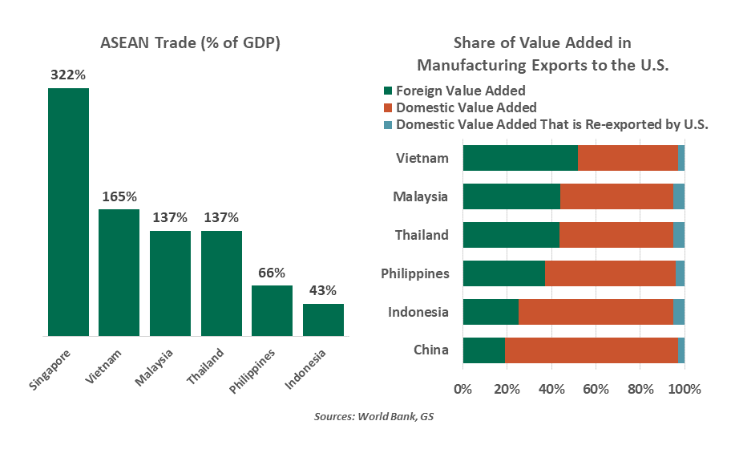
 These efforts are already underway. Some nations are offering targeted incentives to attract foreign investment in strategic manufacturing sectors. Simultaneously, governments are also strengthening commercial ties with other major markets such as India and the European Union. Regional frameworks like the Regional Comprehensive Economic Partnership and upcoming updates to the ASEAN Trade in Goods Agreement later this year will widen sourcing channels and sustain export momentum.












