I recently had to clean out my pantry to facilitate some kitchen reconstruction. It was like an archaeological dig, only with food. I found eight different varieties of rice; thankfully, they all have a long shelf life.
Among the collection was a sack of sushi rice, prized for its pearl shape and its sticky texture. Naturally, it got me thinking about economics. Rice was one of the two products (along with autos) that were central to the trade deal announced by Japan and the United States this week. Washington agreed to reduce tariffs from 25% to 15% in exchange for greater market access. The tariff level is still much higher than it had been, but the agreement takes the worst case off the table.
Washington agreed to reduce tariffs from 25% to 15% in exchange for greater market access. The tariff level is still much higher than it had been, but the agreement takes the worst case off the table.
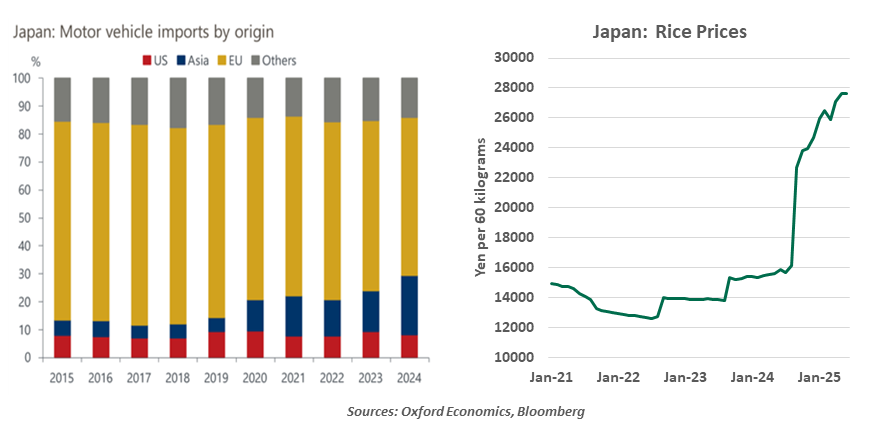
 Stress between U.S. and Japanese automakers is longstanding and well-documented. Japanese makers have a 40% share of the U.S. market; about half of that total are vehicles for which final assembly takes place in the U.S. By contrast, U.S. car brands have a minimal market share in Japan. This is not the result of tariffs, which are not applied to U.S. auto imports in Japan. Instead, it seems to be a matter of taste.
The issue with rice also seems to be a matter of taste. Japanese favor the strain which is produced in their country. A failed harvest last year has resulted in very high prices for rice, but the trade agreement with the U.S. does not raise the Japanese quota for imports of this commodity.
On the surface, then, the new trade agreement does relatively little that is concrete to open these two critical markets to more U.S. supply. Automakers and farmers have significant political influence in Japan. Recent elections have rewarded parties that favor a less accommodative approach to trade relations, so further progress on bilateral trade may be more difficult to achieve.
The trade deal has been labeled a success by the Administration, but the proof will be in the pudding…rice pudding.
Information is not intended to be and should not be construed as an offer, solicitation or recommendation with respect to any transaction and should not be treated as legal advice, investment advice or tax advice. Under no circumstances should you rely upon this information as a substitute for obtaining specific legal or tax advice from your own professional legal or tax advisors. Information is subject to change based on market or other conditions and is not intended to influence your investment decisions.
© 2025 Northern Trust Corporation. Head Office: 50 South La Salle Street, Chicago, Illinois 60603 U.S.A. Incorporated with limited liability in the U.S. Products and services provided by subsidiaries of Northern Trust Corporation may vary in different markets and are offered in accordance with local regulation. For legal and regulatory information about individual market offices, visit northerntrust.com/terms-and-conditions.
A message from Advisor Perspectives and VettaFi: To learn more about this and other topics, check out some of our webcasts.
© Northern Trust
Read more commentaries by Northern Trust
 Stress between U.S. and Japanese automakers is longstanding and well-documented. Japanese makers have a 40% share of the U.S. market; about half of that total are vehicles for which final assembly takes place in the U.S. By contrast, U.S. car brands have a minimal market share in Japan. This is not the result of tariffs, which are not applied to U.S. auto imports in Japan. Instead, it seems to be a matter of taste.