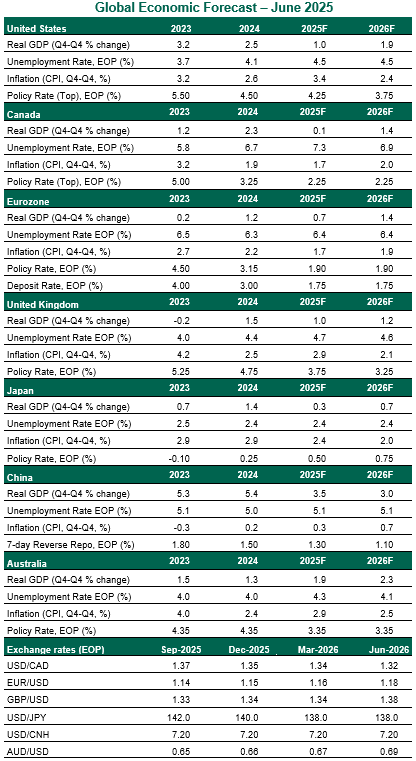
The temperature around global trade has generally eased since early April, when the U.S. administration rolled back some of its sweeping tariffs. Negotiations are ongoing, with progress achieved on a couple of fronts. Economic activity has emerged unscathed in most places, and some cautious optimism surrounds the outlook.
But international commerce is unlikely to see a return to old norms. Trade pacts are unlikely to result in significant tariff reduction. Sectoral and universal levies, along with non-tariff barriers, remain key impediments. U.S. duties on steel and aluminum imports have been doubled to 50% for some nations. Further, geopolitical tensions could complicate an already intricate economic backdrop.
Growth is expected to decelerate across major markets during the balance of the year, but it is unlikely to come crashing down. As long as the worst of trade tensions are behind us, the global economy can continue to grow through uncertainty.
Following are our thoughts on how top markets are faring.
United States
- Gross domestic product (GDP) in the first quarter was heavily influenced by front-loaded imports ahead of tariff announcements. These flows have stopped, and trade will be less of a damper on second quarter growth. Consumer and business spending has remained solid, and we expect it to continue rising at a moderate pace. There is a growing belief that the U.S. administration will not push the trade war to recessionary extremes. However, the costs and uncertainties of new tariffs will make for slower growth and higher prices in the second half of the year.
- With inflation above target and the labor market still performing reasonably well, the Federal Reserve is staying on the sidelines. Tariffs have added to inflation risk, even as some policymakers have characterized them as a one-time shock. We anticipate one rate cut this year, followed by two in 2026.
Japan
- Growth was revised up from an initially reported -0.7% annualized quarter over quarter contraction to a smaller -0.2% decline in the first quarter. The upgrade was primarily driven by a sharp revision to inventory investment alongside a better private consumption reading. Household demand should continue to grow, backed by improving real incomes. But higher U.S. tariffs and elevated uncertainty will prove to be a lasting drag on exports and business investments. Hopes of a trade deal with the United States have risen ahead of the July 9 deadline but may fall short of providing a reprieve to the country’s vital auto sector. The U.S. has been reluctant to offer concessions on this front.
- Inflationary pressures have strengthened, but not owing to demand-side pressures. The core-core consumer price index (excluding fresh food and energy) remained above 3% year over year in May, led by surging rice prices. By contrast, services inflation was tame at 1.4%. The Bank of Japan (BoJ) remains on the sidelines, given the high level of uncertainty. However, the central bank announced its exit plan from quantitative easing, starting in FY2026.
China
- Economic activity in China has remained resilient in the first half of the year, benefiting from front-loaded exports and consumer goods trade-in programs. Neither of these two supports are likely to sustain growth for very long. The country’s important real estate sector remains in an extended slump. Elevated trade tensions coupled with relatively higher tariffs on Chinese goods will hinder external demand. The de-escalation in trade tensions from a point of a virtual trade embargo was a welcome development, but a more durable accord that further reduces frictions is nowhere in sight. Even under a best-case scenario, levies on Chinese imports into the U.S. will be much higher than they were at the start of the year.
- The urgency to double down on macro easing waned after the tariff truce, but fiscal and monetary policies are likely stay loose. Further rate reductions and liquidity-boosting measures will be needed to keep deflationary pressures at bay. Incremental easing, rather than more sweeping stimulus measures, remains our base case.
Australia
- Australian real GDP growth slowed to a crawl in the first three months of the year, rising just 0.2% quarter over quarter. Consumers and businesses remained cautious amid sluggish real wages and high global uncertainty. Lower borrowing costs alongside improving purchasing power should aid in a revival of economic activity. Australia has managed to fly under the Trump administration’s radar on trade. But as an open economy with deep links to China, Australia is vulnerable to a slowdown in external demand.
- In line with expectations, the Reserve Bank of Australia resumed its easing cycle as it lowered the cash rate by 25 basis points to 3.85%. The minutes of the meeting revealed that the Board considered a larger 50 basis points reduction, owing to downside risks to both the global and domestic outlook. While the statement did not provide explicit guidance for further easing, the central bank’s tone appears to have become more accommodative. We continue to see two more sequential cuts.

Information is not intended to be and should not be construed as an offer, solicitation or recommendation with respect to any transaction and should not be treated as legal advice, investment advice or tax advice. Under no circumstances should you rely upon this information as a substitute for obtaining specific legal or tax advice from your own professional legal or tax advisors. Information is subject to change based on market or other conditions and is not intended to influence your investment decisions.
© 2025 Northern Trust Corporation. Head Office: 50 South La Salle Street, Chicago, Illinois 60603 U.S.A. Incorporated with limited liability in the U.S. Products and services provided by subsidiaries of Northern Trust Corporation may vary in different markets and are offered in accordance with local regulation. For legal and regulatory information about individual market offices, visit northerntrust.com/terms-and-conditions.
A message from Advisor Perspectives and VettaFi: To learn more about this and other topics, check out some of our webcasts.
© Northern Trust
Read more commentaries by Northern Trust