The Biblical story of David and Goliath offers inspiration to underdogs facing seemingly impossible battles. David, a shepherd, defies all expectations and defeats the giant Philistine to become king.
On today’s trade battle grounds, there are unlikely to be any Davids. But observers will be watching the clash of the Goliaths in international commerce.
America’s looming trade confrontation with the European Union (EU) will be one such skirmish. The two markets have the world’s largest commercial relationship, with goods and services worth over $1.5 trillion changing hands each year.
In a major escalation, President Trump has announced 25% tariffs on all steel and aluminum imports that will take effect on March 12. This would not only revive an old trade dispute with the EU from his first term, but will also represent a 15 percentage point increase from the prior duty on aluminum. The President has threatened reciprocal tariffs against EU countries, levies that are equal to the tax rates that other nations charge on U.S. imports. Uncertainty around the timing and scope of the administration’s protectionist measures is quite high.

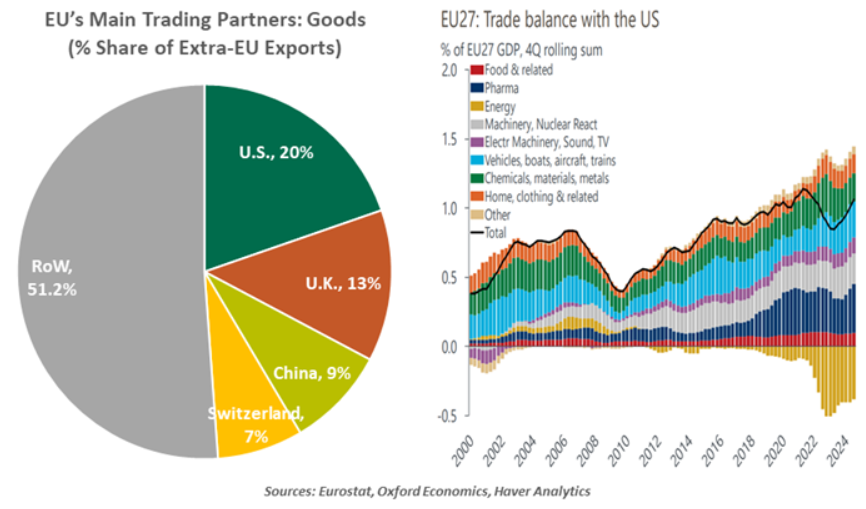
America is the top destination for European goods, contributing to a $160 billion EU surplus in 2023. Machinery, pharmaceuticals and autos account for well over half of the bloc’s shipments to the U.S.
It bears mentioning that the U.S. has a substantial ($110 billion) surplus in services trade with its partners across the Atlantic. Europe is the strongest market for America’s digital services; scientific, technical, and financial services lead the list. These activities support nearly 100,000 jobs in the United States, and might certainly be a target of EU retaliation in any trade scuffle. The net of goods and services exchanges between the U.S. and the EU is not a large number, but Washington seems fixated on merchandise flows.
Europe has more retaliatory tools up its sleeves than it did in 2018.
EU member states vary in their direct trade exposure to the world’s largest economy. Among the major ones, Germany, Italy and Ireland rely most heavily on demand from the United States. Germany is by far the bloc’s largest exporter of goods to America, representing over 30% of transatlantic product shipments.
President Trump has long complained about Europe’s higher import taxes. American goods face an average tariff rate of 3.95%, only slightly higher than the 3.5% levies applied to products that head west across the Atlantic. However, the imbalance is more pronounced for automobiles, food and beverages. The EU levies a 10% duty on imports of American cars, compared to U.S. tariffs of 2.5% on European cars. On food and beverages, European tariffs are on average 3.5% higher than those set by the United States.
The U.S. administration’s grievances with the EU do not end with trade: North Atlantic Treaty Organization (NATO) defense spending is also a sticking point. Seven EU nations failed to hit the goal of spending 2% of gross domestic product (GDP) on security last year, with several reaching the target only after a late spending push in the run up to the U.S. election. America is also pushing for a boost to defense outlays to 5% of GDP, a goal higher than the 3.5% which the U.S. currently spends.
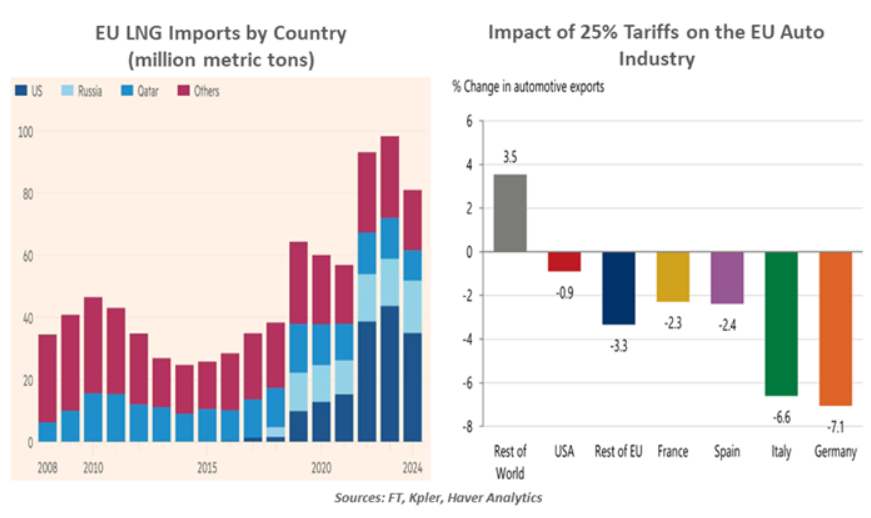
De-escalation will remain the preferred option for the EU, given the potential hit to economic activity of a full-on trade battle. There are three central options to appease the U.S.: the EU could buy more American oil and gas, it could substitute American imports for Chinese imports, and it could meet NATO spending targets by purchasing more materiel from the U.S. While certainly within the realm of the possible, all of these options could stress the delicate fiscal positions of many member states.
The messaging from the EU is hardly conciliatory, calling for a "firm response" to America’s trade policies. At the onset, Brussels’ reaction is likely to closely resemble the 2018 experience, with new levies potentially covering metals, agricultural products, chemicals and jets.
In a worst-case scenario, the EU could even deploy their 2023 Anti-Coercion Instrument. The tool enables the bloc to go far beyond a tit-for-tat tariff escalation, opening the possibility of restrictions on U.S. foreign direct investment in Europe and access to public procurement. The EU could also reintroduce the suspended digital services tax to target large tech companies.
A transatlantic trade war will be painful for both sides, but more so for Europe. The continent has fallen behind the U.S. and other major markets in economic growth and competitiveness. A 10% tariff could subtract up to 0.6 percentage points from the GDP of major economies like Germany and Italy by 2027, according to Oxford Economics.
Trump’s protectionist agenda will hit the German and Italian economies especially hard.
The German and Italian vehicle industries will be the most exposed to a 25% tariff on EU auto exports: Oxford Economics estimates a 7.1% and 6.6% decline in German and Italian auto shipments in this event. The sector is an important source of employment, supporting around 14 million jobs.
Investments will take a hit amid uncertainty, higher costs, and a weaker demand backdrop. The European Central Bank will find itself caught between upward inflationary pressure from a weaker euro and a negative growth shock. Given the risk of stagflation, the central bank will likely be forced to go below the neutral policy rate.
As the U.S. and the EU sling stones at one another, we don’t expect to see either side emerge a winner. The parable of Goliath teaches us that pride leads to failure, and that one should never underestimate an opponent. World markets can’t afford to have either of these trade titans felled.
Information is not intended to be and should not be construed as an offer, solicitation or recommendation with respect to any transaction and should not be treated as legal advice, investment advice or tax advice. Under no circumstances should you rely upon this information as a substitute for obtaining specific legal or tax advice from your own professional legal or tax advisors. Information is subject to change based on market or other conditions and is not intended to influence your investment decisions.
© 2025 Northern Trust Corporation. Head Office: 50 South La Salle Street, Chicago, Illinois 60603 U.S.A. Incorporated with limited liability in the U.S. Products and services provided by subsidiaries of Northern Trust Corporation may vary in different markets and are offered in accordance with local regulation. For legal and regulatory information about individual market offices, visit northerntrust.com/terms-and-conditions.
A message from Advisor Perspectives and VettaFi: To learn more about this and other topics, check out some of our webcasts.
© Northern Trust
Read more commentaries by Northern Trust