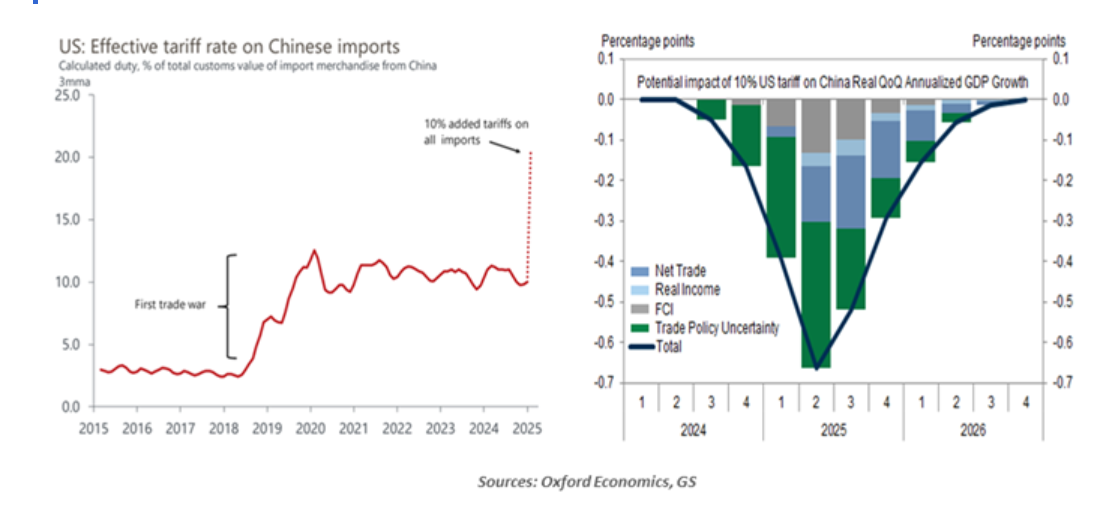
Much of the focus last week was on tariff drama within North America. But whereas the U.S. granted its neighbors a thirty-day reprieve from new restrictions, no such accommodation was made for China. An additional 10% duty has been applied to all American imports from China, including small parcels that had been covered by a de minimis exception.
China and the U.S. land initial blows in what could be an extended trade battle.
Beijing responded by raising its tariffs on energy imports from the U.S. and further limiting exports of critical metals used in American manufacturing of high-tech products. While not insignificant, analysts view the response as somewhat measured; if tension escalates, China could sanction American agricultural commodities, as they did with damaging effect in 2018.
Whereas the scale of recent threats against Canada and Mexico has been somewhat unexpected, the move against Chinese products is not. China maintains a massive trade surplus with the U.S., and has long been accused of unfair practices. Negotiation has not produced much progress: in 2020, China signed an accord with the United States under which it agreed to purchase $200 billion in additional imports over the coming two years. But by the end of 2021, China had only fulfilled 58% of its commitment.

If sustained, Oxford Economics estimates that the 10% tariff top-up against China will add 0.2% to the rate of inflation in the United States. The impact on China could be more significant: Goldman Sachs estimates a decline of up to 0.7% in the pace of real growth, an unwelcome result for an economy that is already dealing with substantial headwinds.
At this juncture, escalation may be more likely than diffusion. President Trump has said that last week’s tariffs are an “opening salvo.” China has filed a grievance with the World Trade Organization, but that body is not in a position to produce binding verdicts.
There is no outline for a comprehensive agreement between Washington and Beijing. And because the relationship between the two has both strategic and commercial elements, negotiations along this axis carry a very high degree of difficulty. The world and its markets may have to get used to a tense relationship between its two biggest economies.
Information is not intended to be and should not be construed as an offer, solicitation or recommendation with respect to any transaction and should not be treated as legal advice, investment advice or tax advice. Under no circumstances should you rely upon this information as a substitute for obtaining specific legal or tax advice from your own professional legal or tax advisors. Information is subject to change based on market or other conditions and is not intended to influence your investment decisions.
© 2025 Northern Trust Corporation. Head Office: 50 South La Salle Street, Chicago, Illinois 60603 U.S.A. Incorporated with limited liability in the U.S. Products and services provided by subsidiaries of Northern Trust Corporation may vary in different markets and are offered in accordance with local regulation. For legal and regulatory information about individual market offices, visit northerntrust.com/terms-and-conditions.
A message from Advisor Perspectives and VettaFi: To learn more about this and other topics, check out some of our videos.
© Northern Trust
Read more commentaries by Northern Trust