The Public Downside to You Living Longer
How to Fix Social Security
AI Playbook
Parkinson’s, Longevity and More
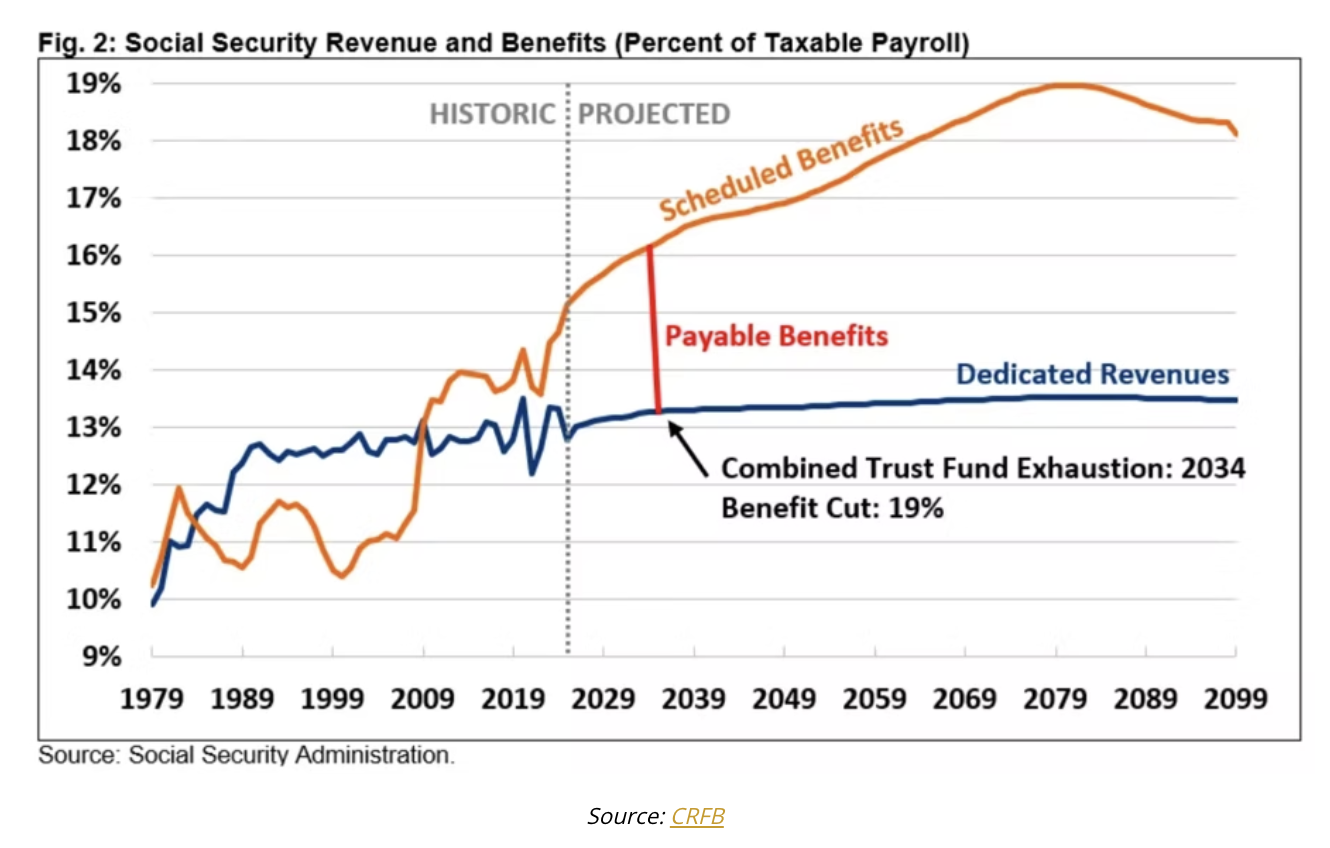
The Social Security Administration recently gave us their annual report with a few blockbuster footnotes. We all know that Social Security, as it is currently constructed, will run out of money in the early 2030s. Social Security's cost has exceeded its non-interest income since 2010. Since then, payments have been made out of the so-called trust fund. Except the trust fund does not hold cash. The money was borrowed by the rest of the federal government to cover other spending, and the government now owes it back.
In 2025, the US government borrowed roughly $180+ billion to make up the deficiency. That number of course increases every year, as more boomers retire. In 2010, when Social Security began to run a deficit, the Social Security Administration stated that the “trust fund” would be able to make payments until 2037. A few years ago, the year was brought forward to 2034. This latest report now tells us it will be 2032. See the trend here? The reasons we will discuss below, reasonable people can conclude it will be 2031 due to people living longer.
Further, buried in Table VI.F1 in the footnotes, we find that there is a $71.9 trillion unfunded liability. You would never know it from reading statements in the report. From my friend and Social Security expert Dr. Larry Kotlikoff Substack:
“Table VI.F1 also reports a $29.3 trillion unfunded liability, which the “Trustees” exclusively reference. How do you make $42.6 trillion — the difference between $71.9 trillion and $29.3 trillion — of red ink disappear? Easy. You assume that $42.6 trillion of net benefits (benefits net of taxes) that will be owed to our current and future children simply won’t be paid. This is no different from rating a bankrupt company by valuing its sales and ignoring much/most of its liabilities.”
First, that is not $71.9 trillion of future money. What the report reveals is that we need $71.9 trillion of capital invested today earning interest and/or growth if we invest in the stock market, which can’t be touched by the government, and will produce future income in order to make the payments. Since we know that is not going to happen, that means the actual taxpayer money we are going to spend on Social Security over the next 75 years will be significantly higher than $72 trillion.
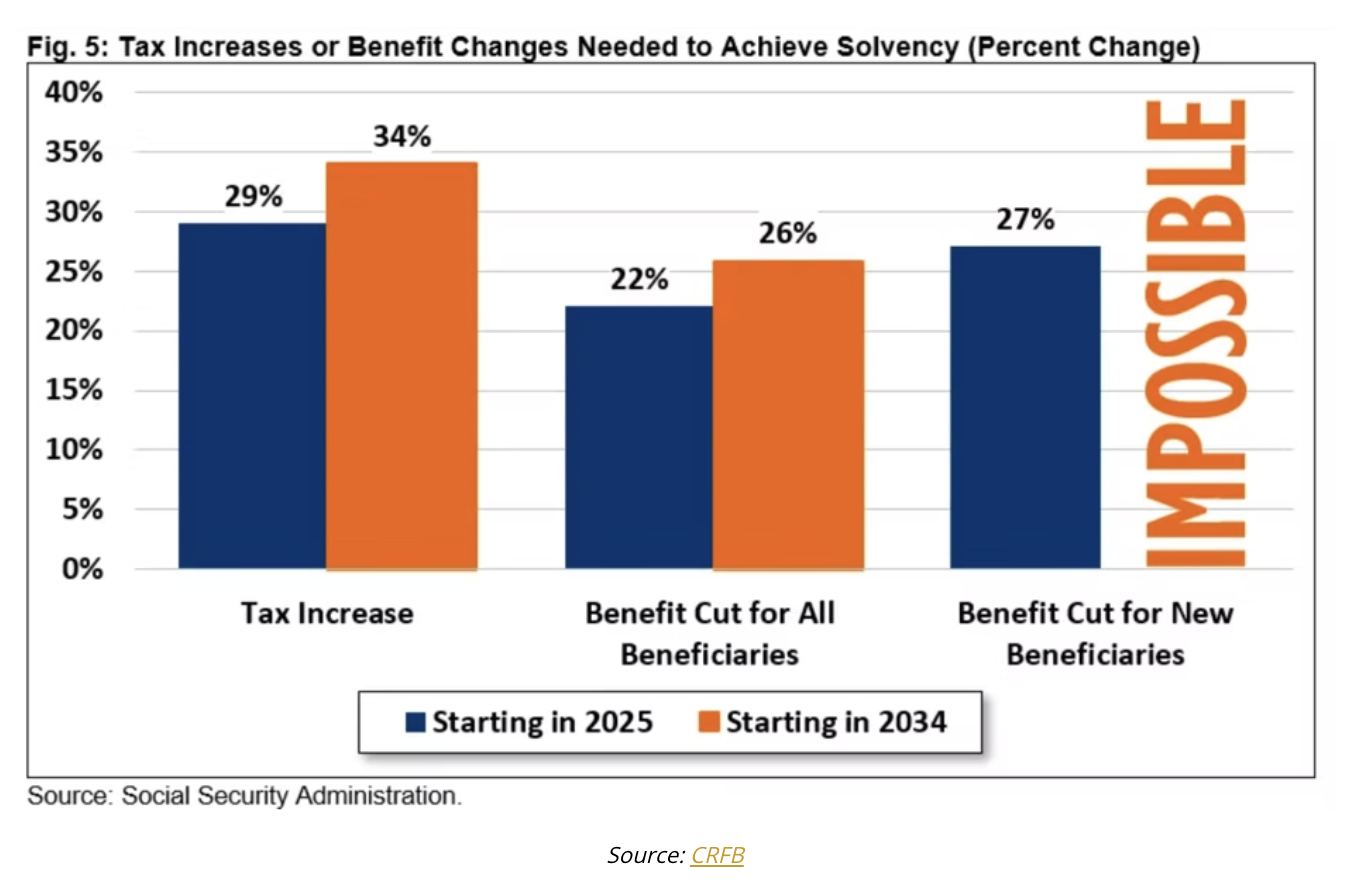
The current law was written in 1983, the last time Congress dealt with Social Security in any meaningful manner. The law states that Congress cannot borrow money to make up the shortfall in Social Security revenue. Thus, we have the fiction of the trust fund lockbox. When that theoretical trust fund is paid back, Social Security payments will have to be made from current Social Security revenue. That means a mandatory 22-23% cut in all Social Security payments in 2032 or earlier.

But it’s worse. If we wait until 2032 or 2034 to fix the problem, it will actually be a 26% cut. Or a 34% across the board Social Security tax increase. (Roughly a 4% SS tax increase.)
But it won’t stop there. That gap will get bigger every year, and so every year will see a decrease in Social Security payments.
Read more: Federal Reserve Press Conference: Lots to Unpack, but Inflation Is Not a Choice
That’s under current law. But we all know that Congress is never going to allow Social Security not to be paid. This begs a number of questions. Will the shortfall be addressed by tax increases, benefit reductions, increasing the retirement age, changing the inflation measures, means testing or some combination of these and other solutions?
To know the answers to these questions we have to ask the next question: who will be in charge of making the new law that will “fix” Social Security? Will it be a Republican Congress and White House, a Democratic Congress and White House, or a divided government? Because the problem will get fixed. And no matter what solution is finally chosen, there will be a significant portion of the country that will not be happy. The group that should be the unhappiest, our children and grandchildren who will bear the cost, will for the most part not even realize it. They might see their taxes go up, future benefits change, but it won’t be as immediate as it would be for current Social Security recipients to see.
So, the situation is dire, but it is not hopeless. But let’s first explore why it’s even more dire than the Social Security Administration tells us.
The Public Downside to You Living Longer
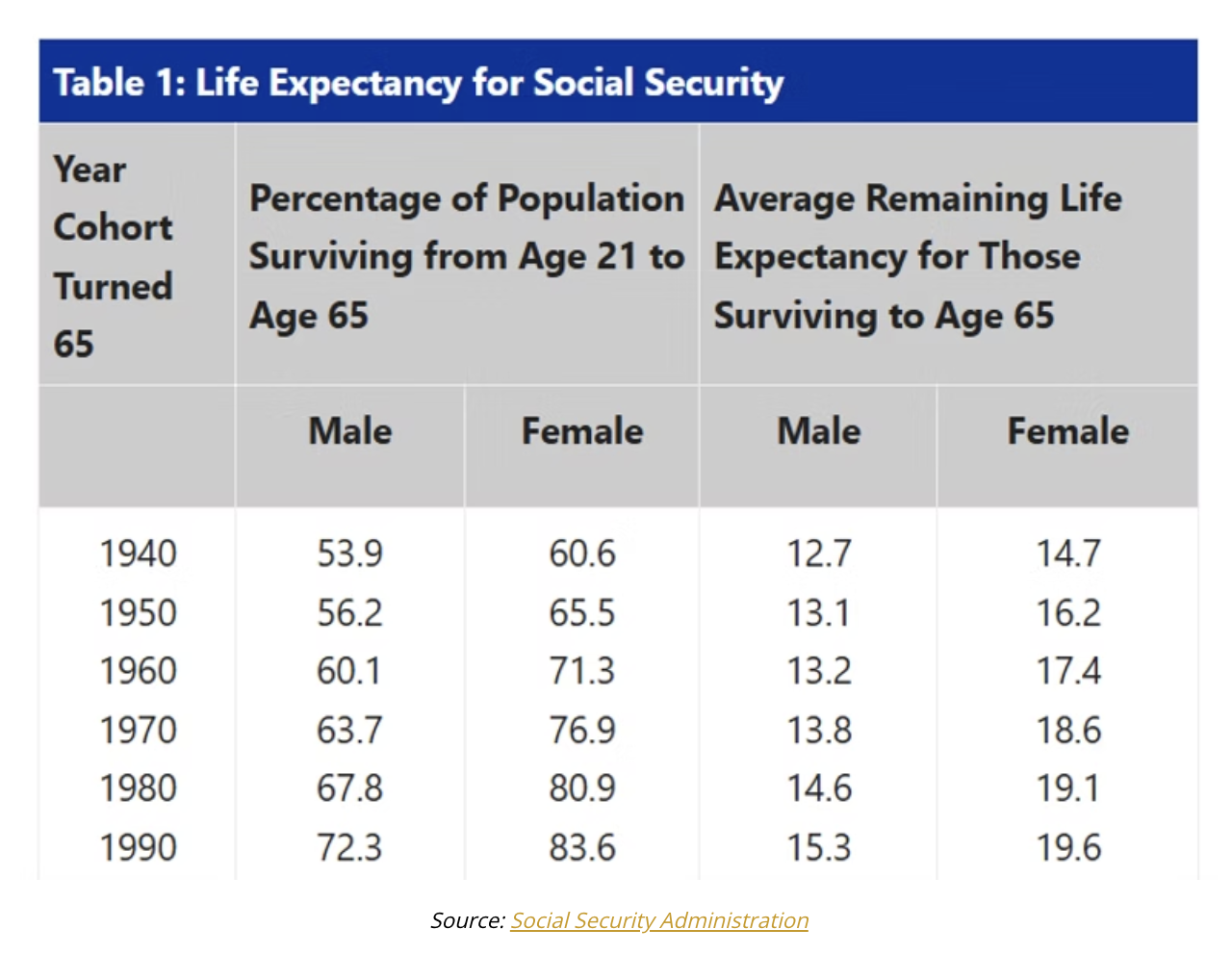
When Social Security was established, the average lifespan was 58 years for men and 60 years for women. But that was largely because of infant mortality. The majority of Americans who made it to adulthood (21) could expect to live to 65, and those who did live to 65 could look forward to collecting benefits for many years into the future. So, we can observe that for men, for example, almost 54% of them could expect to live to age 65 if they survived to age 21, and men who attained age 65 could expect to collect Social Security benefits for almost 13 years (and the numbers are even higher for women).
If today you reach the age of 65 in the US, you can expect to live an additional 19.5 years on average, which means you would live into your 80s. Specifically, men aged 65 can expect to live 18.2 more years, while women can expect to live around 20.7 more years.
The average life expectancy for someone reaching 65 is only about 7 years better than in the 1930s. That is a big difference in actuarial accounting. But the even bigger difference was the sheer number of people who were surviving 65. And with the sad exception of white middle-aged Midwest male Americans, age and survivability have improved every decade.
Good news for you: advances in medicine are going to allow Americans on average to live longer. According to Dr. Mike Roizen, GLPs will increase average age by four years and another 2 ½ years every decade after that. GLPs will become increasingly less expensive and more ubiquitous. When there is a pill (and there will be one), I will be taking a microdose because of the clear longevity and health benefits, even though I don’t need to lose weight. And there are numerous other treatments that will have health span and lifespan benefits that will allow the Boomer generation to keep drawing on Social Security.
Ironically, I get emails and conversations that talk about the problems of people living longer because of the cost of the government. So far, none of these people have offered to die on whatever their theoretical time limit is.
Mike has identified 12 scientific pathways that will allow us to live significantly longer. All are being researched. Three and possibly more of those pathways have been successful. He believes most of them will be available within 10 years. We have a lot of shots on goal. And while that is good for you as individuals, that will make the Social Security and Medicare and pension problems worse.
It’s the Social Security equivalent of the paradox of thrift: the more you save individually the better off you will be in the future, but too much savings will reduce consumer spending and thus the economy.
So, as we talk about solutions below, just keep in the back of your mind that it’s going to be worse than current projections. I’m not talking about immortality here; I’m talking about how an increase of just four years of longevity is a statistical disaster for the Social Security fund.
How to Fix Social Security
“Little did Ida May Fuller know she would find a piece of history inside her mailbox when she opened it on a February day in 1940. When the 65-year-old retiree and lifelong Republican lifted the lid of the mailbox outside the front door of her Ludlow, Vermont, house, she found a check for $22.54 from the U.S. government.
“That check dated January 31, 1940, was the first payout from the Social Security program that had been enacted five years earlier by the federal government during the Great Depression.”
Social Security retirement benefits are calculated based on your highest 35 years of earnings, adjusted for inflation, and then run through a progressive formula called the Primary Insurance Amount (PIA). The PIA is the benefit you would receive at full retirement age, before any early or delayed claiming adjustments. Starting benefits before full retirement age generally lowers your monthly amount; waiting beyond full retirement age, up to age 70, increases it. Working additional years can also raise your future benefit if those years replace lower-earning years in your covered work history.
In 1981, the maximum amount of coverage you were taxed on was $29,700 at a rate of 10.4%. In 2026, the maximum amount of earnings on which you must pay Social Security tax is $184,500. That means between the employee and the employer Social Security taxes will be $22,878 (12.4% of salary) or in the case of the self-employed they would be paying the full amount.
Full disclosure: when I first started taking Social Security in 2019 at 70 years of age I was getting $36,000 a year. Then we had high inflation. Today I receive $59,000 a year from Social Security with $2,420 deducted for Medicare. (I literally get 200 times what Ida May Fuller got back in 1940.) However, I will pay roughly $23,000 in Social Security taxes this year as I am still working, plus 85% of my benefits are taxed. That easily adds up to another $20,000. Not quite as good on a net-net basis.
It gets even worse when you realize how poorly Social Security grows. I asked Claude the following question:
Starting in 1981, let's assume contributions to a retirement account of $3000 a year, and contributions increased by $450 a year for the next 45 years. Those contributions will earn a blended 9% return on investments, 50% from the S&P 500 (11% annualized) and 50% long bonds (7.5-8% annualized). What will the final amount be in 2026?
Claude tells me roughly $4.63 million at the end of 2025.
The key numbers:
-
Total out-of-pocket contributions over 45 years: $630,000 (starting at $3K/year, ending at $25K/year) with the final annual contribution in 2026 being $23,500 or close enough for government work.
-
Investment growth: $4,001,425
-
That's roughly 6.4x your money from compounding alone
$4.6 million and 4% would yield me an annual income of $184,000 and the principal would still be growing. That is roughly 3 times what I get from Social Security today and it allows my children to inherit a rather substantial sum in the future. And the government wouldn’t have to pay for my retirement. Of course, your mileage will likely vary.
George W. Bush tried to reform Social Security, allowing for investments in the stock market and bonds, and there was almost zero support in Congress to touch the third rail. Hopefully when we decide to deal with Social Security private accounts will be on the table for future retirees and our children.
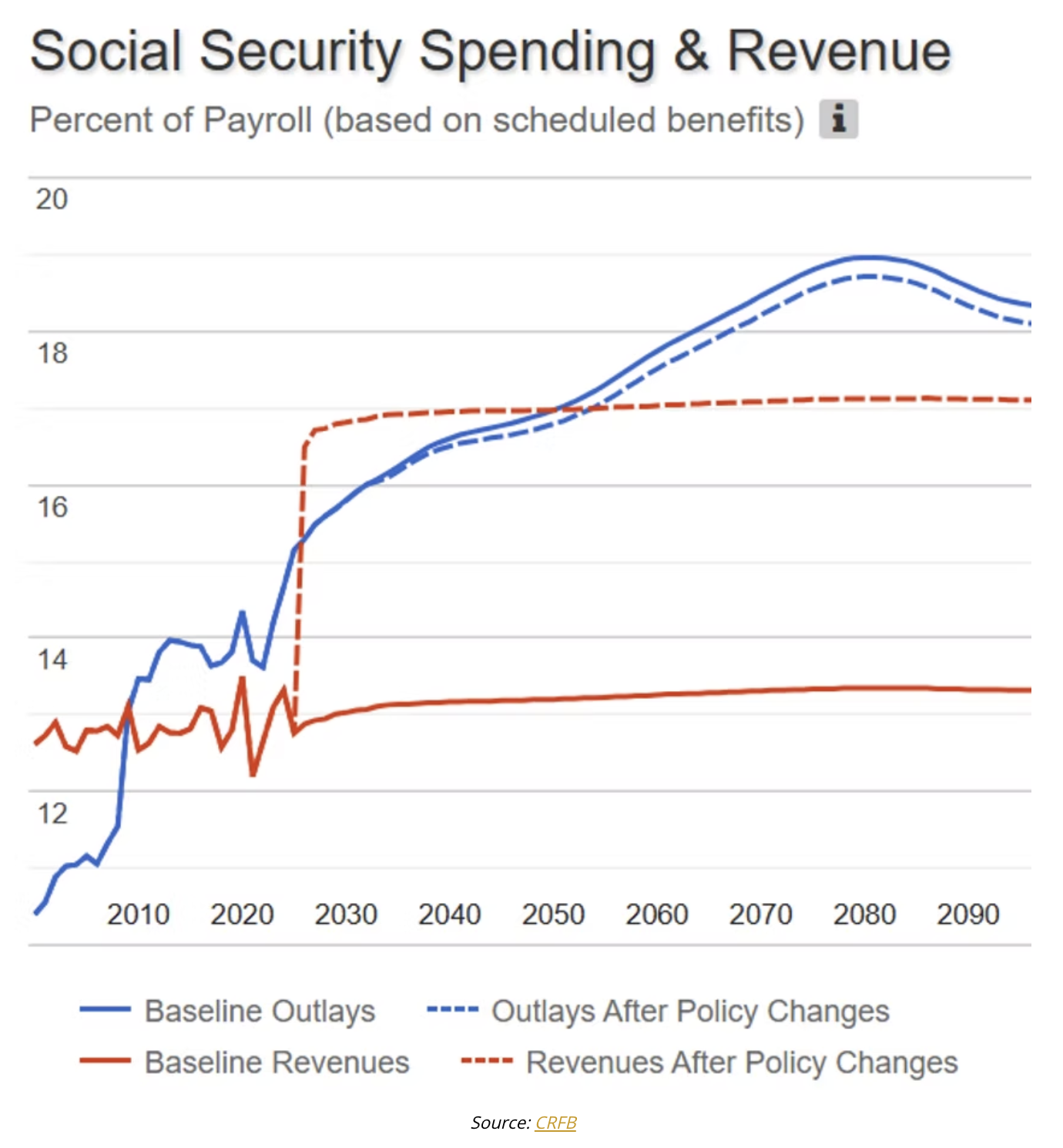
With that, the Committee for a Responsible Federal Budget just released their comments on Social Security here and for our purposes we have a handy interactive software package that allows you to see how much of an impact any potential Social Security reform would be. All graphs below come from that source:
For instance, a simple 4% tax hike to 16.4% starting today would solve 100% of the current funding problems up until 2050, and thereafter if there was actually a physical trust fund as opposed to just more debt.
Wait, John, I don’t want to pay 4% more taxes. Can’t we raise revenue another way? Yes, we could eliminate the maximum amount of salary under Social Security that would solve 68% of the problem. If you make $1 million, you will end up paying another $120,000 in Social Security. On top of your regular taxes. Which is generally 40% except in high tax states it would be 53%. Or more. Your effective tax rate would be 52% or 65%.
Taxing all benefits for retirees making over $100,000 would only stop 4% of the problem. If we applied the payroll tax to health insurance contributions, that would solve 23% of the problem.
What about dealing with the benefit side? If we raise the retirement age from 67 to 68, that would only solve 12% of the problem. Considering that we are living substantially longer and that is likely to continue, if we index the retirement age to life expectancy, that would partially solve the problem. If we raise the retirement age to 69 and then index retirement age to life expectancy that would get us 36% of the way there.
If you change the formula for the cost of living adjustment from using CPI to PCE that would get 17% of the needed funds. If you cap the cost-of-living adjustments for the top 50% of beneficiaries, that would get you 25% of the needed funds.
Means testing benefits for high earners would get you 18% of the way. If you calculate the benefits based on the highest 40 years instead of the highest 35, that gets you 16% of the way.
There are a lot of “what ifs” so I will just choose one. You can do your own if you would like.
Let’s assume we raise Social Security taxes by 1.6%. We also raise the maximum salary to cover 90% of wages which is about $330,000 in 2026. That’s a big tax increase on higher earners, especially the self-employed. Let’s raise the retirement age to 69, then index to life expectancy. Then we calculate the benefits based on the highest 40 years of earnings. That does it.
You can reduce the taxes needed by means testing benefits for higher earners, tightening the disability insurance eligibility criteria for 6% (a good idea), change the cost of living increases to PCE or Chained CPI (17%).
The trade-offs are endless. The point is that it can be done in one shape, form, or fashion. But every one of those simple adjustments comes with paying higher taxes or lower benefits. I think it’s safe to say your taxes are going to go up and the benefits for higher earners will go down.
Professor Larry Kotlikoff of Boston University has his ideas on how to fix the system. He favors a combination of high retirement age and higher taxes. This is from his recent Substack.
“My guess is they will gradually raise the full retirement age from 67 to 70 and raise the ceiling on Social Security-taxable earnings so that the same share of total labor earnings is subject to Social Security’s FICA tax. These reforms will close perhaps 20 percent of the System’s fiscal gap but roughly half of the 75-year liability. The rest of the 75-year liability will likely be covered by an increase in corporate income taxes or, perhaps, the introduction of a business cash-flow tax whose structure would replicate that of a value added tax. Again, such a “fix” will leave us with a very large and growing financial tumor.”
What would I do? I would phase in a value-added tax to cover current Social Security outlays, reduce and then eliminate Social Security taxes over time and (again over time) require a 10% investment in a retirement account each year from total income starting with everyone under 45, and making it optional for those over 45. That allows the younger generation to accumulate assets and to have enough income to more than make up for getting no Social Security. Retirement age would be immediately moved for those over 45 to 68 and then indexed every four years for longevity.
This only solves the Social Security problem, and so we would still need to deal with Medicare which could be done with some of the value-added tax (VAT) revenues. Combine the pain of a VAT (and I hate it but…) with no Social Security taxes on our children and grandchildren (which would give them a substantial income increase), reduce income taxes to get Republicans to go along with a VAT, together with reforms on spending that would require all budgets to grow less than CPI, etc., and you can actually come together with a system that would over time first get the deficit below nominal GDP and then balance the budget. Yes, we would be paying higher taxes but that’s going to happen. We just need to choose what format we want to pay higher taxes in.
AI Playbook
Which raises a question I keep circling. Social Security is funded by a tax on human paychecks. So what becomes of it in a world where AI is busy rearranging what human work is even worth?
A few weeks ago, I summarized Tyler Cowen's seven steps for protecting your career from AI, as shared at SIC. The third was simple but not easy: be proficient with the tools. Sound advice. The trouble is almost nobody tells you how.
So my team has spent the better part of a year building something to help with exactly that. It is called the AI Playbook, and it is the most comprehensive thing we have ever produced on a single subject. We asked nearly 5,000 of you last September what you wanted from us on this topic, and the answer was: stop telling us AI matters and start showing us how to use it.
This is not about letting AI run your life. Instead, it's about using it well enough that it saves you time, sharpens your decisions, and gives you a real edge. In your portfolio, your business, or your life.
The course covers what the technology is actually doing, how to separate the real investment opportunities from the bubble froth, how to put these tools to work for you, and how to talk about all of this with the people you care about. We worked with — and you'll hear from — some of the brightest minds in the field along the way, including Jacob Shapiro, Mikhail Voloshin, and Stephen McBride.
If there was ever an excuse to invest in yourself, this is it. We're offering a steep $200 discount until July 1. You can get all the details here.
Parkinson’s, Longevity and More
I remember in the 80s studying Social Security and, of course, Ross Perot. We all “knew” that Social Security was a Ponzi scheme, and I doubted that I would ever see a penny. Things do change.
Last week, I mentioned that four people have been cured of Parkinson’s disease. I had a lot of responses, mostly looking for help for themselves or family. I asked Mike Roizen to give me some details. The problem is that there are not many. It is a current phase 1 trial study which is still in process. There will eventually be 12 people in the trial. I will give you more details next week.
An update on Lifespan Edge. We have officially opened clinics in West Palm Beach and Columbia, Maryland (essentially DC). Dallas and Dorado Beach are open as well. We are booking patients in all of these locations. We are in significant discussions with well over a few dozen doctors and locations throughout the country to expand our services.
The reason for the interest? More and more, longevity experts are telling their clients the first part of their journey should begin with Therapeutic Plasma Exchange, which deals with inflammation, Alzheimer's and dementia, and other symptoms of aging as well as long Covid.
My partner in this endeavor is Dr. Mike Roizen, one of the truly leading longevity experts in the world. You can learn more at Lifespan-Edge.com. If you haven't, you really need to read our main research report. The research and other information (plus our fabulous documentary on the website) can make a real difference in your life. You can set up a discovery call to talk with our doctors about the procedure, as well as look at a lot more research.
And with that, I will hit the send button. You have a great week and I trust you’re enjoying your summer, at least if you are in the northern hemisphere.
Your amazed that I’m getting Social Security analyst,
John Mauldin
A message from Advisor Perspectives and VettaFi: Discover something new! Click here to register for our upcoming webcasts.
© Mauldin Economics
More Closed End Funds Topics >