Investors often view commercial real estate (CRE) through the narrow lens of the office sector. We think this office-only focus understates how broad the asset class is and its potential. Offices may face well-documented headwinds, but many other CRE segments appear more resilient.
CRE spans a diverse range of asset types, including multifamily housing, industrial and logistics, hospitality, and niche sectors investors can access through both public and private markets. At a foundational level, we think CRE credit offers a distinct profile within fixed income. Loans are secured by buildings or properties that generate income and have their own value.
Unlike intellectual property or other intangible assets, we think real estate is less susceptible to being displaced by technology. Advances in artificial intelligence, for example, aren’t likely to stop people from living in apartment buildings or using warehouses for storage. In our view, that’s why much of this tangible collateral keeps its value—even in volatile markets.
CRE Deals Often Have Sizable Buffers for Lenders
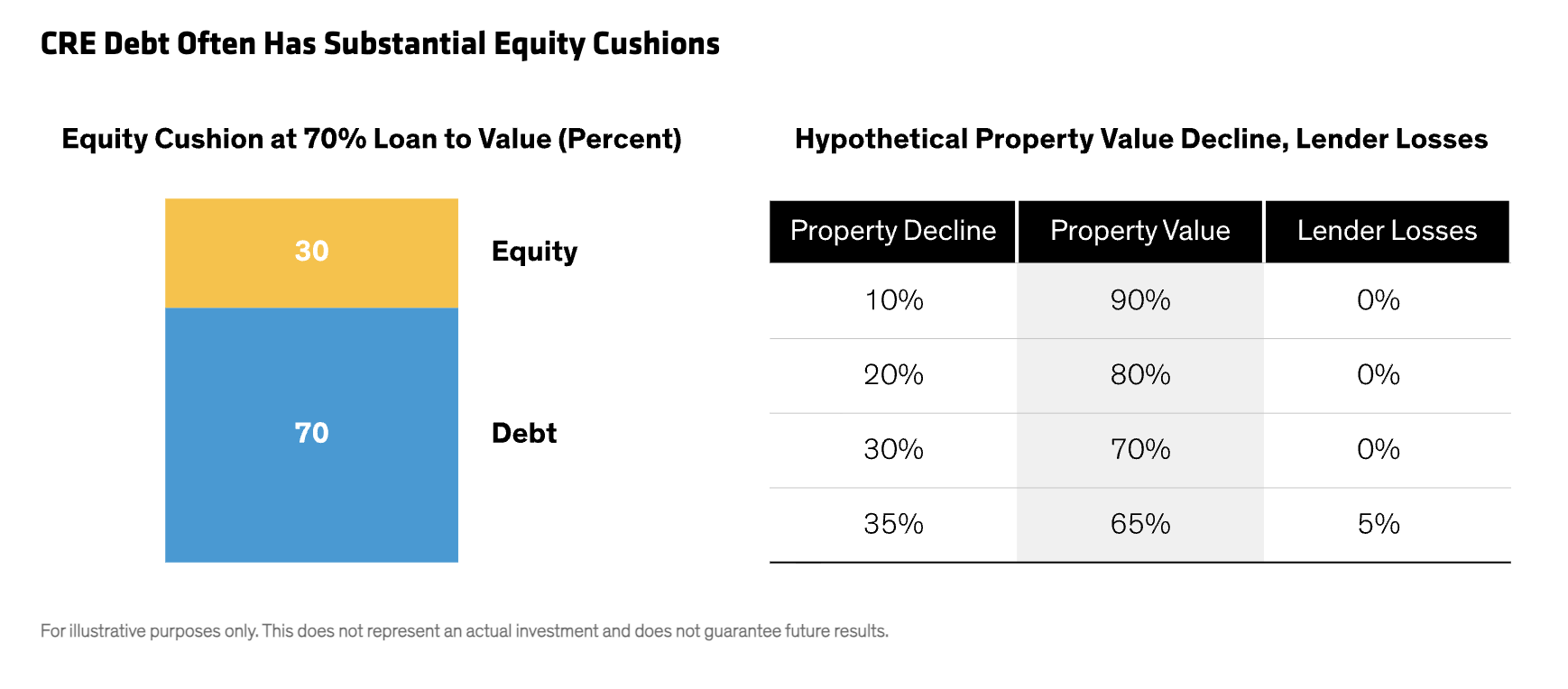
The structural framework underpinning these investments is equally important. Real estate deals typically include substantial borrower equity that’s subordinate to the debt used to finance them. This equity creates a sizable buffer for credit investors in case the asset’s value declines.
These buffers are key, because, if property values decline enough, lenders take losses at a certain point. In the example below, the property’s value would have to decline by more than 30% before lenders would face losses (Display). This buttress enables credit investors to make generating income and having downside mitigation a priority instead of relying on the property value rising.

What’s more, we think commercial real estate debt’s’s combination of seniority, contractual income streams and physical collateral can foster durability across economic cycles. For investors, that resilience can shift the emphasis away from trying to time the real estate market. In our view, it also helps explain the historical staying power of CRE credit, even in uncertain environments.
Read more: How Bond Optimizers Can Work More Optimally—and Why It Matters
A Transition, Not Decline, for Commercial Real Estate
We think the CRE landscape is in a period of transition—not broad-based contraction. Capital markets have recovered from their 2025 lows, thanks in part to increased participation from private credit providers, insurance investors and structured-products markets.
And while many office properties face challenges from changing work habits and what employers and employees want from a modern office, that doesn’t add up to broad-based decline. Asset quality and location matter. What’s more, developers are increasingly adapting unwanted offices for other purposes.
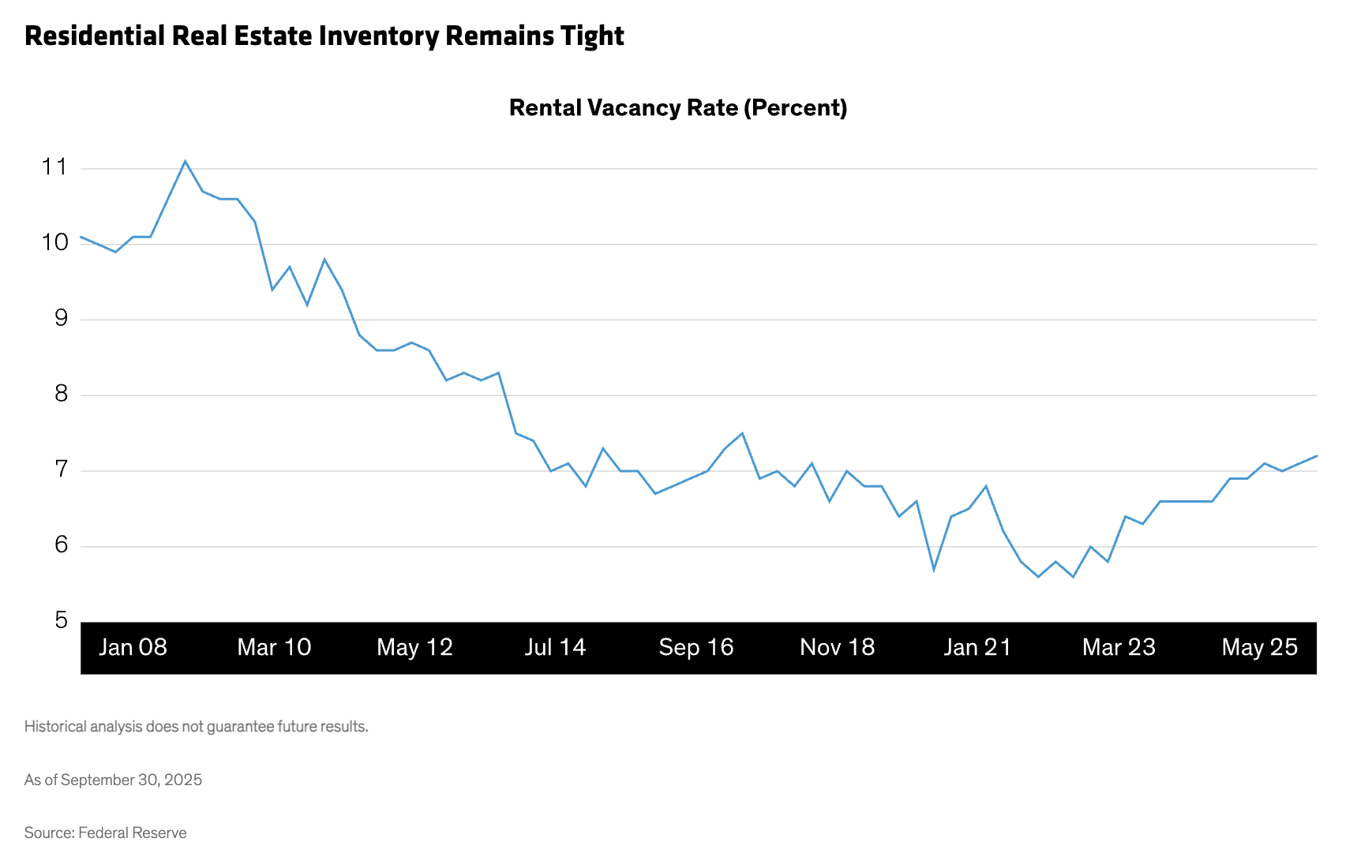
In sectors beyond office space, the CRE picture is brighter. Demand for industrial property remains stable, while high-quality hotels and resorts continue to outperform. Meanwhile, high real estate prices and limited supply are boosting demand for multifamily residential real estate, brightening that sector’s medium-term outlook. Slower home construction activity is likely to keep a lid on excess inventory (Display), and support home prices and rental values—even in a more volatile interest-rate environment.
Convergence Underway Across Public, Private Markets
Investors have historically accessed CRE credit exposure through either private lending or public market vehicles such as commercial mortgage-backed securities (CMBS). Increasingly, private and public channels are converging, creating a more flexible and dynamic investment landscape.
In private markets, investors can originate or provide capital directly to borrowers, often capturing a premium for sourcing, loan structuring and illiquidity. These investments typically offer structural features and attractive income profiles that may reduce mark-to-market volatility.
Public markets can present compelling opportunities during periods of dislocation. As we see it, recent volatility has been driven more by macro uncertainty than by deteriorating fundamentals. That disruption could create attractive entry points for investors.
Single Asset Single Borrower: Best of Bold Worlds?
Positioned between public and private segments is the growing single asset single borrower (SASB) market, where transactions have elements of both public and private investment, including:
- Access to institutional assets, either individually or through a diversified portfolio
- Simpler loan structures than the more tailored structures in private markets
- Liquidity and price transparency associated with public securitized markets
With the potential to combine asset-level underwriting discipline with market-based liquidity, we think SASB deals broaden investors’ toolkits.
Rather than viewing public and private markets as siloes, portfolios can allocate dynamically based on relative value. This may mean emphasizing private lending when spreads are lower and leaning into public markets when volatility creates price dislocations. With SASB structures, meanwhile, investors can access high-quality assets with attractive structures and liquidity.
A Diverse Opportunity Set
Commercial real estate isn’t monolithic, and it’s not defined by the office sector alone. It’s a diverse asset class that spans public and private markets, offering exposure to income-generating physical assets with conservative capital structures that may enhance risk-mitigation potential.
For investors, we think the commercial real estate market adds up to a compelling set of opportunities. Periods of uncertainty can obscure these dynamics. But these are often the moments when relative-value dynamics are most attractive.
The views expressed herein do not constitute research, investment advice or trade recommendations, do not necessarily represent the views of all AB portfolio-management teams and are subject to change over time.
Scott Greenfield is a Principal and Senior Vice President for AB CarVal, where he is responsible for managing commercial real estate loan and securities investments in North America.
Brian Resnick is a Director and Senior Investment Strategist for Alternatives.
A message from Advisor Perspectives and VettaFi: Discover something new! Click here to register for our upcoming webcasts.
© AllianceBernstein
Read more commentaries by AllianceBernstein