Technology stocks have continued to benefit from enthusiasm over the transformative potential of artificial intelligence (AI). Yet many investors are concerned that share prices and valuations may reflect overly exuberant earnings expectations. We asked several AB equity portfolio managers to share their thoughts and investing perspectives on the sustainability of AI-driven enthusiasm.
Are we in an AI bubble?
Shri Singhvi, Chief Investment Officer—Strategic Equities: There’s a big difference between an AI bubble and a stock market bubble. AI is most likely a generational disruption and may turn out to be one of the biggest we have seen in our lifetimes. Yet the use cases for AI, how widely it is deployed and the associated return on investment (ROI) are probably in the first or second innings. Meanwhile, the AI and AI-enabler stocks might be in much later innings. That is the challenge equity investors must grapple with. This so-called stock market bubble is not just AI centric; it’s fueled by excess liquidity from monetary and fiscal policies and goes far beyond AI. Most risk assets, including cryptocurrencies and meme stocks, are being bid up even though they have nothing to do with AI. That said, equity investors face a precarious choice: Is it better to be early or late should the market excesses correct significantly? Timing is hard and the cost of being wrong is high on both sides.
Lei Qiu, Chief Investment Officer—Thematic Innovation Equities: I think it’s probably too simple to label the entire AI revolution as a bubble. Historically, we often underestimate the long-term impact of transformational changes while being overly optimistic about short-term revisions. Disruptive changes tend to happen suddenly and dramatically, but investors usually expect change to follow a steady, linear path. This mismatch can trigger violent moves in sentiment and stock prices. When it leads to a mispricing of companies with highly levered business models, “bubbles” will burst.
The internet bubble burst because few business models could be monetized at the time. Streaming, social media and the proliferation of mobile apps didn’t exist when the heavily leveraged networking companies failed. However, the initial infrastructure investments—from undersea cable to fiber optic networks—created far too little capacity to support the number of users and the amount of traffic we have today. I think investors should keep these historical lessons in mind when considering AI today.
Lastly, we should also recognize that when supply for components and power supply is so tight, there will be price gouging and double ordering. Over the longer term, the big question is which companies can maintain pricing power and generate profit pools. At some point, it will no longer be a “rising tide that lifts all boats” for anything that mentions the word AI. The short answer is that some companies are true AI winners and deserve the market cap, while many are not. So it’s a good time to be an active investor.
John Fogarty, Co-Chief Investment Officer—US Growth Equities: The AI narrative drove the US equity rebound in 2023–24 after a sell-off in 2022, particularly for the tech titans. AI has continued to dominate equity performance in 2025. Beyond NVIDIA, more infrastructure providers have been catalyzed and rewarded by the increasing spend on data center build-out. It is more than hype, however, as the narrowness of the market can partially be explained by the substantial contribution of this capex cycle on GDP. But the question whether these trends can be sustained looms large.
The continued parabolic spending intention rests on two critical assumptions: 1) AI training will continue to scale with increased compute to achieve artificial general intelligence (AGI). 2) AI inference will generate sufficient revenues to support the capital build-out in years to come. A challenge to either assumption that even just slows capital spending could cause a “bubble burst” equity market correction. That, in turn, could cascade into a negative wealth effect, given the fragility of market concentration that has coalesced around the AI narrative.
Jim Tierney, Chief Investment Officer—Concentrated US Growth: I agree with John about the market fragility. Think about the recent announcement that NVIDIA would give $100 billion to OpenAI—a large customer—so it can buy more graphic processing units (GPUs). This circular deal raises big questions. It reminds me of Pets.com and the internet bubble of the late 1990s. Here, OpenAI is the big spender, yet it has had negative free cash flow for years. So the risk is that if the market pulls the funding rug, the AI capex spending frenzy could cool quickly. Everything touching the AI space is predicated on capital spending climbing for years. But that story can be disrupted from many directions, such as more power-efficient chips, lower incremental model gains, power constraints, limits on AI-productivity improvements and overcapacity. We believe there’s no free lunch in AI land right now.
Thorsten Winkelmann, Chief Investment Officer—European and Global Growth Equities: In my opinion, there are some differences to former bubbles like dot-com. All the major listed US, European and Asian companies involved in the AI narrative (think NVIDIA, Microsoft, Meta Platforms, ServiceNow, ASML, Applied Materials and Taiwan Semiconductor Manufacturing) are profitable, trade on explainable valuations (perhaps excluding NVIDIA) and are making a positive return on their AI investment at the moment.
The bubble factor is more relevant to some key unlisted AI companies (OpenAI, Anthropic, Thinking Machines Lab, Z.ai, etc.), where valuations look absurd, in my opinion. The problem is, as Jim pointed out above, these companies are amplifying spending on AI infrastructure, which can be called circular when financed by the vendor. This pumps up order books and revenue expectations of the listed companies mentioned above.
It seems as if we are in bubbly territory, but I’d argue that it’s less inflated than what we saw in the dot-com era.
Kent Hargis, Chief Investment Officer—Strategic Core Equities: I think we are likely still in the early stages of a bubble. We’re witnessing an enormous AI-beneficiary rally in the market, driven by both quality mega-caps and low-quality speculative stocks. We’re also seeing an enormous amount of capital flowing into private companies (OpenAI valued at $500 billion; xAI and Anthropic each valued in the $150–$200 billion range). This initial capex phase of the AI infrastructure boom was largely funded by hyperscalers with strong cash flows and balance sheets capable of supporting massive capital outlays. However, the next phase is increasingly being fueled by less stable sources—including debt-financed expansion, inflated private company valuations, circular financing arrangements and risky private credit structures. This dynamic is adding fuel to speculative excesses and amplifying systemic risk as capital becomes less disciplined and more return-chasing. AI is a transformational technology, but based on our projections, technology capex is likely to surpass levels previously seen only during the dot-com boom. These and other notable red flags suggest that while the timing is uncertain, a correction at some point seems likely.
How can investors gauge real AI potential versus hype?
John: AI has transformed computer programming and transitioned digital advertising analytics from machine learning. Beyond that, there is more promise than irrefutable commercial successes fueling certain ROI adoption. As active managers, especially given our constructive view on this new compute paradigm, we are excited to identify successful AI adoption that improves productivity and sustainable profitability. However, these success stories have not progressed linearly, which may point to slower adoption or the need for incremental model improvement. While the clock ticks, the market continues to reward AI spending intent rather than AI adoption.
Jim: To identify further AI upside, investors must look at 2026 capex growth, emerging revenue models and real-world cost/benefit stories from management teams.
Lei: I’d argue that the “DeepSeek” moment in early 2025 marked an inflection point in adoption of AI inferencing, and we’re now seeing accelerated AI output. What NVIDIA is doing with OpenAI is simply funding a disruptor to challenge very well-funded tech giants’ dominance of their respective markets, which forces a faster pace of adoption of accelerated compute. We’ve always maintained the view that AI is as offensive as it is defensive when it comes to the mega-cap tech companies, as they simply cannot afford not to spend.
Kent: The underlying technology must continue to advance to justify the rising intensity of AI-related capex. Large language models have improved at a remarkable pace, primarily by scaling compute during training. More recently, post-training techniques and reasoning models have been especially promising. Over the long run, sustained returns will require broader adoption of AI across use cases that meaningfully replace human labor. We’re already seeing early traction in areas such as coding, writing assistance, content creation and customer service. We’re monitoring these advances closely as leading indicators of potential ROI on the vast capital being deployed. If the rate of progress slows, the AI trade will inevitably correct.
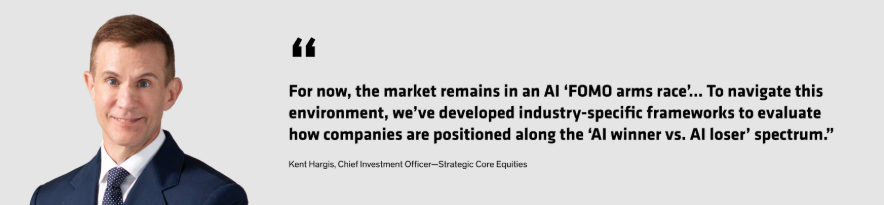
For now, the market remains in an AI “FOMO arms race,” exemplified by comments from Mark Zuckerberg and other prominent technology executives that the cost of underinvesting outweighs the cost of overinvesting. To navigate this environment, we’ve developed industry-specific frameworks to evaluate how companies are positioned along the “AI winner vs. AI loser” spectrum. While timing cycles remains inherently difficult, we believe a bottom-up approach focused on identifying true AI winners offers significant alpha potential.
Shri: While it is true that early AI pilots have had mixed results, it’s too early to call AI hype. Those disappointments reflect a lack of corporate readiness for AI as well as the early stage of AI capabilities. There are also some big initial success stories, like in coding, where companies have seen efficiency gains between 25%–40%. Customer service is another very successful use case. And in healthcare, cycle times and costs of managing and filing claims have been reduced dramatically. Even bigger use cases are inevitable and can never be known beforehand. For example, the iPhone was launched in 2007, but Uber wasn’t even founded until 2010 and not widely used until much later. So with AI, we haven’t come close to imagining what use cases might be possible with time.
We do know that every company and industry will have to adopt AI, if not for offense, then for defense. No one can afford to fall behind because catching up will require overcoming tremendous amounts of technology debt and significant competitive disadvantages. Finally, AI’s potential goes way beyond white-collar job efficiencies. We’re already seeing nascent physical AI applications with robots and autonomous operations like driving. The most important metrics to watch here are models and applications continuing to improve, 2) token costs continuing to get cheaper, and 3) not watching the average ROI on AI but the ones for companies that are leading the charge and have cracked the code on harnessing AI—because if they do, their competitors have no choice but to follow.
Is there a way for equity investors to capture AI potential without taking excessive risk
Kent: In any bubble, speculative and lower-quality companies often outperform in the short term. But as speculative excesses continue to build across parts of the AI ecosystem, it’s increasingly important to stay disciplined and focus on quality. I think the most effective long-term approach is to identify companies that offer both meaningful upside from AI exposure and the risk reduction that comes from strong fundamentals in their core businesses. There’s always risk in any investment—particularly in a rapidly evolving growth theme like AI—but our strategy’s objective is to deliver attractive risk-adjusted returns while minimizing downside risk. That means investing in durable, high-quality businesses capable of compounding value over time, rather than chasing the transitory gains of speculative AI stories.
Shri: Investors need a nimble and basket approach to investing in AI while avoiding concentrated bets, as it is nearly impossible to call winners and losers early on. There are lessons to learn from the dot-com boom. In 1999, if you were investing in dot-com winners, you would have bought AOL and Yahoo—two early movers that were eventually disrupted. The eventual big winners, like Google, Meta and Apple, weren’t obvious early on. That’s why it’s critical to be nimble in a changing landscape and to be active and selective in approaching AI investing. I think a prudent approach is to get broader exposure to three baskets of AI: direct AI beneficiaries, indirect AI beneficiaries and AI users.
AI will be highly disruptive for many industries in which current leaders will face the innovator’s dilemma. So it’s equally important for investors to avoid companies that will be disrupted by AI, including certain types of software companies, IT services groups and staffing companies.
Lei: Historically what “bursts” a bubble is usually the debt market, when a company fails to pay interest owed because it is strapped for cash. Given the players involved, I think it’s too early to call it a bubble that is about to burst. In the meantime, though, we should monitor developments in the private credit market. If there is a bubble, I think it will begin to show there first.
John: There are noted differences between this infrastructure build versus the telecom internet build around 2000, namely less debt financing so far and satisfying immediate demand versus the dark fiber build-out at the time. Nonetheless, capex intensity to current revenue for the hyperscalers has doubled, just like the internet boom. Capex cycles peak, as do associated valuations, regardless of a benign or steep fall off in spending. Looking beyond how this picks-and-shovels phase ends, like the eventual dot-com era, I think it’s likely that companies capitalizing on the application of AI have not yet emerged as market leaders. Identifying those adopters will generate alpha, regardless of the duration and ROI of the build-out.
Thorsten: Those are all valid observations. That said, our strategy focuses AI-related investments on the “picks and shovels” rather than the gold diggers. When investing in the AI enablers, we always pay attention to which part of future revenues is explained by “regular” business and how much is AI hype that might be canceled or postponed tomorrow.
The views expressed herein do not constitute research, investment advice or trade recommendations and do not necessarily represent the views of all AB portfolio-management teams. Views are subject to revision over time.
References to specific securities are presented to illustrate the application of our investment philosophy only and are not to be considered recommendations by AB. The specific securities identified and described do not represent all of the securities purchased, sold or recommended for the portfolio, and it should not be assumed that investments in the securities identified were or will be profitable.
A message from Advisor Perspectives and VettaFi: Discover something new! Click here to register for our upcoming webcasts.