Companies today face intensifying pressures—from surging electricity demand and water shortages, to shifting policies and regulations, to a rise in megamergers. How companies handle these pressures matters to their bottom lines—and to shareholder value. The challenge for investors is determining which businesses will adapt and thrive, and which will struggle. In our view, applying a stewardship lens can help.
That means assessing how companies manage the fundamentals that drive long-term value: resource use, supply chain practices and governance. We believe that companies that conserve water and energy, demonstrate sophistication around their supply chains and maintain corporate discipline are better positioned to protect margins and preserve capital. That discipline can translate, in our analysis, into more resilient earnings and stronger shareholder outcomes over time.
When Drought Hits Chipmakers
Taiwan’s semiconductor industry is a case in point.
Taiwan is home to dominant global semiconductor chipmakers that require substantial amounts of water—particularly the ultrapure variety used in the chip-manufacturing process. But Taiwan has a long history of restricting water consumption during drought conditions, making the country’s chipmakers vulnerable to environmental disruptions.
In 2021, Taiwan endured its worst drought in decades, leading to water rationing and production cutbacks. In many cases, manufacturers were ordered to reduce water consumption by up to 15%, prompting some firms to truck in water and drill wells just to keep factories running.
As droughts become more frequent, we expect Taiwan’s semiconductor industry to face sustained climate-related water stress, even as chip demand rises.
Rising energy demand is another concern. The International Energy Agency projects that worldwide electricity demand will climb 3.3% in 2025, followed by 3.7% in 2026—driven in part by power-intensive artificial intelligence (AI) data centers.
Against this challenging backdrop, firms have an opportunity to materially differentiate themselves. Our analysis shows that companies with thoughtful water and energy conservation programs have more effectively navigated environmental constraints than their competitors—resulting in lower costs, greater operational efficiency and higher profits.
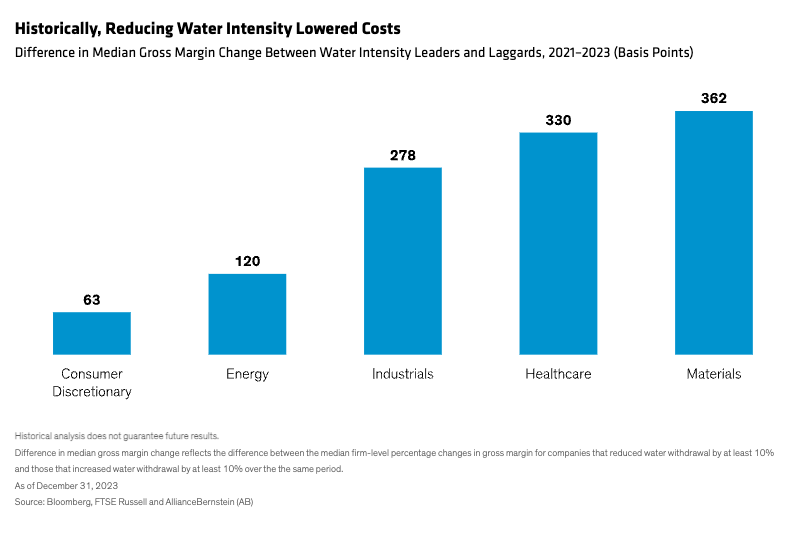
From 2021 through 2023—the most-recent period with robust data—we found that companies that reduced water intensity (water volume per unit of production) by 10% or more achieved median margin expansion across sectors up to 362 basis points (bps) greater than peers that increased water intensity by 10% or more (Display).

Supply Chains Under Strain
COVID-19 highlighted the vulnerabilities of global supply chains. Since then, we’ve seen a broad realignment, with companies reshoring some operations, diversifying suppliers and building new regional hubs. These shifts have unfolded against a backdrop of rising policy uncertainty.
For example, the Biden administration’s AI Diffusion Rule—set to impose tiered restrictions on AI chip exports from the US—was scheduled to take effect in May 2025. Just days before implementation, the Trump administration rescinded it and issued new guidance limiting the use of advanced Chinese chips and imposing fresh export controls on certain technologies.
Episodes like these, along with a spate of new tariffs, illustrate the recent volatility of trade and export policy. In our view, companies with concentrated supply chains are especially exposed, while those that diversify sourcing geographically are better able to adapt.
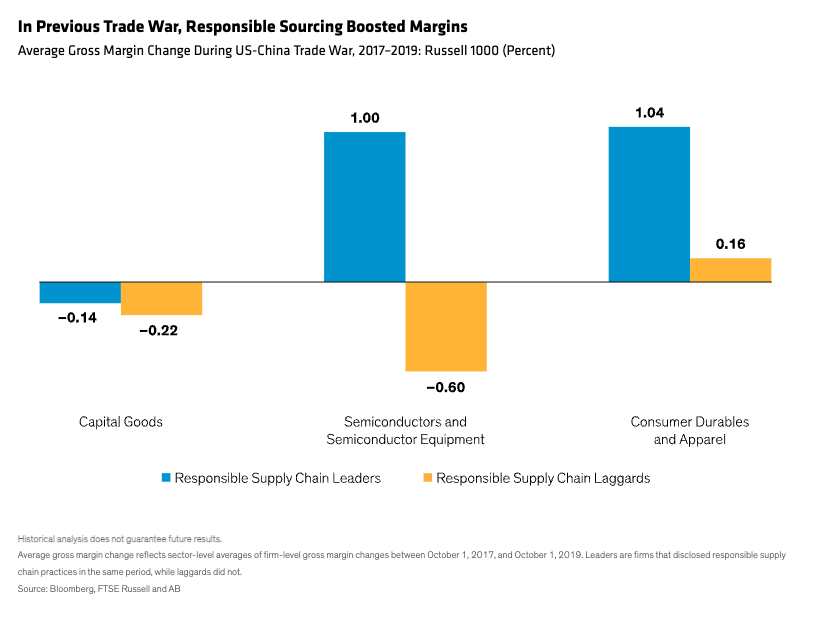
Beyond where supply chains are located, companies’ ability to respond effectively to supply chain shocks also matters. Our research shows that firms that set strong sourcing standards generated bigger profits than their peers during the US–China trade war of 2017–2019. Export-oriented companies with practices such as monitoring safe working conditions achieved gross margins up to 160 bps higher than peers without those practices (Display). In today’s volatile geopolitical climate, we believe this kind of gap could widen.
We believe the ability to set sophisticated sourcing standards indicates capable supply chain management. In our view, it’s a useful barometer for investors to gauge which companies may be best positioned to manage policy volatility.
Board Oversight and Deal Discipline
A stewardship lens should also include board oversight—a key hallmark of good governance. Merger and acquisition (M&A) activity is gaining steam in a less stringent regulatory environment, leaving fewer external constraints on management decisions. Weakened external guardrails underscore the importance of effective corporate boards that ensure alignment between a company’s management and its shareholders.
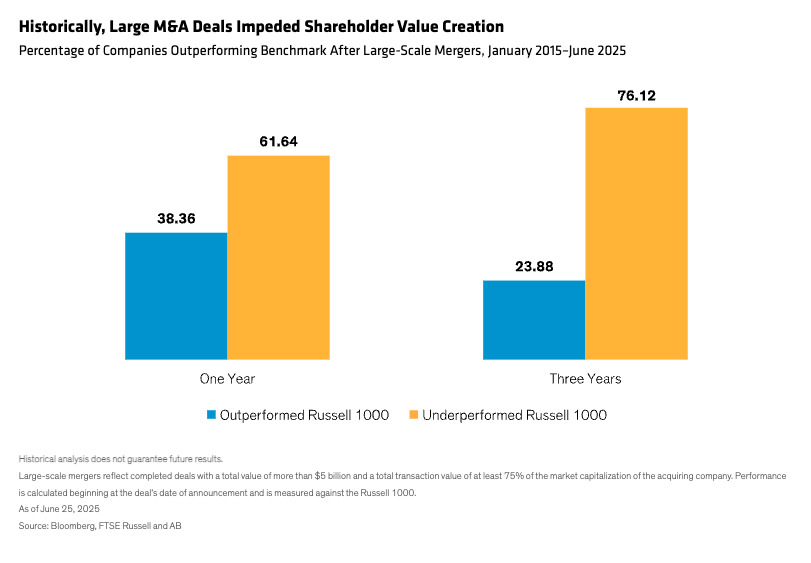
Typically, one of the biggest disconnects between management and shareholders is large-scale merger and acquisition (M&A) activity. In our analysis, many large deals benefit the executives that initiate the deals at the expense of shareholders. In fact, we found that large, transformational deals were followed by underperformance roughly two-thirds of the time. Of the 74 companies involved in M&A deals larger than US$5 billion since 2015, 51 underperformed their benchmark during the ensuing three-year period (Display).
In our analysis, companies with strong governance structures tend to demonstrate greater M&A discipline—helping to preserve capital and shareholder returns in the process. As regulatory barriers to large-scale M&A ease, we believe strong governance could help companies avoid value-destroying M&A.
The link between corporate stewardship and shareholder value is often overlooked, but ignoring it may have material ramifications, in our view. In today’s uncertain environment, we think a stewardship lens offers investors a clearer way to separate leaders from laggards.
The authors would like to thank Michael Crovetto, Research Analyst, for his invaluable contribution to this piece.
The views expressed herein do not constitute research, investment advice or trade recommendations, do not necessarily represent the views of all AB portfolio-management teams and are subject to change over time.
A message from Advisor Perspectives and VettaFi: Discover something new! Click here to register for our upcoming webcasts.
© AllianceBernstein
Read more commentaries by AllianceBernstein