Takeaways
-
S&P 500® EPS growth expected to come in at 4.8% for Q2, which would be the lowest growth rate since Q4 2023.
-
Banks unofficially kick off the season when JPMorgan Chase, Wells Fargo and Morgan Stanley release results on Tuesday
-
Q2 peak earnings season falls between July 28 - August 15
As the second quarter earnings season kicks into gear, Wall Street analysts are forecasting modest earnings growth of 4.8% for companies in the S&P 500. According to FactSet, this would be the lowest YoY growth rate since Q4 2023 (4.0%).1 Despite potentially posting the lowest growth rate in six quarters, 4.8% would still reflect resilient corporate performance, particularly in the technology sector, against a backdrop of persistent macroeconomic headwinds, including elevated interest rates, a cooling labor market, and ongoing trade policy uncertainty.
Early Earnings Reports Off to a Mixed Start
While many associate the big bank reports with the unofficial kick off of earnings season, it’s important to note that we’ve already gotten results from 20 S&P 500 companies that can give us clues as to how the season will progress.
Those early reports have painted a mixed picture of the US economy and the health of corporate America. Early standouts include Micron and Delta, while less impressive results came from FedEx and Nike.
Micron reported a significant beat on both revenue and earnings, driven by surging demand and pricing for its memory chips, yet another sign that AI demand is back in full force and not cooling anytime soon. However, their consumer segment told a different story. While the AI story was stellar, management noted that the markets for traditional memory used in PCs and smartphones remain lackluster, showing a clear divergence in technology spending. All-in guidance was bullish, with Micron projecting continued strength in pricing and AI-related demand.2
Delta Airlines was one of the few consumer related names to report thus far to show robust demand. After a lackluster Q1 report, and a downgrade to expectations, everything is coming up roses in Q2. The international carrier reported earnings and revenue that topped analyst estimates, showcasing the continued strength in travel demand. The airline saw increasing demand for summer travel, particularly in its premium cabin and transatlantic routes. Consumers are still prioritizing experiences and travel over goods.3
On the flipside, Nike and FedEx didn’t paint as robust a picture of the US consumer. FedEx offered a cautious but stabilizing view of the second half. The logistics giant delivered earnings per share that narrowly beat analyst expectations, while revenue was largely in-line with forecasts. The primary driver of those results was massive cost-cutting. FDX saw continuing volume weakness in overall shipping volumes, but particularly in their higher-margin Express segment. Management provided a guarded outlook for the upcoming fiscal year, signaling expectations for continued slow global economic growth.4
Nike presented an even more challenging picture, reflecting the pressures on the global consumer. Nike missed revenue expectations, although earnings per share were slightly ahead of consensus due to disciplined cost management. The revenue miss was driven by softness in North America and a mixed recovery in China. Management spoke of a more "promotional environment" to clear through inventory, signaling weaker consumer appetite for full-price discretionary goods. As such, the footwear giant provided disappointing guidance for the upcoming quarter and full fiscal year, citing macroeconomic uncertainty and foreign exchange headwinds.5
Q2 Sector Leaders and Laggards
A significant theme for the quarter is the expected divergence in performance across different sectors. The technology and communication services sectors are once again poised to be the primary drivers of overall earnings growth for the index. The continued demand for artificial intelligence and cloud computing is expected to fuel strong results for the Mag 7 and other large-cap tech companies.
Conversely, the energy sector is anticipated to be a significant drag on S&P 500 earnings, with analysts predicting a year-over-year decline in profits. This is largely attributed to comparisons with a stronger period of energy prices in the previous year.
On Deck this Week - Big Banks
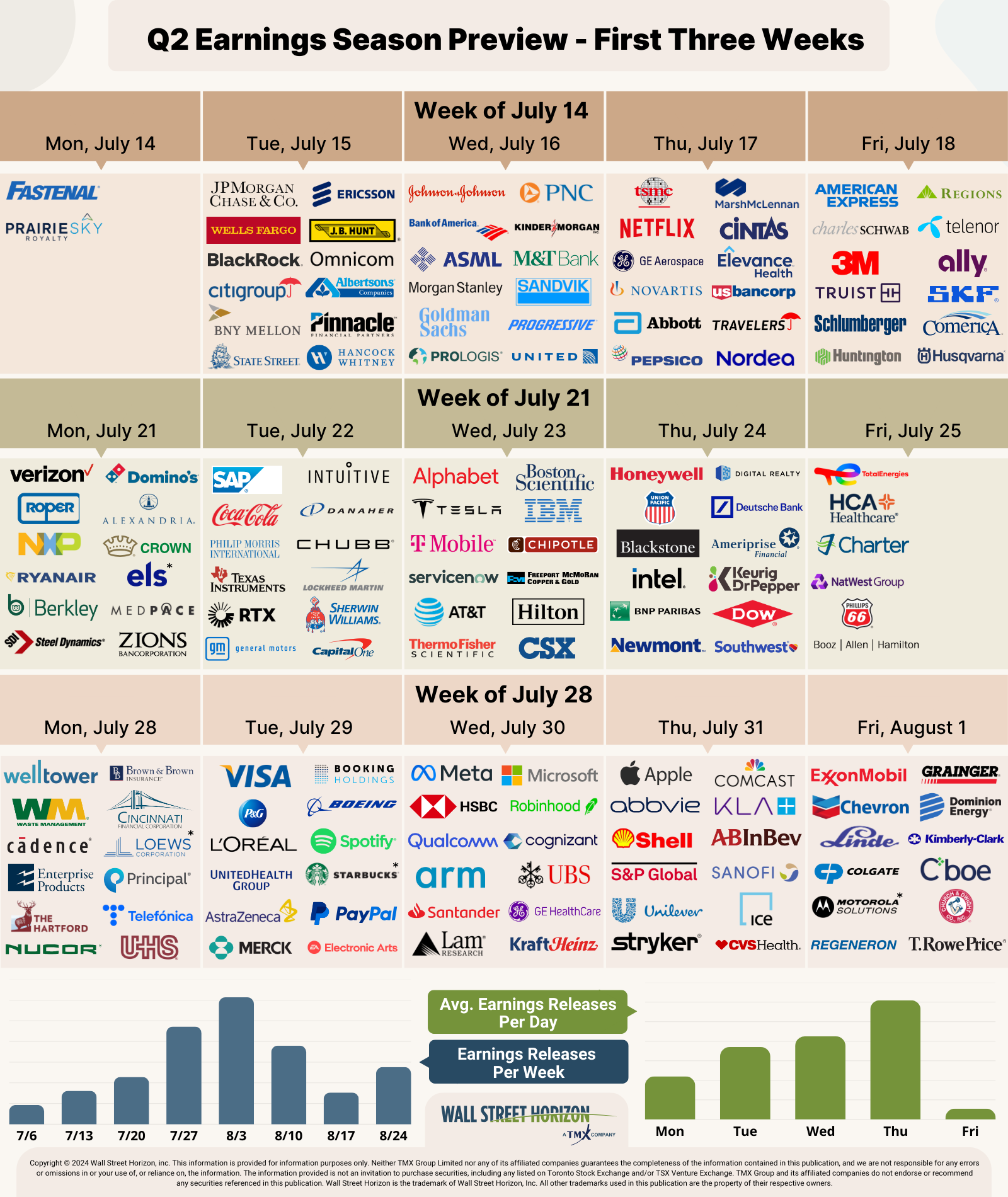
This week all eyes will be on big bank results, with JPMorgan Chase, Citigroup, and Wells Fargo set to report their results on Tuesday, July 15, followed by Bank of America, Morgan Stanley, and Goldman Sachs on Wednesday, July 16.
On these calls we’ll be looking for an update on second half banking and US economic conditions. The overarching theme is a shift away from the massive earnings boost provided by rapidly rising interest rates to a more challenging environment where credit quality and a tepid capital markets recovery take center stage.
Key figures to watch in bank reports:
Net Interest Income - The surge in Net Interest Income—the difference between what banks earn on loans and pay out on deposits—which powered bank profitability for the last two years, is expected to have plateaued or even begun to modestly decline in the second quarter.
Investment Banking - Starting to show signs of life? After a prolonged drought, there is cautious optimism for a nascent recovery in investment banking fees. The number of IPOs has steadily improved during the first half of the year as has the performance of companies going public. M&A still remains subdued, although mega-deals have stolen headlines. This week Goldman Sachs and Morgan Stanley will be key bellwethers and any significant beat in IB revenues would signal a broader "re-opening" of capital markets.
Credit Quality - This will be the most intensely watched area of the bank reports. Analysts are looking for signs of stress among both consumers and commercial borrowers. Net charge-offs for credit cards and auto loans will be in focus as delinquency rates are rising from historically low levels.
Sales & Trading - The last few quarters of volatile trading lead to spectacular revenues for banks, but with that calming a bit in the second quarter the results are expected to be solid but not as good as those quarters by comparison.

Source: Wall Street Horizon
Q2 Earnings Wave
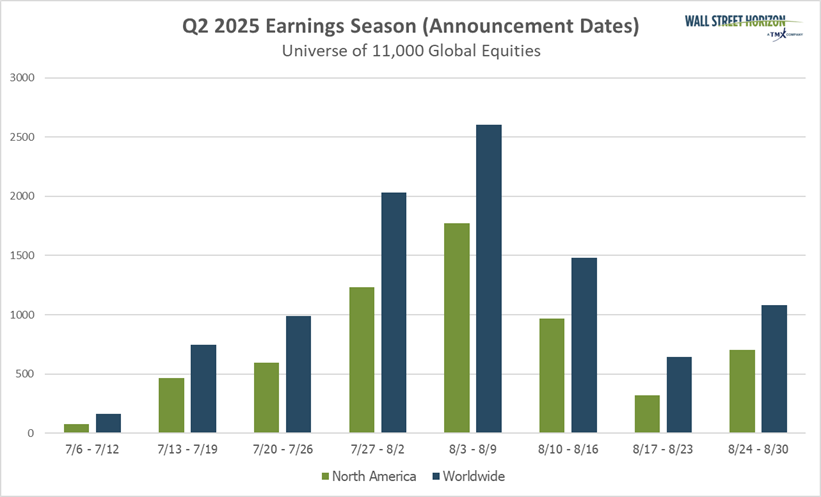
The peak weeks of the Q2 earnings season are expected to fall between July 28 - August 15, with each week expected to see over 2,000 reports. Currently, August 7 is predicted to be the most active day with 1,269 companies anticipated to report. Thus far, only 49% of companies have confirmed their earnings date (out of our universe of 11,000+ global names), so this is subject to change. The remaining dates are estimated based on historical reporting data.
Source: Wall Street Horizon
1 FactSet Earnings Insight, John Butters, July 11, 2025, https://advantage.factset.com
2 Micron Technology, Inc. Reports Results for the Third Quarter of Fiscal 2025, June 25, 2025, https://investors.micron.com
3 Delta Air Lines Announces June Quarter 2025 Financial Results, July 10, 2025, https://ir.delta.com
4 FedEx Reports Fourth Quarter Diluted EPS of $6.88 and Adjusted Diluted EPS of $6.07, June 24, 2025, https://investors.fedex.com
5 Nike Inc. Reports Fiscal 2025 Fourth Quarter and Full Year Results, June 26, 2025, https://s1.q4cdn.com
Copyright © 2025 Wall Street Horizon, Inc. All rights reserved. Do not copy, distribute, sell or modify this document without Wall Street Horizon's prior written consent. This information is provided for information purposes only. Neither TMX Group Limited nor any of its affiliated companies guarantees the completeness of the information contained in this publication, and we are not responsible for any errors or omissions in or your use of, or reliance on, the information. This publication is not intended to provide legal, accounting, tax, investment, financial or other advice and should not be relied upon for such advice. The information provided is not an invitation to purchase securities, including any listed on Toronto Stock Exchange and/or TSX Venture Exchange. TMX Group and its affiliated companies do not endorse or recommend any securities referenced in this publication. This publication shall not constitute an offer to sell or the solicitation of an offer to buy, nor may there be any sale of any securities in any state or jurisdiction in which such offer, solicitation or sale would be unlawful prior to registration or qualification under the securities laws of any such state or jurisdiction. TMX, the TMX design, TMX Group, Toronto Stock Exchange, TSX, and TSX Venture Exchange are the trademarks of TSX Inc. and are used under license. Wall Street Horizon is the trademark of Wall Street Horizon, Inc. All other trademarks used in this publication are the property of their respective owners.
A message from Advisor Perspectives and VettaFi: To learn more about this and other topics, check out some of our webcasts.
© Wall Street Horizon
Read more commentaries by Wall Street Horizon