Key Takeaways
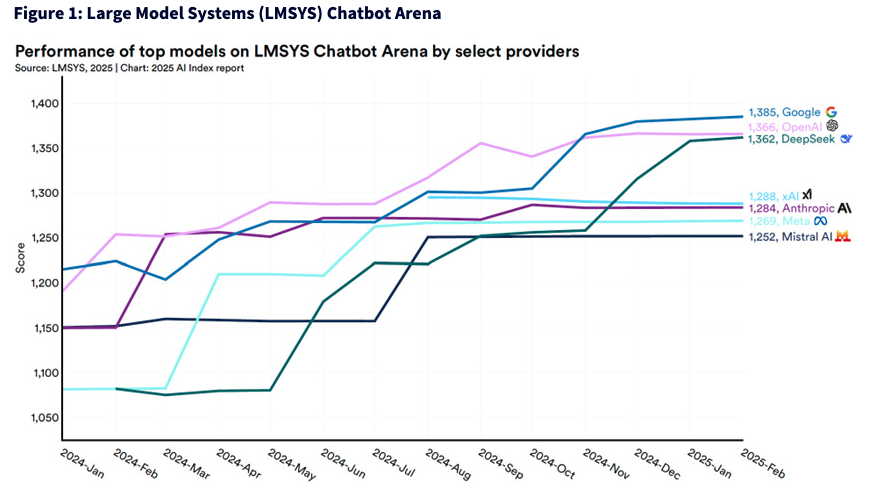
- In 2025, frontier AI model performance converged dramatically, with performance benchmarks like LMSYS’s Chatbot Arena revealing near-parity among top systems—a seismic shift suggesting excellence across different large language models (LLMs) is now ubiquitous, not rare.
- Breakthroughs in reasoning, shown in such benchmarks as ARC-AGI-1 and GPQA, signal a paradigm shift from memorization to genuine cognitive capability, with models beginning to challenge and even outshine human experts on complex, abstract problem-solving in certain cases.
- As technical performance across more LLMs equalizes, the competitive advantage pivots to cost efficiency, contextual integration and user experience—marking a new era where “state-of-the-art” is no longer a differentiator, but a baseline.
In the early years of the artificial intelligence (AI) race, performance benchmarks told a clear story: a handful of frontier models, developed by a few dominant labs, consistently outperformed the rest. In 2024, that changed. The 2025 Stanford AI Index Report reveals a stunning convergence in technical performance at the very top of the leaderboard. In just 12 months, the once-substantial gulf between the most powerful models and their challengers narrowed into near-parity. We are entering an era of ubiquitous excellence in the sphere of large language models (LLMs).
Each year, the Stanford AI Index report sets a new standard in giving us a better sense as to the progress the world has seen in AI. Over the coming weeks, you will see five different articles where we will highlight our most impactful takeaways from the 2025 edition. We will also provide one further piece contextualizing the different investment strategies available for those looking at AI as an investment.
Enter the AI Model Thunderdome
If you wanted to understand which AI model is "best," you might assume the answer lies in obscure academic metrics or labs with billion-dollar compute clusters. But in reality, the most useful models—the ones that genuinely help people—are best judged in the wild. That's the premise of Large Model Systems (LMSYS's) Chatbot Arena, a kind of public Thunderdome for AI where models go head-to-head in blind matchups, judged by everyday users. No brand names, no reputations—just raw performance. One model's answer goes on the left, another on the right, and the users pick their favorites. The result is something rare in the world of AI: a benchmark that is crowdsourced, dynamic and deeply human.
What makes the leaderboard interesting isn't just the scores—it's the storylines. Google recently pulled ahead with a model that feels like it skipped a generation. DeepSeek, a Chinese upstart, has surged toward the top of the heap after garnering little if any attention prior to 2025. And while OpenAI and Anthropic still post elite results, challengers like xAI and Mistral show how much competition remains. In a world where every company is promising AI transformation, LMSYS offers something simple but powerful: an honest signal of what actually works when real people put models to the test.

A Comparison of Multimodal Systems—The Case of Vision
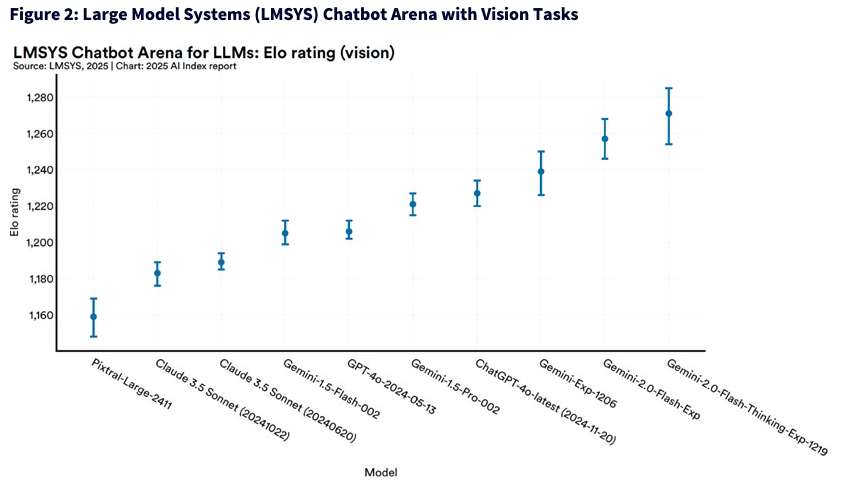
In the rapidly evolving race of multimodal AI—where models are judged not just by how they write, but how they see—Google's Gemini 2.0 models have seized the high ground. The latest leaderboard from LMSYS's Chatbot Arena, which uses an Elo rating system derived from human-voted head-to-head matchups, shows Gemini dominating vision tasks by a meaningful margin. Its top models don't just edge out rivals like GPT-4o—they establish clear distance. That matters. Because when users are feeding these systems images, graphs or charts, the gap between "gets the gist" and "understands the nuance" is the difference between a mediocre assistant and an indispensable co-pilot.
What makes this moment interesting isn't just the leaderboard—it's what it signals about how fast the frontier is moving. Six months ago, most conversations centered on OpenAI's GPT-4 as the gold standard. Today, it's still a powerhouse, but the spotlight is shifting. Claude sits solidly in the middle tier, while lesser-known entrants like Pixtral are struggling to keep up. Now, here's the nuance that can be easy to miss: even a 30- to 50-point Elo gap on this chart is meaningful. These are not cosmetic differences—they reflect repeated, statistically significant wins in blind head-to-head matchups. In a system modeled after chess rankings, a 50-point edge translates to winning about 57% of the time. That's not trivial. In a world where tasks are increasingly delegated to AI—interpreting a chart, summarizing an earnings call, responding to a visual prompt—small percentage wins compound into huge differences in productivity. So while the models may all look clustered together, the best ones are quietly stacking real-world advantages.
Each dot on the chart represents the average Elo rating of a specific large language model (LLM) in the LMSYS Chatbot Arena, focused on vision-based tasks. The Elo rating system is originally used in competitive games like chess, and it helps rank models by performance based on pairwise comparisons—higher Elo means stronger overall performance in head-to-head matchups.
The vertical lines (error bars) around each dot show the uncertainty or margin of error in that model's Elo rating. This reflects variability in the model's performance across different test prompts and evaluators. A shorter line means the model's rating is more stable and consistent. A longer line means there's more variability, suggesting the performance could be slightly better or worse than the average depending on the test conditions.
Together, the dots and lines give a visual summary of both performance and confidence in that performance across the different models.
The Models Are Evolving—and So Are the Tests!
In the world of AI evaluation, most benchmarks eventually become obsolete—not because they're poorly designed, but because the models evolve faster than the tests themselves. ARC-AGI-1 is different. The Alignment Research Center Artificial General Intelligence (ARC-AGI) evaluation is a benchmark developed to assess whether advanced AI systems show early signs of general intelligence—that is, the ability to solve a wide range of problems, including unfamiliar ones, without being specifically trained on them.
It was developed by the Alignment Research Center, an independent nonprofit focused on ensuring that future AI systems are safe and aligned with human intentions. ARC created this test to evaluate how well AI models can reason, plan, and solve tasks that require multiple steps or abstract thinking—in other words, skills beyond memorizing answers or pattern-matching.
Why was it developed?
Most AI benchmarks measure how well a system performs on a specific skill (e.g., summarizing text or answering trivia). But the ARC-AGI test aims to answer a deeper question:
"Does this AI system exhibit the kind of general problem-solving ability that would make it capable of behaving like an early form of AGI?"
ARC-AGI is designed to:
- Detect early warning signs of general intelligence
- Provide a more rigorous test of reasoning and adaptability
- Ensure safety evaluations keep pace with the rapid progress of model capabilities
It includes tasks that are intentionally challenging for today's models, often requiring multi-step thinking, code generation, logical reasoning, or unfamiliar problem-solving.
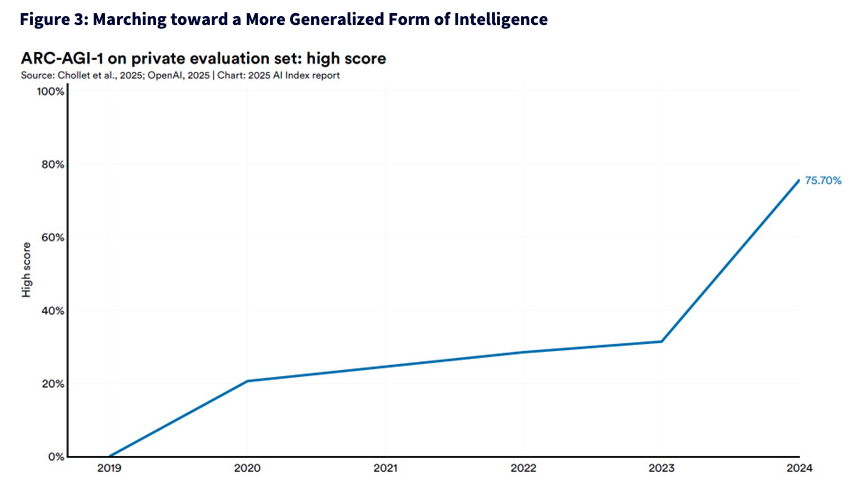
The most striking thing isn't just the test—it's the leap seen in the results. From 2019 through 2023, models made slow, incremental progress, struggling to crack 30% on the ARC-AGI-1 private evaluation set. But in 2024, something changed. The high score jumped to 75.7%, a near threefold increase. That kind of curve doesn't suggest a slightly better model—it suggests a fundamentally different one. You don't see this kind of progress unless a system gains some new degree of agency, planning or inner scaffolding for how it reasons through problems. It's as if the lights suddenly came on in a room that we thought was already fully lit.
For investors and technologists, this shift should be treated less like an isolated metric and more like a signal flare. The progress on ARC-AGI-1 is a proxy for something deeper: the emergence of models that don't just answer but reason. This raises the ceiling on what AI can do in research labs, enterprise workflows and even autonomous systems. But more importantly, it compresses timelines. Every few years, we recalibrate our expectations for when AGI might arrive. This year's leap suggests we may be ahead of schedule.
The blue line represents the highest score achieved by any AI model on the ARC-AGI-1 test's private evaluation set for each year shown, from 2019 to 2024.
- The Y-axis shows the percentage of questions answered correctly—this is the model's high score.
- The X-axis shows the calendar year in which that top score was achieved.
- The 2024 data point, marked at 75.70%, is the most recent high score reported.
This line provides a time-series view of AI progress on a benchmark designed to measure general problem-solving ability. It illustrates how the best-performing models each year have steadily improved on this difficult reasoning task set, with especially rapid gains seen between 2023 and 2024.
Getting Beyond Searching and Recalling to Measuring Something More
Imagine you're preparing for an exam in a subject you know deeply—say, organic chemistry at the graduate level. You're not memorizing facts; you're reasoning through why a signal in an NMR spectrum moves downfield, what that says about electron environments and what kind of catalysts might explain the transformation. NMR spectrum refers to the graphical output produced by Nuclear Magnetic Resonance (NMR) spectroscopy, a powerful analytical technique used to determine the structure, dynamics, and environment of molecules, particularly organic compounds.
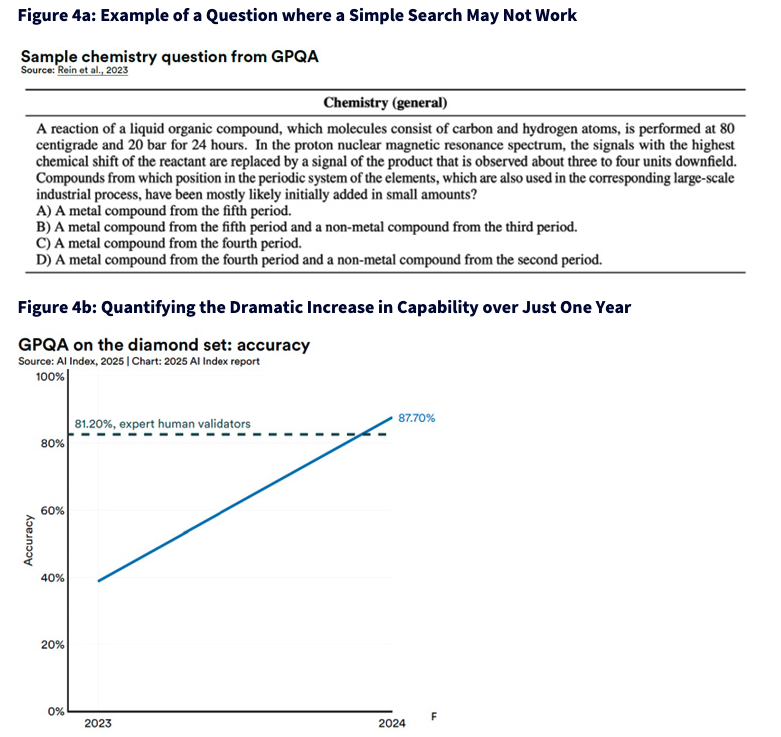
That's the level of thinking required by the GPQA benchmark, which isn't testing trivia—it's testing whether a model can walk the same mental pathways as someone who has truly studied the subject. GPQA stands for Graduate-Level Professional and Quantitative Aptitude. It is a benchmark dataset and evaluation designed to test whether advanced AI systems can answer difficult, expert-level questions across a wide range of scientific and technical domains. The sample chemistry question feels pulled from a real-world industrial process, asking not what's happening, but why—and what kind of elements, from where in the periodic table, would help make it happen.
Now here's the part that should stop you in your tracks: in 2023, the best AI models answered these questions right less than half the time. In 2024, they beat expert human validators. The accuracy jumped from 40% to nearly 88%, clearing the 81% benchmark set by humans trained to validate these answers. That's not a minor improvement—it's a paradigm shift. Because these aren't questions you Google. They're problems you solve, requiring contextual knowledge, logical sequencing and domain abstraction. The fact that a model can now perform this way implies something profound: we're building tools that reason, not just recall.
The implications are vast. In the same way calculators changed math class or spreadsheets transformed finance, these systems could begin changing what it means to "know" something professionally. If an AI can reason like a specialist across chemistry, law and economics, then the constraint becomes less about what one person can hold in their head, and more about how fast and reliably we can ask the right questions. GPQA isn't just a test—it's a window into a world where intelligence scales. And when intelligence scales, everything else does too.
The blue line in the chart shows the year-over-year accuracy of the top-performing AI model on the GPQA Diamond Set, from 2023 to 2024.
- The Y-axis shows accuracy, measured as the percentage of questions answered correctly.
- The X-axis spans two years: 2023 and 2024.
- The data point in 2024 reaches 87.70%, which is the best accuracy achieved by an AI model on this test to date.
The dashed horizontal line at 81.20% represents the average accuracy of expert human validators on the same set of questions—essentially a benchmark for human-level performance. The chart shows that by 2024, the top model outperformed expert humans on this challenging, graduate-level technical benchmark.
Technical Excellence Is Now Table Stakes
These are just some examples—there are many—showcasing the progress we are seeing in different AI models and what they can do. In years past, releasing a model that could achieve top-1 scores on certain evaluations and tests was a headline event. In 2025, it's the new minimum.
Consider that Claude 3.5 Sonnet, OpenAI's o1 and Gemini 2.0 all exceed 90% on GPQA Diamond—a benchmark for graduate-level science reasoning (figure 4b cited this test but didn't specify individual model results). That means even subtle differences in architecture or training regimes no longer yield clear performance edges.
If Everyone Is Excellent, What Matters?
With performance parity at the frontier, the manner in which the different large language models seek to differentiate themselves from one another shifts.
-
Cost and Efficiency: Training cost for Llama 3.1-405B reached $170 million. Inference cost for GPT-3.5-level outputs dropped 280-fold in 18 months. Models like o1 are six times more expensive to run and 30 times slower than GPT-4o. Efficiency is no longer a technical afterthought—it's central to platform viability. For clarity, AI models are developed, trained and then allowed to run and serve users. This ‘running and serving users' is often termed ‘inference.' When inference costs are discussed, it tends to mean what it costs to allow possibly hundreds of millions or even billions of users to use the model for their needs.
-
Agency and Reasoning: Models like o1 and o3 from OpenAI show advanced planning, chaining and task execution capabilities. This agentic layer, not just raw token prediction, may become the next arena for differentiation.
-
Contextual Integration: Gemini's 2M-token context window and the rise of retrieval-augmented generation (RAG) pipelines suggest a shift from standalone model intelligence to system-level orchestration.
-
Ecosystem and Interface: With the landscape getting closer and closer to parity in core intelligence, user interface (UI)/user experience (UX), data integrations and developer ecosystems may become the real moats.
The Commoditization of Brilliance
The AI Index 2025 calls it clearly: the Turing test is no longer a meaningful boundary. On benchmark after benchmark, LLMs now equal or exceed human baselines. But the democratization of state-of-the-art performance may be more disruptive than any single breakthrough.
We are entering a world where "the best model" is not a unique crown but a crowded field. What follows is not about building better answers, but about building better systems, better interfaces and better outcomes.
Welcome to the age of commoditized brilliance.
A message from Advisor Perspectives and VettaFi: To learn more about this and other topics, check out some of our webcasts.
U.S. investors only: Click here to obtain a WisdomTree ETF prospectus which contains investment objectives, risks, charges, expenses, and other information; read and consider carefully before investing.
There are risks involved with investing, including possible loss of principal. Foreign investing involves currency, political and economic risk. Funds focusing on a single country, sector and/or funds that emphasize investments in smaller companies may experience greater price volatility. Investments in emerging markets, currency, fixed income and alternative investments include additional risks. Please see prospectus for discussion of risks.
Past performance is not indicative of future results. This material contains the opinions of the author, which are subject to change, and should not to be considered or interpreted as a recommendation to participate in any particular trading strategy, or deemed to be an offer or sale of any investment product and it should not be relied on as such. There is no guarantee that any strategies discussed will work under all market conditions. This material represents an assessment of the market environment at a specific time and is not intended to be a forecast of future events or a guarantee of future results. This material should not be relied upon as research or investment advice regarding any security in particular. The user of this information assumes the entire risk of any use made of the information provided herein. Neither WisdomTree nor its affiliates, nor Foreside Fund Services, LLC, or its affiliates provide tax or legal advice. Investors seeking tax or legal advice should consult their tax or legal advisor. Unless expressly stated otherwise the opinions, interpretations or findings expressed herein do not necessarily represent the views of WisdomTree or any of its affiliates.
The MSCI information may only be used for your internal use, may not be reproduced or re-disseminated in any form and may not be used as a basis for or component of any financial instruments or products or indexes. None of the MSCI information is intended to constitute investment advice or a recommendation to make (or refrain from making) any kind of investment decision and may not be relied on as such. Historical data and analysis should not be taken as an indication or guarantee of any future performance analysis, forecast or prediction. The MSCI information is provided on an “as is” basis and the user of this information assumes the entire risk of any use made of this information. MSCI, each of its affiliates and each entity involved in compiling, computing or creating any MSCI information (collectively, the “MSCI Parties”) expressly disclaims all warranties. With respect to this information, in no event shall any MSCI Party have any liability for any direct, indirect, special, incidental, punitive, consequential (including loss profits) or any other damages (www.msci.com)
Jonathan Steinberg, Jeremy Schwartz, Rick Harper, Christopher Gannatti, Bradley Krom, Kevin Flanagan, Brendan Loftus, Joseph Tenaglia, Jeff Weniger, Matt Wagner, Alejandro Saltiel, Ryan Krystopowicz, Brian Manby, and Scott Welch are registered representatives of Foreside Fund Services, LLC.
WisdomTree Funds are distributed by Foreside Fund Services, LLC, in the U.S. only.
You cannot invest directly in an index.
© WisdomTree, Inc.
Read more commentaries by WisdomTree, Inc.