- Market-moving events can highlight structural shifts underway. Our investment leaders grapple with the implications of a world shaped by supply.
- U.S. stocks soared last week, marking their largest weekly gain of the year. Small caps and banks led the way following President-elect Donald Trump’s victory.
- This week, U.S. CPI will help gauge if inflation is still falling toward the Fed’s 2% target. Recent PCE data indicates inflation will settle higher in the medium term.
We are in a world where multiple, starkly different outcomes are possible. The decisive U.S. election outcome has stoked uncertainty about future U.S. policy. At our 2025 Outlook Forum last week, BlackRock investment leaders met to discuss how to invest given large structural shifts happening now – and we updated the range of scenarios we considered feasible six months ago, reflecting our discussions on U.S. exceptionalism, geopolitics and artificial intelligence (AI).

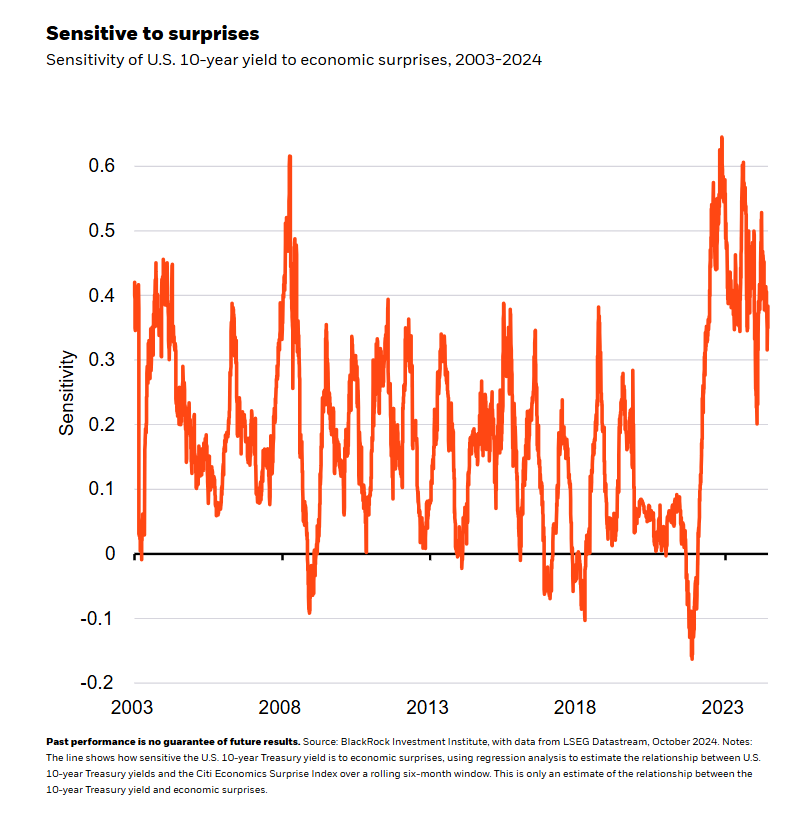
Our Outlook Forum took place against the backdrop of a momentous U.S. election. Markets welcomed the decisive result that took some near-term uncertainty off the table – even as medium-term policy uncertainty remains. Shifting narratives, from AI booms to recession fears, have driven volatility this year. Markets can overreact to these shifts. We have seen unusually sharp swings in 10-year U.S. Treasury yields with key macro releases. See the chart. We think that reflects investors viewing new data and news through a business cycle lens when broader structural changes are at play. We have been nimble with our tactical view changes this year to lean against narrative-driven volatility. The goal of last week’s Forum: tracking the transformation driven by these structural changes. We evolved our macro scenarios to better understand and position for the transformation’s opportunities.
Structural forces at play
U.S. exceptionalism – strong economic and corporate earnings growth – was a topic of debate at the Forum. Our portfolio managers are broadly positive on U.S. equity markets. They noted this has more room to run, even if U.S. stock valuations look steep. The contrast with lagging European economic growth, and stock performance, remains stark. Forum participants also spied a disconnect in Fed policy. The Fed cut its policy rate another 25 basis points last week as it sees inflation moving closer to its 2% target. Yet financial conditions are loose after a historically sharp tightening cycle. This unusual backdrop reinforces our view that this is not a typical business cycle – but rather an environment where structural forces are at play.
The geopolitical fragmentation mega force – or structural shift impacting returns now and in the future – ran through most discussions. The incoming U.S. president takes office at a time of greater global fragility given wars in the Middle East and Ukraine, and ongoing tensions with China. A punishing year for incumbents around the globe is pressuring G7 partners. Germany is headed for a new election. This follows France's divided election outcome earlier this year. The reform proposals laid out by Mario Draghi detail the challenges Europe faces. China rolled out some details of its fiscal stimulus highlighting its weak growth near term – and also faces long-term challenges from an aging population. AI will increasingly take center stage in geopolitics, featuring heavily in U.S.-China strategic tech competition. Under the Biden administration, the U.S. has elevated AI to the core of its military and technological priorities.
The debate on the impact of the AI mega force keeps evolving. Much of the discussion at our last Forum in June centered on AI and its energy and investment needs. That was still a focus – and we generally agreed that the AI buildout can broaden to include other beneficiaries. Quantifying AI’s longer-term economic impact remains challenging, but we think AI has the potential to eventually reshape economies and boost economic growth.
Our bottom line
Our Forum discussion sought to clarify how structural shifts are driving the investment opportunities we see while assessing what’s in the price. We think having a solid framework is key for anchoring views in this unusual environment.
Market backdrop
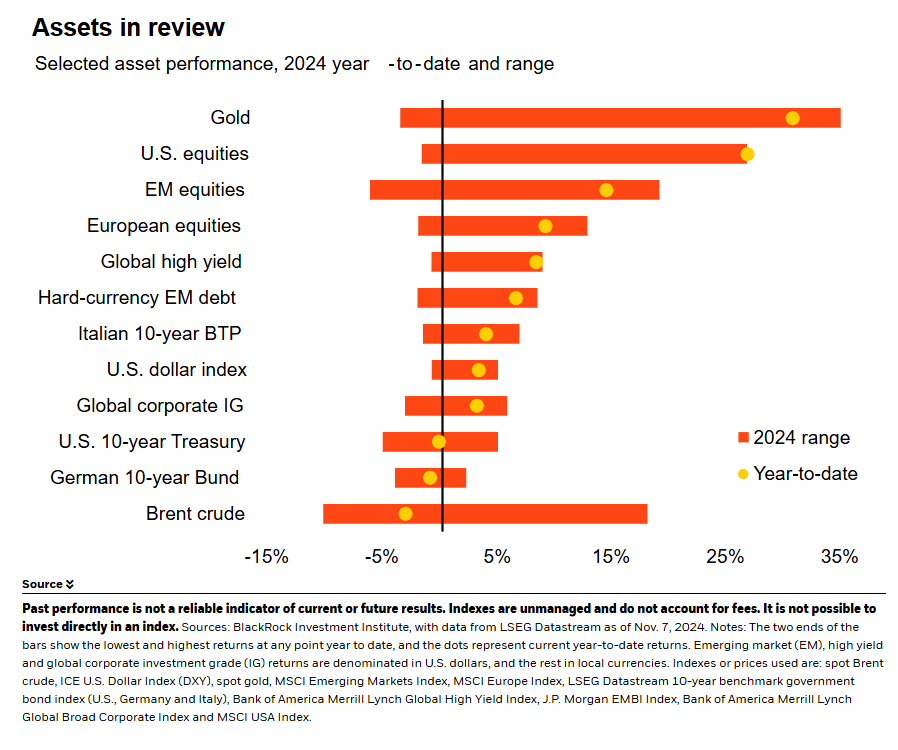
U.S. stocks soared to new all-time highs last week, notching their largest weekly gain of the year. Small caps and banks led the way as possible beneficiaries of a second Trump term. U.S. 10-year Treasury yields finished around 4.30%, down slightly on the week after jumping to four-month highs. A telegraphed 25-basis point Fed rate cut failed to move markets. Pricing of future cuts has come closer to our view, yet we still see rates settling higher than markets do.
This week, we focus on U.S. CPI to see if inflation will keep falling toward the Fed’s 2% target. Short-term inflation has been decreasing, with immigration boosting the labor supply and cooling wage growth. However, recent services PCE data remains sticky, indicating that inflation may settle above 2% in the medium term. Long-term, structural supply constraints – like a shrinking workforce due to population aging – are expected to keep inflation pressures persistent.
General disclosure: This material is intended for information purposes only, and does not constitute investment advice, a recommendation or an offer or solicitation to purchase or sell any securities to any person in any jurisdiction in which an offer, solicitation, purchase or sale would be unlawful under the securities laws of such jurisdiction. The opinions expressed are as of Nov. 11, 2024, and are subject to change without notice. Reliance upon information in this material is at the sole discretion of the reader. Investing involves risks. This information is not intended to be complete or exhaustive and no representations or warranties, either express or implied, are made regarding the accuracy or completeness of the information contained herein. This material may contain estimates and forward-looking statements, which may include forecasts and do not represent a guarantee of future performance.
A message from Advisor Perspectives and VettaFi: To learn more about this and other topics, check out some of our webcasts.
© BlackRock
Read more commentaries by BlackRock