Stocks have been buoyant this year, but market conditions are still in flux. Looking at equity factors can help investors make informed judgments about how allocations are prepared for different scenarios.
Equity factors are an important way to gauge portfolio exposures. To some, factors might seem daunting and technical. But it doesn’t have to be that way. Think about factors as helpful tools that provide important clues about performance patterns to evaluate the features of stocks. Common factors include value, size, volatility, momentum and quality.
Each factor is defined by different metrics. Using these metrics, we can analyze how groups of stocks scoring high or low on a particular factor performed versus the broader market. Alternatively, a group of stocks that ranks high on a factor can be compared with low-scoring stocks on the same factor, or against other factor cohorts.
Quality Stocks Continue to Shine
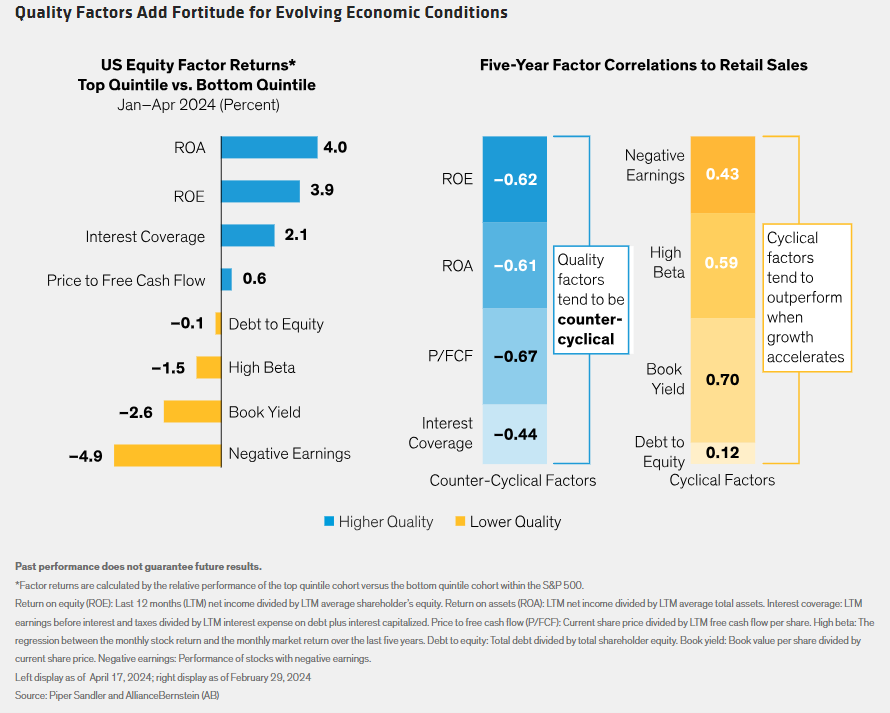
High-quality US stocks have been on a winning streak that began in earnest at the start of 2023 and has continued into this year. We divided the market into quintiles based on quality factors such as return on equity (ROE) and return on assets (ROA), two profitability metrics that signal business resilience. The top quintile of higher-quality stocks based on ROE and ROA within the S&P 500 outperformed the bottom quintile of the same factor by about 4% in the first quarter. Stocks with high interest coverage also did well; this quality metric indicates whether a company is too heavily burdened by debt.
Stocks with lower-quality factors were much weaker. These included companies with negative earnings (i.e., loss making), or those with a high book yield, which tend to be more capital intensive and cyclically sensitive.
In recent years, higher-quality equity factors tended to be counter-cyclical. That means they performed better in scenarios of moderating economic growth. Lower-quality factors benefited when growth accelerated, meaning they’re cyclically oriented. We see this in the correlation of stocks with higher- and lower-quality factors to retail sales—a good proxy for economic activity—over the last five years.
Factors and Fundamentals: A Recipe for Resilience
Today, US interest-rate cuts are expected to happen later than anticipated at the beginning of the year, amid tight labor markets and sticky inflation. We expect economic growth to moderate—known as a “soft landing”—over the coming year.
That may be just the right economic temperature for quality stocks. But equity factors are just a starting point. In our view, rigorous fundamental analysis is the best way to build portfolios with desired factor exposures based on business advantages that drive high-quality profitability for companies—and long-term return potential for investors.
The views expressed herein do not constitute research, investment advice or trade recommendations and do not necessarily represent the views of all AB portfolio-management teams. Views are subject to change over time.
A message from Advisor Perspectives and VettaFi: To learn more about this and other topics, check out some of our webcasts.
© AllianceBernstein
Read more commentaries by AllianceBernstein