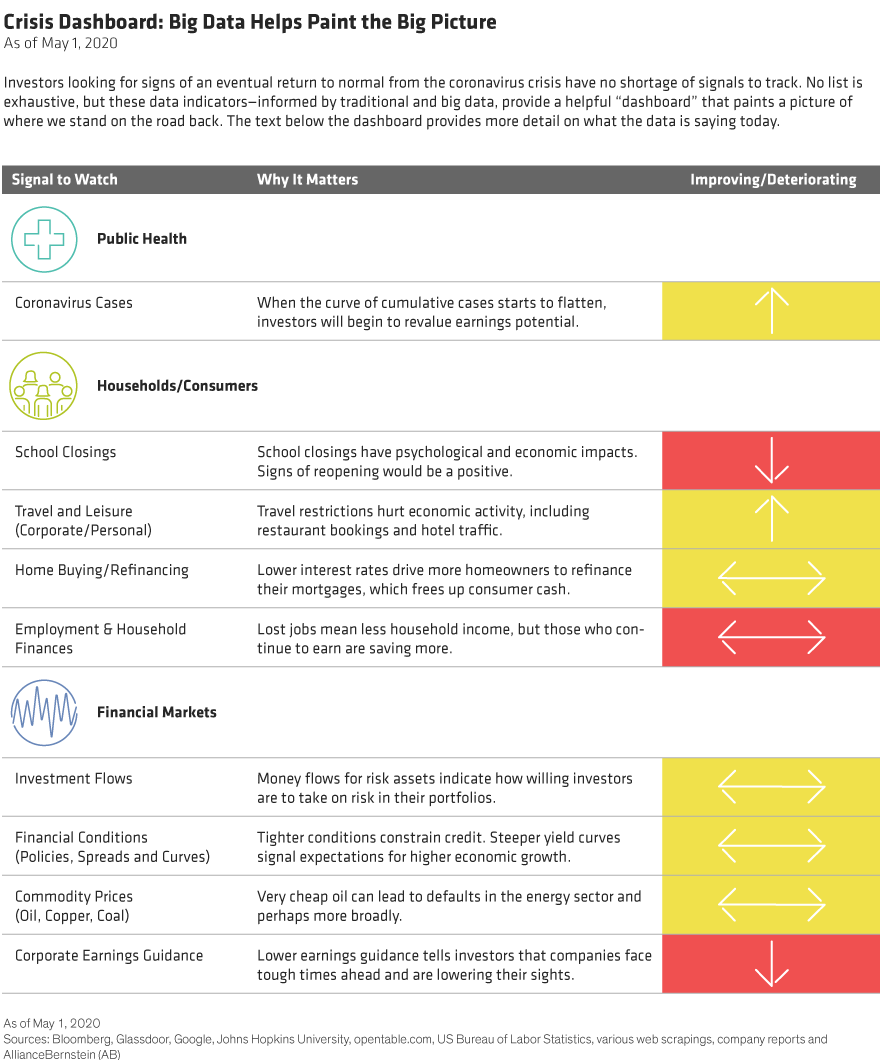
Our crisis dashboard includes signals from three areas: 1) public health, 2) the consumer sector and 3) financial markets. By pulling big data from traditional sources (earnings growth and gross domestic product, for example) and nontraditional sources (like Google Trends and Glassdoor), we can create a better mosaic of the road back. Public health, of course, is the key: until there’s a vaccine, the cascading impact of the virus may continue.
The dashboard color codes (red, yellow or green) indicate the current state of each signal, while the arrows indicate the trend (improving, deteriorating or unchanged). Since our last update, we’ve seen improvement in the public health battle against COVID-19 and in our travel-and-leisure indicator, but there’s still a long road ahead. We note upticks in a few other areas, but not enough to change the current indicators.
We’ll continue to update this data as we move forward.
Public Health
Globally, the number of coronavirus cases continues to rise—it’s currently at about 3.2 million. Cases are still rising in some part of the world (Brazil, for instance), but the increase is decelerating. Europe and Asia are seeing improvement. The R0, which tracks the average number of cases spread by one person, is currently near 1.0 globally and is declining. Case estimates from Johns Hopkins University are slowing.
Households/Consumers
School Closings: More schools globally have shut their doors, and closings could last longer than expected—including for the rest of the academic year. Higher education might suffer as well. There are early signs of schools preparing for online classes to continue in the next academic year, which would likely slash the number of students willing to pay high prices for higher education.
Travel and Leisure: Travel restrictions are widespread, but we’re not necessarily seeing wholesale lockdowns. Open tables are commonplace at restaurants, and subway ridership—down more than 90%—is still at all-time lows. Google search trends for “vacation idea” have dropped everywhere except Asia. China, for example, has seen searches picking up relative to 2019).
Home Buying/Refinancing: While refinancing activity remains weak, it’s showing signs of improvement, encouraged by low interest rates. New construction is slowly picking up from its lows in certain parts of the world (notably the Los Angeles market in the US).
Employment & Household Finances: US jobless claims continue to rise, with 33 million filings in the past six weeks. Nearly 60 million jobs across the European Union and UK are at risk. Unemployment rates across the Asia-Pacific region could rise by well over three percentage points—twice as high as seen during the average recession. Credit card spending data still points to major weakness due to business closures (but is showing early signs of improvement). The personal savings rate as a percentage of disposable income increased from 8% to 13% in the US from February to March.
Financial Markets
Investment Flows: Globally, outflows continue from most risky assets, with money funds and cash benefiting. We’ve started to see some money flow back into risk assets, including investment-grade and high-yield bonds, over the past few weeks (Source: Strategic Insight and Bank of America).
Financial Conditions: Despite sizable rescue packages, conditions still seem tight. Credit spreads are above average but have pulled back from their highs. A rise in defaults is certainly coming. While liquidity isn’t as big of a concern as it was weeks ago, concern is starting to build about solvency for some companies.
Commodity Prices: Coal consumption in China is slowly picking up again (it’s currently flat relative to last year). Oil prices plummeted again last week, as demand appears nonexistent and storage facilities are near capacity. Energy companies will either have to stop drilling or find international buyers. Copper prices were unchanged last week after rising for the two prior weeks.
Corporate Earnings Guidance: 2020 earnings per share estimates are still in freefall, with no bottom in sight. More than 100 companies in the S&P 500 have withdrawn guidance altogether. Glassdoor trends in employee attitudes highlight a disparity between companies that prepared well for work-from-home scenarios and those that didn’t.
Scott Krauthamer is Global Head of Product Management and Strategy at AB. Jonathan Berkow is Senior Quantitative Research Analyst and Alternative Data Lead for Equities at AB.
The views expressed herein do not constitute research, investment advice or trade recommendations and do not necessarily represent the views of all AB portfolio-management teams. Views are subject to change over time.
© AllianceBernstein L.P.
© AllianceBernstein
Read more commentaries by AllianceBernstein