Advisor Perspectives welcomes guest contributions. The views presented here do not necessarily represent those of Advisor Perspectives.
Historical returns have been outstanding for convertible-bond strategies. Moreover, low drawdowns during bear markets give these products an attractive risk-return profile, especially when compared to other liquid alternatives.
But convertible bonds are like comedian Rodney Dangerfield: They get no respect. Convertibles are overlooked because they are hard to label and underappreciated because they are not as sexy as stocks. So convertible bonds are relegated to a supporting role in a portfolio.
But after many years of consistently strong performance, convertibles are ready for a leading role.
While attending an investment forum in Boston on September 28, I met with Greg Miller, a portfolio manager at Wellesley Investment Advisors (WIA). His firm specializes in convertible-bond funds. Miller focused on the long-term track record of WIA and its Miller Convertible Bond Fund (MCIFX).
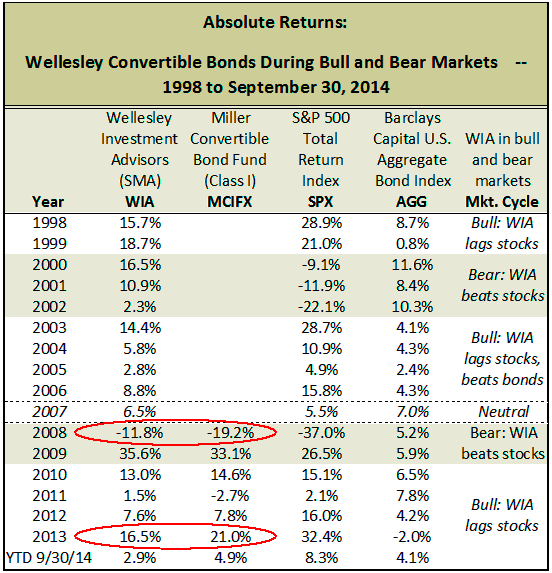
His presentation included the returns of WIA’s separately managed account (SMA), shown in Exhibit 1. The returns have been surprisingly strong through both bull and bear markets and have had limited drawdowns during bear markets. According to Miller, the SMA has generated annual returns of 10.7% from inception in 1995 through 9/30/14 (net of fees of 0.75%). This compares to returns of 9.7% for the S&P 500. As for volatility, WIA has had a standard deviation of 8.2% since inception in 1995, while the S&P 500 has had 15.2% for the same time period.
This pattern of returns immediately struck me as extraordinary. I have been on the buy side since 1985, and I am the co-author of a book that evaluates alternative mutual funds: Alts Democratized, just released from Wiley Finance. Alts Democratized systematically reviews all 11 Lipper classifications of alternatives. Most of these products have not delivered attractive long-term returns. Moreover, most liquid alts are highly correlated to traditional asset classes (stocks, bonds, etc.) and to traditional factor exposures (value vs. growth, optionality, trend following, etc.). Consequently, most liquid alts fail to deliver on their marketing promises.
Convertible bonds from Wellesley are an outlier. WIA generated attractive returns over a full market cycle without excessive drawdowns. The reason is simple; convertibles are correlated to stocks during bull markets because of the conversion feature, but the par value of the bond provides downside protection during bear markets. After all, convertible bonds are bonds first and foremost. As long as the company remains solvent, investors get their money back.
Most convertibles also have a “put” feature that gives the owner the right to sell the bond back to the issuer and receive early payment of principal (usually par value of $1,000). The investor may have this right to put the bond on one or more dates, as specified in the prospectus. These dates may be every one, three or five years depending on the maturity date of the bond. Regardless of the details, the put feature reduces the effective duration of the bond, which mitigates both credit risk and interest rate risk.
No respect
Despite their impressive track record, convertible bonds are easy to overlook, like comedian Rodney Dangerfield, famous for his trademark line: “I don’t get no respect.” Dangerfield wrote and starred in Back to School, which was a top-10 film in 1986, but he stuck with the hapless on-stage persona.
Back to School featured Joe Pesci, who later won an Academy Award for his work in Goodfellas. Pesci won Best Actor in a Supporting Role and this may be a better a metaphor for convertibles: Character actors often deliver outstanding performances, but they rarely get a star turn.
Likewise, convertibles are not as flashy as stocks, so they often suffer in comparison. Convertibles are also hard to label, just like character actors.
Nevertheless, as demonstrated in the return data below, convertibles are ready for a leading role.
Exhibit 1
Absolute Returns

Source: Wellesley Investment Advisors
Notes
Bull markets are in white horizontal bands.
-
Bear markets are in shaded horizontal bands.
2007 is considered "neutral" for illustration purposes.
Returns are rounded to one decimal place.
Historical returns
Exhibit 1 shows the returns of WIA, the S&P 500, the Barclays Capital U.S. Aggregate Bond Index over the course of the market cycle. Bull markets are indicated in white horizontal rows, and bear markets are shown in shaded horizontal rows. The exhibit uses WIA for comparison purposes since the SMA has data going back to 1998. The second column shows the Miller Convertible Bond Fund (MCIFX), which launched in 2008, while the next two columns show the SPX and AGG. The last column on the right has Miller’s comments about the performance of WIA during bull and bear markets.
As you might expect, WIA has generated returns that lagged stocks during bull markets. But WIA more than made up for this during bear markets. This return pattern is exceptionally difficult to find among alternative investments of any type. Strategies such as managed futures, long/short equity, absolute return and global macro tend to generate lower returns and/or have higher volatility. So the performance of WIA not only suggests that it has the characteristics of a liquid alt, but also that it is quite attractive as an investment strategy.
As for the mutual fund, MCIFX has a more aggressive risk/return profile than the SMA with greater upside during bull markets and downside during bear markets. This is because MCIFX includes 144A securities that are unlisted and restricted to institutional investors with over $100 million in assets. Convertible bonds issued under Rule 144A allow convertible debt to be issued more quickly and are often unrated since issuers may not want to pay the ratings agencies.
As of September 30, 2014, MCIFX had a 60% allocation to unrated convertibles, and these have historically been more volatile. Consequently, advisors who use MCIFX in a portfolio should note that it is riskier than the SMA from WIA. Advisors should adjust the asset allocation of client portfolios accordingly.
The riskiness of MCIFX versus WIA was evident in 2008 when MCIFX returned -19.2%, compared to -11.8% for WIA. These returns are circled, as is the outperformance of MCIFX in 2013, when it rose 21.0%, compared to a rise of 16.5% for WIA.
Relative returns
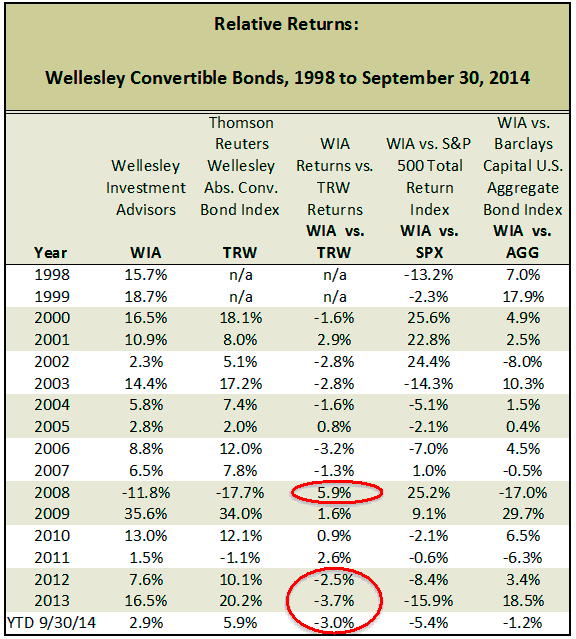
Turning to relative returns, Exhibit 2 shows how WIA has fared compared to various indices. The first column shows returns for WIA, and the second column shows the Thomson Reuters Wellesley Absolute Convertible Bond Index (TRW). This index was designed as a joint venture between Thomson Reuters and Wellesley in an attempt to provide an appropriate benchmark for WIA. Wellesley Investment Advisors focuses on convertible bonds and does not buy convertible preferreds or other securities that are included in traditional convertible benchmarks, such as the Merrill Lynch/BofA VOAO index.
Another distinctive feature of WIA is its buy discipline, which emphasizes buying bonds that sell at appropriate premiums over par value. Wellesley avoids buying convertibles that have a “loss to worst,” which is calculated based on the coupon and the maturity. For example, if a three-year bond yields 4%, Wellesley would pay up to 112 for the bond. This would allow WIA to redeem the bond at 100 and collect a total of 12% over three years. In a bull market a convertible like this might sell for more than 112, and this would lead to a loss at redemption. Wellesley’s buy discipline reduces risk, but it also reduces the investible universe during bull markets. (WIA sometimes buys synthetic convertibles when it can negotiate a deal structure with bankers that makes sense for investors.)
Wellesley’s buy discipline has historically limited downside during bear markets since the par value of the bond provides a floor. Finally, WIA performs its own credit analysis of issuers, since it has found that conflicts of interest make it difficult for ratings agencies to deliver independent and objective credit ratings.
The conservative approach used by WIA shows up in the relative returns in Exhibit 2. For example, in 2008 WIA generated returns of -11.8%, which was 5.9% better than the TRW index during a painful bear market. Conversely, WIA has lagged the TRW index from 2012 through 9/30/2014, a bull market. This return pattern is exactly what one would expect for a convertible bond fund that is run more conservatively than the TRW index. (The returns in both 2008 and 2012 through 9/30/14 are circled in Exhibit 2.)
Other factors may also come into play, such as the fact that WIA leans more towards smaller convertible bond issues, and these factors affect the performance of WIA when compared to TRW.
Exhibit 2
Source: Wellesley Investment Advisors
Notes
-
TRW is the Thomson Reuters Wellesley Absolute Convertible Bond Index.
The TRW index is not an investable asset and has no management fees or transaction costs.
Returns are rounded to one decimal place.
Portfolio construction
Investors can get inexpensive beta exposures through ETFs and passive mutual funds; low-cost diversification should be the core of a portfolio, while other investments are the satellite.
Liquid alts can complement the core of portfolio by offering returns uncorrelated to stock or bond indices that help manage volatility. This is a critical issue for retirees who seek lifetime income, and who face negative real returns from government bonds, the traditional “go-to” asset class for offsetting equity risk. Due to their asymmetric risk/return profile, convertible bonds from Wellesley are an attractive complement to the beta “core” of client portfolios.
Another attractive feature of convertibles is the dynamic hedging that typically plays out over a full market cycle. In a sense, an allocation to convertibles reduces the portfolio’s effective exposure to stocks during a bear market. (Convertibles tend to trade like stocks during bull markets, but like bonds in bear markets.) For those who claim no ability to time the market, convertible bonds offer a low-cost form of dynamic downside protection (especially compared to buying puts, inverse-leveraged ETFs or hedging products based on the VIX).
Another consideration is that convertibles provide a psychological “buffer” that helps clients deal with the emotional strain of bear markets. Clients find it very reassuring to own bonds when stocks hit the skids. Convertible bonds are also relatively easy for clients to grasp: Convertibles are an investment that advisors can explain without heavy statistics or obscure language, unlike managed futures and other hedge-fund strategies.
The key risks with convertible bond funds are equity market volatility and adverse security selection. WIA owns illiquid securities, and investor redemptions during a bear market could magnify losses. Moreover, the credit quality of convertibles would suffer during a sharp recession, so these bonds may not hedge a portfolio’s equity exposure when investors need it most.
An overlooked opportunity
If convertibles seem too good to be true, consider why the asset class is neglected: It is a $200-billion market that is complex and specialized, and the rewards play out over long periods of time. Many portfolio optimizers and asset allocation models are flummoxed by convertibles and cannot classify them in a way that is accurate or intuitive. Consequently, advisors tend to ignore them.
Perhaps convertibles will follow the career path of Robert De Niro, who started out in supporting roles and worked his way to leading man. If you consistently deliver strong performances, people will eventually take notice.
Robert J. Martorana, CFA has been an investment professional since 1985. He owns Right Blend Investing, LLC, which focuses on institutional research of liquid alternatives. He is the co-author of Alts Democratized. The author has a position in MCFAX.
Read more articles by Robert Martorana