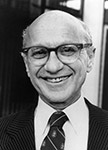
When I was a senior at the University of Chicago in 1975, many professors engaged in the now shocking and politically incorrect practice of serving sherry to undergraduates, in the name of fostering intellectual discussion in an adult atmosphere. I was one of several students in charge of sherry hour at the notoriously louche Shorey House, and I took it upon myself to invite almost every Chicago student’s hero, Milton Friedman, to join us for drinks and conversation.
I just walked into his office, said hello and invited him to the sherry hour. He responded with such unstudied humility that I wasn’t even sure I had the right guy. But he came to the sherry event, signed a Monopoly board with the motto “Down with monopoly!” and left a couple dozen impressionable undergraduates feeling that they had been touched by greatness.
This was not necessarily destined to happen.
Thirty years earlier, as Friedman emerged as a lonely voice for capitalism in a collectivist era, he seemed doomed to a hundred years of solitude. Instead, he arguably became the preeminent public intellectual of the hundred years that followed his 1912 birth.
Politicians such as Winston Churchill, Franklin Roosevelt, John Kennedy and Ronald Reagan are better known for their contributions to social progress, but ideas – not personalities – were at the center of such change. Milton Friedman’s great idea, that free-market capitalism is the only economic system that maximizes prosperity and human liberty, has become the prevailing wisdom. It provides direction (not fully realized) for China, India, Russia, much of Latin America and Eastern Europe and many other parts of the world. As our own growth in the U.S. falters, these places, governed at least partly under the influence of Friedman and the Chicago School of economic thought, are undergoing the most rapid improvement in human welfare ever experienced.
A sample of Friedman’s writings, both on public policy and on economics, is available in a remarkable new collection entitled The Indispensable Milton Friedman, edited by Lanny Ebenstein. These writings are previously unpublished or appeared in small-circulation journals. Thus, readers of Capitalism and Freedom and Free to Choose, his most popular books, will find the essays fresh and new.
Friedman is, of course, also known for “monetarism,” a term that he did not like. Monetarism is the view that economic outcomes are explained at least partially by the money supply, which Friedman thought should grow at a stable and predictable rate. Monetarism has the advantage of providing near certainty about future prices to businesses and consumers. It also keeps the government from trying to fine-tune the economy, a practice that has generally backfired (as we are currently re-learning).
But it is in public policy, not economic theory, that Friedman’s influence is most widely felt. The 1940s and 1950s, when Friedman began his career, were dark days for the idea, if not the practice, of capitalism. While government had not grown as large as it is now, the almost universal consensus among intellectuals and policymakers was that virtually all desirable social goals would be best achieved by expanding government and shrinking the role of private business. No such consensus exists now, in part due to the impact of Friedman’s work on other academics, public officials, opinion leaders and voters.
Friedman gives credit for his intellectual independence to the fad-resistant University of Chicago and the associated, market-oriented Chicago School of economics. If he had pursued his academic career in New York or Massachusetts, he wryly remarks in his essay “Schools at Chicago” in this book, “I would have been regarded as a ‘kook’ and no doubt would have begun to act like one even earlier than I did.”
An overview of the new collection
The Indispensable Milton Friedman is divided into two sections: politics and economics. Happily for most readers, the politics section is not about what we now call politics (elections and public officials); it’s about political economy, the application of economic ideas to governance. Likewise, the economics section is not about economics in a technical sense – it’s about intellectual history, especially merits and foibles of various influential economists.
Of the 20 essays in this book, my personal favorite is “Liberalism, Old Style,” originally published in Collier’s. One of my pet peeves is that leftists have expropriated the lovely word “liberal” (freedom-loving, open-minded, generous) for illiberal causes such as state control of major economic activities. This leaves classical liberals with the less lovely word “conservative.”
Now, there are many things worth conserving, including the environment, works of art, old buildings and certain old manners and mores – but not others. A free market does not conserve anything. As the great economist Joseph Schumpeter said, capitalism is “first and last a process of change.” Schumpeter famously called capitalism an agent of “creative destruction,” and he saw that as a good thing. So Friedman wins my heart in sticking to the old, 18th century terminology in which liberalism means what its etymology says it should mean: freedom-ism.
Cycles of thought and practice
In a title that refers to Shakespeare’s Julius Caesar, Friedman’s chapter, “The Tide in the Affairs of Men,” captures the centuries-long tension between collectivism and socialism, on one hand, and individualism and free-market capitalism on the other. Friedman notes that there can be a long time lag between thought and practice, so that the pendulum of thought can be swinging one way while the pendulum of action is moving in the opposite direction.
The first wave of free-market thought is associated mostly with Adam Smith, who published The Wealth of Nations in 1776, although he had antecedents in John Locke and David Hume and a direct intellectual descendant in David Ricardo. But the heyday of free-market policies occurred in the middle and late 19th century, some two generations after the seminal works on the topic were written. Friedman writes, “The repeal of [Britain’s] Corn Laws in 1846 is generally regarded as the final triumph of Smith after a 70-year delay.” Government really was limited: “At the height of laissez-faire, peacetime government spending was less than 10% of national income in both the United States and Great Britain. … Federal spending [in the U.S.] was generally less than 3% of national income, with half of that for the military.”
Maybe that’s not enough government. I suspect that even many advocates of limited government remember Franklin Roosevelt fondly because he expanded government when it was too small. At any rate, the intellectual tide began to turn in 1848 with the publication of Karl Marx’s Communist Manifesto. In Friedman’s words, “the flood stage, when collectivism began to dominate intellectual opinion, came some decades later.” By 1900, the “Fabian [democratic socialist] tide” had reached its maximum.
But what about putting theory into practice? The flood stage of socialism-in-practice came in the 1940s in Great Britain, when Clement Attlee defeated Winston Churchill and the National Health Service was established. The flood stage lasted for a while: most of the newly independent countries of Africa were founded on socialist principles in the 1960s. True socialism – public ownership of the principal means of production – never really caught on in the United States, although the role of both the federal and state governments in the U.S. grew and grew.
Into this battle strode Milton Friedman, accompanied by his University of Chicago colleague Friedrich A. Hayek (1899-1992), who was originally the better-known economist of the two. For a while, the pair’s crusade for capitalism and freedom seemed not only quixotic but disgraceful. Their academic colleagues were “disgust[ed],” for example, by Friedman’s position as an advisor to the right-wing U.S. presidential candidate Barry Goldwater in 1964.
Under relentless pressure from Friedman and his students, this rigidity began to change. In 1979 and 1980, Margaret Thatcher and Ronald Reagan, both deeply influenced by Friedman, were elected to lead the U.K. and U.S., respectively. The second wave of capitalist thought, epitomized by Hayek and Friedman, took place between about 1940 and 1980 and gained increasing, if grudging, academic acceptance over that period. Friedman was elected president of the American Economic Association in 1967.
In keeping with the principle of a delay between theory and practice, the flood stage of capitalism in public policy arrived in the 1980s and 1990s. Among the events of that period were: the emergence of a market-oriented “Washington consensus” on economic development, Bill Clinton’s adoption of a partially free-market philosophy, major capitalist reforms in China in 1978 and India in 1992 and the subsequent economic booms in those countries, the fall of communism between 1989 and 1991 and the election of market-oriented regimes in much of Latin America and eastern Europe. That’s a lot of change!
Today, we observe a possible turn against capitalism in practice. Among other factors, we see strong public antipathy to the financial sector in the wake of the 2008 crash. This trend is consistent with the idea that the tides of collectivism and individualism rise and fall in long cycles. It has been a while since a revolutionary thinker of the stature of Milton Friedman stood up for capitalism, although his ideas and those of others permeate economics departments and business schools. We need a new Milton Friedman.
Curing health care
Friedman’s essay, “How to Cure Health Care,” written in 2001, could not be more timely. As one might expect, he applies principles of open competition and deregulation to see where they might lead.
First, Friedman observes that medical expenses are, by and large, tax-deductible while other consumption goods are not. Consequently, too much money is spent on medical care overall. Second, he argues that overreliance on third-party payers – insurance companies and government agencies – causes consumers to neglect price in their comparison of health-care providers.
Interestingly, Friedman notes that medicine is already more socialized than we think – “we are headed toward completely socialized medicine and are already halfway there.” But, he argues, we are not getting the cost savings that a true single-payer (monopoly buyer) system makes possible.
Friedman’s habit of mind, when faced with a social problem, is to see whether the problem has been caused or abetted by a government regulation or action and, if so, to reverse that action. Nowhere is that habit more visible than in his recommendations for curing healthcare:
[R]everse past action: repeal the tax exemption of employer-provided medical care; terminate Medicare and Medicaid; deregulate most insurance; and restrict the role of the government…to financing care for the hard cases.
It is not clear what Friedman meant by terminating Medicare and Medicaid. Terminating Medicare would mean not only terminating benefits but also returning Medicare tax money to taxpayers. But haven’t beneficiaries paid into the system for their whole working lives, hoping to receive benefits in old age? If the Medicare tax is no longer collected, a small savings will flow to current workers, but existing beneficiaries who must then buy their own insurance (and who are in various states of decrepitude) will not get their considerable investment in Medicare back. Friedman allows, “many details would have to be worked out.” Indeed. It is one thing not to start a government program, but quite a more difficult thing to end it.
Friedman’s prescription, after much rumination, is a combination of catastrophic health insurance (privately offered) and medical savings accounts. He would not make these items tax-exempt. But if there is a general tax exemption for medical expenses, he would apply it evenly to all such expenses, instead of favoring employer-provided comprehensive insurance over all other means of paying for healthcare.
Friedman’s approach to reforming health insurance has an apparent deficiency: it makes no special allowance for the fact that health-care needs, unlike other needs, are very unevenly distributed. Some people are perfectly fine as long as they receive a $500 physical examination every year; others require millions of dollars worth of surgery, medical devices or rare medications. (Of course, these price points could all be brought down through competition, but the unevenness would still be there.) Friedman’s narrative seems to assume that markets in catastrophic health insurance will develop to even out these disparities, but shunting catastrophic costs over to a third party, while encouraging consumer choice for ordinary medical expenses, probably means that some of the cost problems we are now experiencing would still be present if Friedman’s recommendations were to be adopted.
School choice and the Milton and Rose Friedman Foundation
Late in life, Friedman expressed concern about rising inequality in the United States. This was in apparent contrast to his earlier view that “a society that puts equality before freedom will get neither, [while] a society that puts freedom before equality will get a high degree of both.”1 What troubled him was the increasingly limited opportunity for the less educated. Better education, he wrote, is the only remedy for this problem.
Friedman had long advocated school choice as a way to break up the obviously unproductive government near-monopoly on schooling. While wealthy parents can send their children to private schools, most parents – having already paid for government schooling through the property tax – cannot afford to then pay separately for different schools. To make school choice financially possible for parents of average means, Friedman proposed a voucher system, which has gained some traction despite fierce opposition from teachers’ unions.
To advance the cause of school choice, Milton Friedman and his wife, Rose Director Friedman, established a foundation that focuses on that cause. My guess is that he thought his foundation could make a greater difference by promoting one specific reform than by advocating for economic freedom in general. The “School Choice” chapter in The Indispensable Milton Friedman expresses his views on this topic of deeply personal importance to him.
Friedman originally became interested in school choice “not [as] a reaction to a perceived deficiency in schooling,” but because of his “interest in the philosophy of a free society.” Free people, he argued, should be free to choose their children’s schools for the same reason that they should be free to choose the manufacturers of their cars or television sets: it is right. In 1955, when Friedman began to write about school choice, “the quality of schooling in the United States was much better than it is now.” This is not the typical nostalgia of an old man – Friedman is far too good a scientist to fall prey to that illusion. The quality of schooling really has declined.
To fix the problem and to alleviate rising inequality that he blames at least partly on the government monopoly over primary and secondary education, , Friedman proposes a free market in schooling. “Here, as in other fields, competitive enterprise is likely to be far more efficient in meeting consumer demand than … nationalized enterprises.” In contrast, American universities, which operate in a fiercely competitive market despite a large number receiving partial state support, are considered the best in the world. Whether the Milton and Rose Friedman Foundation succeeds in advancing competitive markets in pre-collegiate education remains to be seen.
Friedman and Keynes
Most of the essays in the economics section of The Indispensable Milton Friedman are less compelling for the general reader than those in the politics section because of their modest, but real, technical content, and because of the obscurity of some of the topics. Does the educated reader who is not an economist care what Friedman thought of Wesley Mitchell or George Stigler? Probably not, though the essays are literary gems from which any sufficiently motivated reader can learn. But almost everyone will enjoy reading Friedman’s views on the great British economist, John Maynard Keynes, who is often regarded as Friedman’s archrival and opposite number.
In fact, Friedman admired Keynes tremendously. Of Keynes’ central opus, the General Theory of Employment, Interest, and Money, Friedman writes:
The General Theory is a great book, at once more naïve and more profound than the “Keynesian economics” that [the Swedish economist Axel] Leijonhufvud contrasts with the “economics of Keynes.”2 … I believe that Keynes’s theory is the right kind of theory in its simplicity, its concentration on a few key magnitudes, its potential fruitfulness. I have been led to reject it, not on these grounds, but because I believe that it has been contradicted by evidence: its predictions have not been confirmed by experience.
Rereading the General Theory has … reminded me what a great economist Keynes was and how much more I sympathize with his approach and aims that with those of many of his followers.
If only all scholars could approach their opponents with such generosity! Friedman’s comments also emphasize his reliance on empiricism over ideology: The correct theory is not the one that conforms to one’s prior ideas, but the one that makes the most accurate predictions.
Friedman and Keynes also agreed on the merits of President John F. Kennedy’s signature economic accomplishment, the 1964 tax cut. Like Abraham Lincoln, Kennedy attracts admirers from all quarters, and many have claimed him as one of their own. Modern supply-side economists identify Kennedy as an early supply-sider, based on his comment, “the soundest way to raise…[tax] revenues in the long run is to cut the rates now.”3 It is impossible to hear Kennedy’s phrase without thinking that he anticipated Arthur Laffer’s famous curve. Yet Friedman writes that Kennedy was acting purely under the influence of Keynes, whose followers in the Kennedy administration enjoyed “their finest hour” with the 1964 tax cut. We misunderstand Keynes if we think he is always on the side of more taxation and more government.
The last words of the next chapter, “The Keynes Centenary: A Monetarist Reflects,” provide the “last word” on Friedman’s view of Keynes:
Keynes was truly a remarkable scientist, even if, to use the words that William Stanley Jevons applied to an earlier brilliant economist, David Ricardo, he “shunted the car of economics on to a wrong line” for some decades.
Readers who are trying to puzzle their way through the today’s macroeconomic and policy issues will benefit both from Friedman’s explanation of Keynes’ theories and from his discussion of why they will tend to lead to policy mistakes. Too many contributors to today’s conversation on macroeconomics throw around Keynes’ name without knowing much about what Keynes said. In particular, Keynes’ advocacy of government spending to combat economic depression is only a tiny piece of a much larger body of work, as Friedman’s essays make clear.
The great depression, the great inflation, and the current malaise
A review of a Milton Friedman book would be incomplete without a few words on money and monetarism. Among professional economists, Friedman is probably most admired for his contributions to monetary theory and for his monetary explanation of the Great Depression. He argued that the Depression was preventable and stemmed from the Federal Reserve drastically contracting the money supply (causing deflation) when it should have been expanding it.
Friedman also predicted the Great Inflation that peaked in 1981. Unlike other economists, who feared a plunge back into depression after World War II, Friedman observed the expansion of the money supply during that period and saw that uncontrolled inflation was the greater danger. The Great Inflation was stopped only when Paul Volcker became Fed chairman in 1979. Although not exactly a follower of Friedman, Volcker pursued a policy informed by monetarism, and the inflation rate plunged from over 13% to under 4%, where it has mostly remained for three decades.
Given this track record, monetarism should have some relevance to the current set of economic woes. A naïve monetarist would predict that the massive expansion of the Federal Reserve’s balance sheet, and the recent high rates of growth in most U.S. monetary aggregates, would have already resulted in inflation rates much higher than we have experienced.
But the line between money and other assets has become blurred since Friedman did his seminal work. Privately provided credit may be regarded as a form of money, but its supply is potentially much larger than government-created money and it is not subject to direct government control.
Thus, Friedman’s monetary prescriptions may not apply directly to today’s dilemmas. No theory is immune to changes in the background environment. We need more work on monetarism and the money supply, performed by researchers of Milton Friedman’s caliber but informed by the institutional facts of today.
Conclusion
If The Indispensable Milton Friedman has a shortcoming, it is that the chapters are selected from Friedman’s second shelf. Friedman was at his very best when explaining hard concepts in simple terms, as he did in his most well known books and on television.
However, this new collection offers us a glimpse into the more detailed workings of Friedman’s mind. It’s an inspiring experience for those interested in free markets, intellectual history and the progress of economic thought over the generations.
Laurence B. Siegel is the Gary P. Brinson director of research at the Research Foundation of CFA Institute and senior advisor at Ounavarra Capital LLC. Before he retired in 2009, he was the director of research for the investment division of the Ford Foundation, which he joined in 1994 from Ibbotson Associates, a consulting firm that he helped to establish in 1979.
Read more articles by Laurence B. Siegel