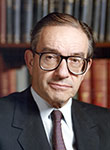
During his six-decade-long career in financial services, Alan Greenspan was a central figure in seminal events that drove investment markets, from the savings-and-loan crisis to the dot-com bubble to the housing crisis. Now, nearing 87, he rarely speaks in public. But he did so last week, offering his forecasts for the U.S. and European economies.
Greenspan was the keynote speaker at the Annual Market Dinner (formerly called the Annual Market Outlook Dinner) of the Boston Security Analysts Society on Feb. 12. The sellout event drew an audience of 700.
Daniel J. Fasciano, the president of the BSAS, introduced Greenspan and briefly reviewed his credentials. Greenspan’s career culminated in his chairmanship of the Federal Reserve as successor to Paul Volcker from 1987, a couple of months before the great market crash of that year, through early 2006. First appointed by President Reagan, he was reappointed by George H.W. Bush, Bill Clinton and George W. Bush. After leaving office, he founded a new firm, Greenspan Associates, LLC. Greenspan was somewhat stooped with age as he approached the dais. But he spoke with the firmness and command of information of his years at the Fed and with greater directness and clarity than he usually allowed himself in public when he served there.
Fasciano posed a number of questions and allowed Greenspan to respond at length.
Pluses and minuses for the economic outlook
Greenspan said 2013 looked to be an extraordinary year, because he could see very major pluses and very major minuses, which he reviewed and combined to reach a conclusion.
He cited, as one plus, the unquestionable improvement in the economy based on indicators such as the weekly index of industrial production. A second plus was the upturn in the housing market, which, he firmly stated, is real. This is partly a function of a decline in the number of vacant housing units, which is driving up prices. He observed that indices of housing are reported with a delay, and he suspected that housing is actually recovering faster than is being reported.
Another plus Greenspan cited was the state of the equity markets. In his words, equity premiums are now at almost the highest level in American history, which means that the market is pleased with the economic outlook and the downside risk is at a minimum. It was extraordinary, he said, to see how far the markets had gone down by March of 2009, when price-to-earnings ratios were at a level where “human beings don’t allow them to go any further.” Although we’re considerably up from there, there is still the possibility of a further rise, he said.
But the minuses, Greenspan asserted, are horrendous and all related to the federal deficit, which we’re having great difficulty controlling. The problem is a rise in social spending, which is not being covered by pay-as-you–go practices and which looks even worse for the future. We’re about to have a major surge as the baby boomers retire, according to Greenspan.
At the same time, discretionary spending is declining, especially military spending, with the end of the war in Iraq and the anticipated end of the war in Afghanistan. The Congressional Budget Office is projecting that the ratio of military spending to GDP will fall to its lowest level since 1940 and the ratio of overall discretionary spending to GDP will sink to its lowest level in 50 years. So the question he asked is, given that there is little room to cut total discretionary spending, how do we fund these entitlements? And the answer, he said, is “with very great difficulty.” This is why Congress is in an extraordinary deadlock.
Equity markets drive the economy
People don’t realize the significance of equity prices, and asset prices in general, for day-to-day economic activity, according to Greenspan. His research shows that equity markets are not only a leading economic indicator, but, much more important, they are fundamental creators of economic activity. Approximately 6% of the growth in GDP is funded by a rise in equity values, on average, though this varies considerably. As a result, increasing equity values can be even more important for economic growth than fiscal stimulus.
The problem with fiscal stimulus is that we measure it gross, by how much it puts into the economy, but we don’t put debits against it. The evidence is unambiguous, according to Greenspan, that rapid increases in deficits raise the expectation of taxes, engendering uncertainty in the business community and leading to significant declines in private capital investment. This lowers the impact of a fiscal stimulus by one-fourth to one-half and possibly significantly more, depending upon conditions. An equity stimulus doesn’t have this negative aspect. The data after March 2009 make clear that the equity stimulus drove the economy. Greenspan acknowledged that an equity stimulus brings with it an increase in private debt, “but not more than the system can handle.”
He reiterated that we must stabilize debt against the growth of GDP, and then bring it down. He said that there is a deep-seated bias in the political system toward spending. And history is incontrovertible: we always underestimate future deficits.
Lessons from the RTC for today’s housing market
Although the housing market is recovering – foreclosures are clearly declining, and the market is beginning to clear – Greenspan said he was reminded of 2008. At that time, half of remediated mortgages went into default again after six months. As prices have gone up and people have built up equity in their homes, that proportion has now fallen to 10%. The key to recovery is having people build up equity in their homes. As that happens, it builds up a cushion; as prices go up 10% or 15%, the underwater homes are cleared out. Remediation made no sense. If we had let the markets adjust themselves, that is, allowed the kind of selling climaxes that clean out an illiquid market and caused prices to fall to a level where the market cleared, we would have been far better off, according to Greenspan.
Greenspan said there were about 750 savings and loans that failed in the late 1980s, when he served on the Resolution Trust Corporation (RTC) Oversight Board. That resulted in a cost to the public, because their accounts were insured by the Federal Deposit Insurance Corporation. These failed institutions held good properties, which the RTC disposed of right away, but they also held “unsalable” properties like 14-hole golf courses and high-rise buildings that were still under construction.
He said he had wondered at the time, how in the world could you sell this stuff? There were no bids. While the properties were empty, they were deteriorating. Vandals were stripping copper off the empty houses. The cost to the public was going to be horrendous. Someone at the RTC decided that the only way to sell these unsalable properties was to bundle them into billion-dollar units and put these units up for auction.
And, he said, a billion dollars then was real money.
The first auction did require some government assistance. And it realized just fifty cents on the dollar, which was about how much the RTC staff had estimated it would. The first result of this was that Congress was very upset, hauled in the RTC, and accused it of wasting taxpayers’ money. But then something very strange happened. The vulture funds saw this and asked themselves how they could have missed this bargain. Wall Street moved in and cleaned out all of the junk in a matter of months. At the end, the net loss was about $80 billion or $90 billion. But it could very easily have been $200 billion if the RTC hadn’t been allowed to use the market to get rid of the overhang.
According to Greenspan, we should have done this again recently. True, there would have been hardship in the short run. But don’t bypass the markets. He said that his longstanding position has been that “if you have people who are really stressed, give them cash,” because cash doesn’t affect the markets.
Don’t try to structure the markets to support prices, he said, because markets will always work out the imbalances no matter what you do. What we have done over the last couple of years has extended the pain far longer than was necessary. Recovery is all about adding to the equity value in homes. But in his view, it’s still not too late to allow the markets to do their work. Prices are, indeed, moving, and he repeated his earlier point that this is one of the major supports today for the economy.
Europe is not as benign as we think
In five years’ time, Greenspan said the European Union is going to be quite different from where it is today, and he outlined the forces that will drive those changes.
Greenspan was party to the early discussions around the European monetary union, when the American, Canadian and Japanese central bankers would meet with the G10 central bankers in Basle, Switzerland. It was interesting that the European central bankers very much wanted to reproduce the monetary system of the United States: no borders, free movement of labor and so forth. Of course, America has a single language, and Europe doesn’t, but as a practical matter, the Europeans use mainly English for commerce across borders. And Greenspan recalled that although the central bankers felt that they couldn’t quite be like the 50 U.S. states, they could come sufficiently close.
There was the serious question of how you could put together countries like Greece, Portugal, Spain and Italy with Finland, Austria and the Netherlands, which have fundamentally different cultures. And the answer given then was that if all the countries joined the euro, the Italians, for example, would become more like the Germans.
At the time, this really didn’t seem implausible. Greenspan recalled that a full five years before the creation of the euro on Jan. 1, 1999, the Italian sovereign 10-year lira note was selling for 500 basis points over the 10-year Deutsche mark note. As the date grew closer, that spread came down, and it did seem as if the Italians were behaving like the Germans. The markets thought so, and so did everybody. The transition went smoothly, and the euro continued to work smoothly for almost a decade.
Greenspan said he had initially been skeptical of the euro, but what he saw happening changed his mind. He recalled making a speech in Frankfurt, when he apologized to his good friend Jean-Claude Trichet, who was president of the European Central Bank. He said, “Jean-Claude, I don't know how you did it but you did. It works. I'm learning something.”
The only problem was that in retrospect, it didn’t work.
The reason the union worked initially was that we were in the midst of a global boom, and the relative competitiveness of the different European countries didn’t matter. They could sell anything they could ship. But underneath, the unit costs of all the “sovereign” Europeans kept rising relative to the “normal” Europeans, he said, with the result that there were intra-Eurozone flows and rebalancing. Debt built up, with the Germans as the creditors and Greece and Portugal at the bottom among the debtors.
Eventually, when the 2008 crisis occurred, the total system could no longer hold together. Spreads, which had become very narrow, blew out to where they were before the existence of the euro. They have since narrowed somewhat, and there's been a lot of economic improvement. Ireland, for example, has improved dramatically. Its labor and production costs relative to the Germany’s have gone straight down and become increasingly more competitive.
But Ireland has another type of problem. Although it had a reasonably sensible fiscal policy, it made the mistake of guaranteeing its banks, which were in terrible trouble. This has created a huge problem that persists to this day.
There is something called “TARGET2” in the European system, which is the debt that the 17 individual central banks lend to each other. In addition to the external debt of the countries, there is also this internal debt, which Greenspan described as a zero-sum game. At one point, Germany had more than $600 billion in net claims on the other Eurozone countries – mainly Spain, Italy and Portugal, but also Greece.
In general, if you rank the European countries by various measures of prudence, Greece is at the bottom with Portugal, followed by Spain and Italy, and you move up the ranks as you move north. The savings rates of the Northern Europeans, for example, are much higher than those of the Southern Europeans. Prudence, we now learn, is what matters.
Greenspan said that he’s working on a book on this subject. We’ve learned that prudence and innovation are what bring countries to the top of the international heap. Measures of these qualities can indicate, for example, how a country deals with corruption and whether there is crony capitalism. Lo and behold –Greece is at the bottom, Portugal next, then Spain, by every one of these indicators.
Greenspan said it is very interesting that the Europeans decided to guarantee the fiscal deficits of all 17 Eurozone countries. There are well over one trillion euros on the European Central Bank’s balance sheet, all financing the deficits. The ECB started guaranteeing the deficits in a small way and continued to do so until it finally decided, “Let's go all out.” So the bank implemented the so-called “outright monetary transaction,” which essentially guaranteed everything.
Greenspan said the ECB reminded him of an old joke – or perhaps it was a true story – that in the days of bank runs, a bank would put all its currency in the window so that customers would see it, be reassured and not try to pull their money out. This is basically what the ECB has done. And it will work only as long as the ECB is sufficiently prudent that its capacity is not called into question.
The U.S. has seen a huge expansion of the central bank’s balance sheet, but it’s never reached the point where there has been any question about the viability of the government’s ability to borrow. Indeed, we can borrow at virtually zero interest. That is not true in Europe. The ECB is on the edge every time a problem arises.
For example, there is an election coming up in Italy. The Socialist party is looking strong, and former Prime Minister Silvio Berlusconi may come back. The centrists, including Mario Monti, do not have very good prospects, according to Greenspan. The result is that the yields on the Italian and the Spanish bonds have spiked up, and the euro has weakened. The reason is that investors fear the system will not hold together. Also, it looks as if Cyprus will have to be bailed out, he said. Cyprus has a very small economy, but there is a real concern about contagion to Greece.
Then again, the European Union has proposed cuts in spending and reduced deficits for the first time, Greenspan said. After surging, then stabilizing, the ECB’s assets have, in the last few weeks, begun to turn down. Greenspan wasn’t sure how long this would last. He also confessed that he didn’t know why the euro was strengthening, especially against the dollar. This is the reason, though, that the European system seems more benign than it may actually be.
Greenspan worried that there is a sense of “austerity fatigue” amongst the Europeans. He wondered how long the Greeks, the Portuguese, the Spaniards and the Italians could maintain the pressure on their budgets. They are not making great progress, but they are not giving up.
He worried about the political cost and what might happen if the people take to the streets. Once we begin to see big revolts against austerity, which he said is a very real possibility, the euro might begin to come apart. It is conceivable that we will see only part of the euro system survive. There is a notion that a group of northern countries, from Finland down to France, could continue to work very well under the euro. Eventually, the Germans, who he said are irrevocably committed to the euro, might say to the Southern Europeans that they should go. Greenspan said that he could not conceive a significant change in culture of the South, which, we now know in retrospect, didn't change after Jan. 1, 1999.
Greenspan said he didn’t know what the euro would be like in five years, but it would likely still exist, only in fewer countries..
Evaluating tail risk
Fasciano asked whether laissez-faire capitalism inherently gives rise to tail risk, and if so, if this is an acceptable risk.
Greenspan replied that if you want to guarantee that that there will be no bubbles, you should have an economy like the Soviet Union’s. A regimented society does not have bubbles; it also doesn't have Standard Oil. We also wouldn't have bubbles if we didn't have human nature, he said. Bubbles come from euphoria, which is a deep-seated inbred characteristic that vies with fear. When we switch from fear to euphoria, bubbles can be the result. Behavioral economists refer to “herd behavior.” We’ve all observed this, when people run in in one direction in droves, like lemmings running over a cliff. And we do that. Yes, Greenspan said, it happens all the time and always will unless human nature changes, which it won’t. Don't question it.
If we wanted the monetary authorities to impose terrible inflation, we would not have stock market bubbles, “I guarantee it.” So the question is, do we live with these problems – and they are problems, but there’s no way around them – or do we live in a highly regimented society? We could impose enough regulations on the financial system, Greenspan said, that bubbles would not occur. But we can’t have it both ways.
The damage caused by low interest rates
Artificially low interest rates result in low “hurdle rates” for return-on-capital investments. Normally, companies add high-tech assets and allow obsolescent assets to depreciate and clear out. The average quality of the capital stock increases. But if interest rates are too low, additions to the capital stock of companies will be of lower quality than the existing assets. In that way, artificially low rates have a negative impact.
And it's also very clear that as interest rates go down, people save less, he said. The data have shown this. “Are low interest rates of value to the system? Yes,” Greenspan said. “Are they a cost? Yes.”
Our irreconcilable fascination with gold
Greenspan observed that it is remarkable that if you go back in history, people have always been fascinated by gold. In Egyptian tombs, the mummies are decorated with it. There seems to be a propensity of human nature to be attracted to gold.
“That makes no sense whatever,” he said. “It is a currency.”
Gold doesn't require signatures, like other forms of credit. Everything else used in payment is essentially credit, but gold is not. Consider, Greenspan said, that in 1944, Britain was on the ropes. It needed to pay for imports, and the only thing its trading partners would take was gold. Gold was the only medium exchanged, the only currency.
There is nothing like gold, he said, with the possible exception of other precious metals. When things get bad, gold can go from $35 an ounce to close to $2,000, as it did at one point recently. This tells you something, he said, and “it ain't good.”
”I was late in the game”
Greenspan was accorded the moniker “The Maestro,” but he has also been accused of fomenting the housing bubble by keeping interest rates low in the early 2000s, following the collapse of the dot-com bubble. He's also faced criticism for failing to recognize the existence of that bubble during his tenure as Fed chairman, arguing that "national price distortion" in housing prices was unlikely. He responded to those claims.
In looking back on the crisis in residential housing, Greenspan said that it was clear at the time that housing was in a bubble. He pointed out, however, that we had just come out of the dot-com bubble, which had virtually no economic effect, and the “so-called” recession 2001 was barely visible. This suggested, he said, that we could probably get through the housing bubble. But he and others made the mistake of recognizing only too late that the dot-com bubble didn't amount to a big problem largely because the toxic assets of the time, which were equities, collapsed in institutions that were not leveraged. Therefore, although there was a very large capital loss, there weren’t the bankruptcies and sequential losses that occur when a leveraged institution holds toxic assets.
The mortgage-debt problem of the 2008 financial crisis was different, according to Greenspan. Mortgages were held in very large leveraged institutions. If we had somehow had the dot-com boom second, it would have been interesting to see how different history might have been, he said.
Greenspan said that he did not become aware of how deep-seated the mortgage-debt problem was until fairly late, say, 2004 or 2005, when it finally it became clear what was happening. At that point, we still had a workable subprime mortgage market that was serving a limited section of our society, which couldn't make a 20% down payment on a mortgage but could nonetheless meet their monthly payments. The mortgage market was reasonably viable and consisted essentially of fixed-rate mortgages. True, he said, there were a few foreclosures, but not enough to matter. The bankers to whom he spoke told him that returns on subprime mortgage were slightly less than the returns on regular mortgages, but principally because of the extra costs of educating people how to manage their mortgages. There wasn't an inherent structural problem.
Then the Department of Housing and Urban Development issued an edict that said that Fannie and Freddie must put a very significant proportion of their assets, which were very substantial, into affordable housing. The only way that the banks could do that, so a president of Fannie Mae told him (not the one involved in the problems), was by going “wholesale.” They created subprime securities. And the subprime securities created a real problem in the marketplace because they required the mortgages to securitize.
When the securitizers tried to get mortgage paper, the group holding the subprime affordable housing mortgages was much too small. The only way to expand the pool of mortgages was downward. The banks couldn’t lower the down payments, so they had to lower the cost of the monthly payments. And the only way they could do this was with adjustable-rate mortgages. A portion of the adjustable-rate subprimes then experienced an increase in rates, and underwriters collapsed. [Some readers may be struck at this point by the contrast with Greenspan’s famous remarks in 2004 in which he all but endorsed the use of adjustable rate mortgages.]
The issuance of subprime securities in 2002 or 2003, which we know only in retrospect because Fannie Mae and others admitted that they were holding extraordinarily large amounts of the stuff, were almost half of net issuance, according to Greenspan. The readjustment of their balance sheets occurred only when Fannie and Freddie started to show sudden and very large losses on what were presumably prime mortgage portfolios. It was clearly not tenable. It was only afterward that they indicated what they actually had, Greenspan said.
For several years, neither Fannie nor Freddie could get a certified accountant to sign off on their accounting statements. Greenspan said that only in retrospect did it become very clear what was happening.
Greenspan said that he had assumed that we would pay some price for this through a decline in market prices, but he thought it was going to be relatively mild. He never expected the 33% decline in prices, which upended the system. “That, to me, came as a shock, a big surprise,” he said. “I was late in the game.”
Adam Jared Apt, CFA, is a financial advisor and the owner of Peabody River Asset Management, based in Cambridge, MA.
Read more articles by Adam Jared Apt