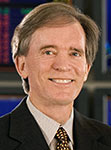
Stocks have come to the end of a “wonderful journey,” according to PIMCO’s Bill Gross, and are now on their own, like “a baby bird just released from the nest.” The journey Gross spoke of is the multi-decade decline in real interest rates, which have fueled bull markets across “risk assets,” especially in equities and bonds.
Real rates can’t go lower, Gross said, and both stocks and bonds are perilously valued; he advised his audience to diversify outside the US.
Gross, who was the opening keynote speaker at the 2011 Morningstar Investment Conference on Wednesday, said that real interest rates have fallen from 4% to -0.5% since October of 2008, as measured by five-year TIPS yields. Nominal rates fell by approximately 200 basis points over that period, and he called both declines “staggering.”
Gross is a founder, managing director and co-CIO of PIMCO, the California-based money management firm.
Real interest rates were 9% in 1981, Gross said, and their decline since then has contributed to secular bull markets in both stocks and bonds.
Real interest rates are now two standard deviations below their average value from the last 25 years.
It’s not just the bond market that has benefitted from the decline in real rates, Gross said. Equity valuations, based on the Gordon model that discounts future cash flows, have risen.
“It’s the real interest rate that’s the critical determinant of asset prices.”
But real interest rates have nowhere to go but up, according to Gross, and that has alarming implications for valuations. “Risk assets have a cap and are limited,” he said.
As evidence that real rates can’t go lower, Gross cited the example of Japan. Its 10-year government bond rates, he said, are just 80 basis points below those in the US. “It is really hard to understand how yields can be driven much lower if only because of the Japanese comparison,” he said. “It's a relevant comparison to make.” Japan has been mired in a two-decade long period economic stagnation, so it serves as the cautionary tale of how capital markets can evolve, despite the government efforts to revive it.
When will rates go up?
Given that real rates can’t go any lower, Gross speculated on what might cause them to rise.
At the beginning of his address, Gross pointed to what he called an “obituary” on the front page of Tuesday’s USA Today – a glaring headline that warned about $68 trillion of US debt, which is still less than the $100 trillion Gross estimates, once Medicare, Fannie Mae and Freddie Mac liabilities are included. This massive debt will weigh down our growth prospects, he warned.
Gross then turned to the effects of this colossal national burden on the bond market.
The Fed is engaged in a “somewhat surreptitious” game of trying to inflate its way out of its debt problems, Gross said. Its primary mechanism has been through quantitative easing (QE). But Gross said there is not enough support within the Fed to engage in another round of QE.
Instead, Gross said, the Fed will attempt to keep rates low through the “language” of its officers – such as their nuanced wording of statements issued following major policy discussions. He expects that language to show that the Fed intends to keep rates low for an “extended” period of time.
Gross doubted that strategy will succeed over the long term. “The Fed can only inflate asset prices so far before, at some point, policy repercussions force investors outside of the US space,” he said.
Savers versus borrowers
According to Gross, the Fed’s loose monetary policies penalize savers and investors at the expense of borrowers – with the US Treasury as the principal beneficiary.
The government’s main play, as Gross sees it, has been to impose a period of “financial repression” in the US. This involves keeping the nominal return on government bonds less than inflation, generating negative returns for investors in the US. Gross’ warning that “this debt will come out of your pocket, Mr. and Ms. Saver!” echoed loudly throughout his address.
Gross drew upon the historical precedent of the 1940s and 1950s to illustrate the likelihood of such a play by the US government. At that time, he said, the government capped interest rates at 2.5%, imposing the same type of “repression” it does now.
An obvious question arises from this less-than-promising outlook for US Treasury debt: Who will buy it? Gross said that banks might buy Treasury bonds, since they haven’t been big buyers recently. Hedge funds might buy some, he said, but he did not identify any other obvious classes of potential buyers.
If the Fed were to guarantee that interest rates would remain low, however, the Treasury would have no problem selling bonds, Gross said. Buyers willing to leverage the ensuing arbitrage opportunity between interest rates and Treasury yields would jump at the chance to buy them.
Even PIMCO would buy Treasury bonds, Gross said, with such a guarantee.
But Gross apparently does not expect the Fed to come forward with such a decisive guarantee, since he has been a recent seller of Treasury debt. Without such reassurance, the market for Treasuries seems likely to go stale. The threat that rising interest rates could cut away at the arbitrage opportunity will deter investors from taking the government’s bait.
The savers’ game
In this repressive environment, how will savers and investors protect themselves from upcoming inflation? In the likely absence of guaranteed low interest rates, it is safest to steer clear of Treasuries, Gross advised.
From all the discouraging prospects through which Gross waded in delivering this address, one clear message emerged: Go global! The signs are clear and the alarms are loud.
Gross sees the most opportunity in bond markets abroad, and he reminded the audience that “Treasuries are only half of the market.” He urged investors to look abroad for opportunities in less repressive countries. While much of the developed world suffers from the same malaise as the US, there are a few bright spots on the horizon, and he foresees a world in the near future in which historically riskier emerging markets offer much more reasonable returns.
Gross pointed immediately to Brazil, which offers real interest rates of 6% to 7%, although he acknowledged that the country’s history of default might give many investors pause. As a somewhat safer alternative, Gross suggested Canadian, German, or even Mexican bonds.
Gross’ other suggestion was US dividend-paying stocks, like Coca Cola, Proctor and Gamble, Johnson and Johnson, and utility stocks. Those securities, unlike Treasury bonds, offer positive real yields, and he said the chance that any of those high-quality companies would reduce its dividend is remote.
The long-term outlook
The future looks bleak in the US, from Gross’ perspective. He confidently declared that in 15 years’ time investors who remain in the US will have had their pockets picked by the government’s financially repressive policies. Furthermore, he predicts the political process will have stalled efforts to reinvigorate the country’s long-term prospects by bolstering infrastructure and education.
In light of Gross’ broader message, though, investors in PIMCO’s flagship Total Return fund, which is now the largest mutual fund in the world, should take caution.
The Total Return Fund’s investors have been richly rewarded since Gross founded it in over 20 years ago, and while much of that growth can be attributed to skillful active management, Gross on Wednesday was very clear: It’s been the decline in real interest rates that has driven total return.
“If real interest rates can’t be driven down further, what total returns can investors expect?” he said.
The fact that Gross is turning to non-US markets and away from Treasury bonds in his fund indicates that, at best, his investors will be exposed to greater currency and default risk. At worst, real rates will increase faster and sooner than most expect, reversing the trend that has so generously rewarded his investors.
Sam Parl is a reporter with Advisor Perspectives.
For more information, please contact Advisor Perspectives at 781-376-0050.
Read more articles by Sam Parl