Dear fellow investors,
In my 45 years in the investment business, we’ve observed numerous peaks of excitement. In 1987, a bull market that started at a 1982 bottom below 800 on the Dow Jones Industrial Average (DJIA) peaked at 2,722. It then crashed 43% in 78 days. In 1990, just following a nationwide Savings and Loan Crisis, the S&P 500 Index bottomed at 322 and peaked at 1,517 in June of 2000. The proceeding bear market took the index down to 916 on June 1, 2002. The index never officially bottomed until September 1, 2008 at 896. It has now hit a recent peak of 7,580.
What did these situations have in common? First, they started with cheap stocks after a bear market decline loaded with fear and investor pessimism. The longer the market moved forward, the more confident investors became. Ultimately, euphoria took over and investors gained what we would call damaging confidence.
Read more: AI’s Expansion Runs on Smaller Companies
In a piece this week, Thomas R. Carroll, Director at Stifel, and his associate, Miles Matyiko, point out what Warren Buffett said about bull-market runs.1 I believe I heard Buffett say one time that a bull market is like an orgy; it always gets the most exciting towards the end. Carroll explains, “Bull markets have explosive starts, unexciting middles and FOMO-driven finales.” The great investor Sir John Templeton always said, “Bull markets are born on pessimism, grow on skepticism, mature on optimism, and die on euphoria.”
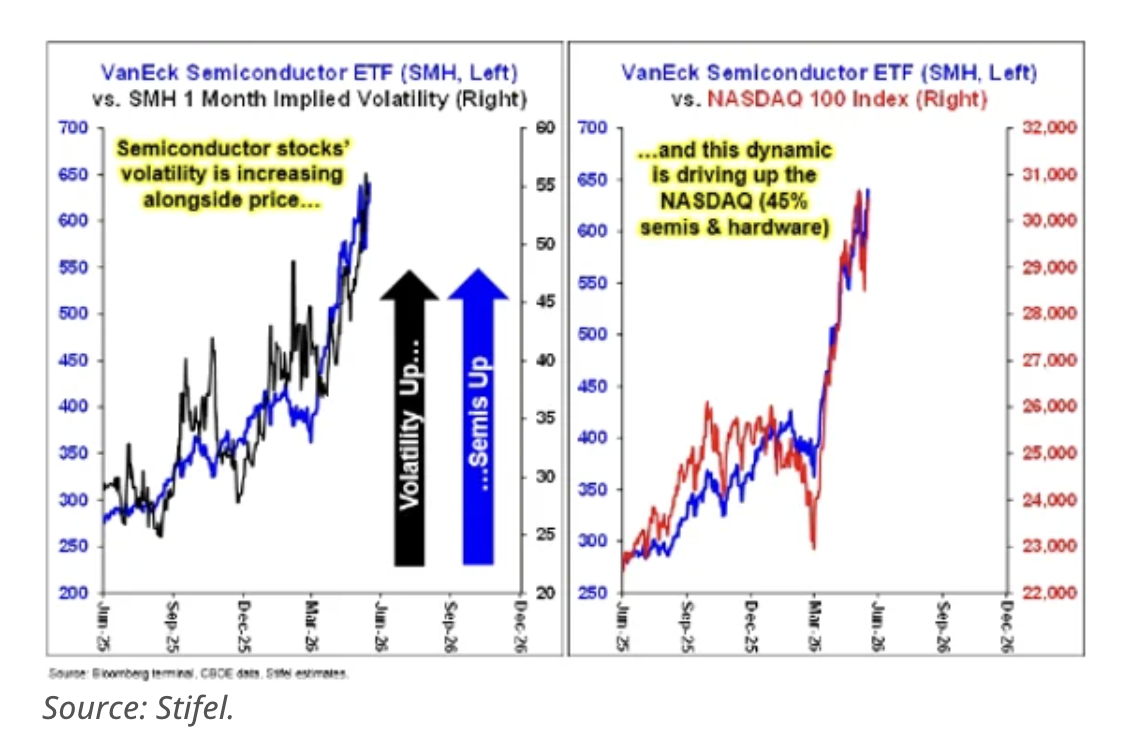
Carroll argues that history shows that when dispersion peaks at major tops in the index, it is a sign of a coming rotation. He says, “They go out with a bang.” Historically, it is a time to get away from whatever seems to be making everyone wealthy. He used this chart of the Van Eck Semiconductor ETF:

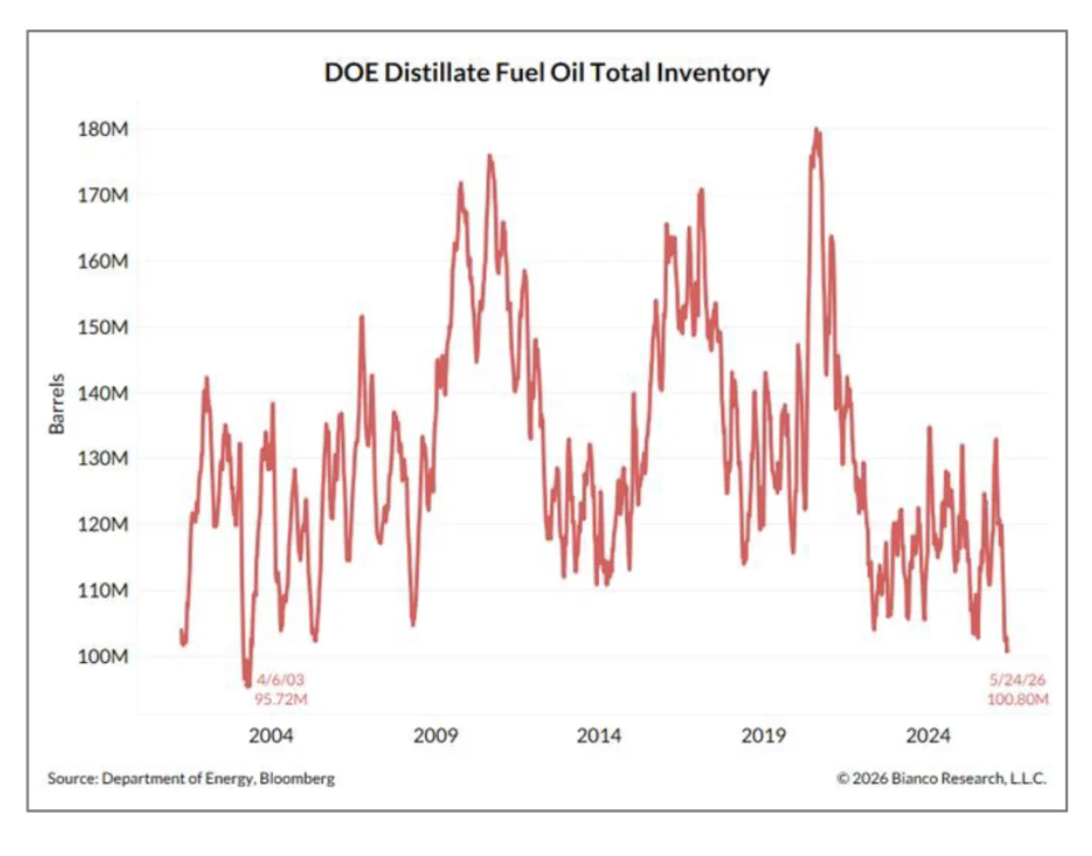
Therefore, if you are wondering why we are positive about the companies in industries like oil and gas, homebuilders and regional banks, look no further than the chart below.
We also expect homebuilders and regional banks to do quite well when money comes out of the popular technology trade of the day. Much like in 2000-2002 when there was a pretty good run in mundane industries and the DotCom mania ended.
Play The Long Game,
William Smead
1Stifel Market Commentary/Strategy article titled, “Stocks don’t ring a bell at the top, but stock volatility might!” Published June 16, 2026.
A message from Advisor Perspectives and VettaFi: Discover something new! Click here to register for our upcoming webcasts.
The information contained in this missive represents Smead Capital Management’s opinions, and should not be construed as personalized or individualized investment advice and are subject to change. Past performance is no guarantee of future results. Bill Smead, Chairman & CIO, wrote this article. It should not be assumed that investing in any securities mentioned above will or will not be profitable. Portfolio composition is subject to change at any time and references to specific securities, industries and sectors in this letter are not recommendations to purchase or sell any particular security. Current and future portfolio holdings are subject to risk. In preparing this document, SCM has relied upon and assumed, without independent verification, the accuracy and completeness of all information available from public sources. A list of all recommendations made by Smead Capital Management within the past twelve-month period is available upon request.
©2026 Smead Capital Management, Inc. All rights reserved.
This Missive and others are available at www.smeadcap.com
© Smead Capital Management
More Closed End Funds Topics >