Are You There, Inflation? It's Me, Kevin Warsh
Membership required
Membership is now required to use this feature. To learn more:
View Membership BenefitsKevin Warsh arrives in Washington with a laundry list of changes he wants as Federal Reserve chairman. He might struggle to achieve them anytime soon—or at all—facing possible backlash from other policymakers and a deep foundation of institutional tradition.
Reducing interest rates from the current range of 3.5% to 3.75% is probably the goal most often associated with Warsh, but with inflation still elevated, that may be his biggest challenge.
"We assume he'll try to have a lower rate bias, but inflation above 2% will make that difficult," said Collin Martin, head of fixed income research and strategy at the Schwab Center for Financial Research (SCFR).
Several other goals stand out, including reducing the size of the Fed's balance sheet, changing how the Fed communicates, and, perhaps most important, convincing the market he's independent from President Trump.
Lighter rates a heavy lift
In April's Federal Open Market Committee (FOMC) meeting chaired by outgoing Fed Chairman Jerome Powell, four policymakers dissented from the FOMC's decision to pause rates between 3.5% and 3.75%. Of those, three weren't against the pause, but instead opposed what they called the FOMC's bias toward easing rates with inflation—surging amid a war-fueled oil rally. Inflation is above 3% annually, and the Fed's inflation goal is 2%.
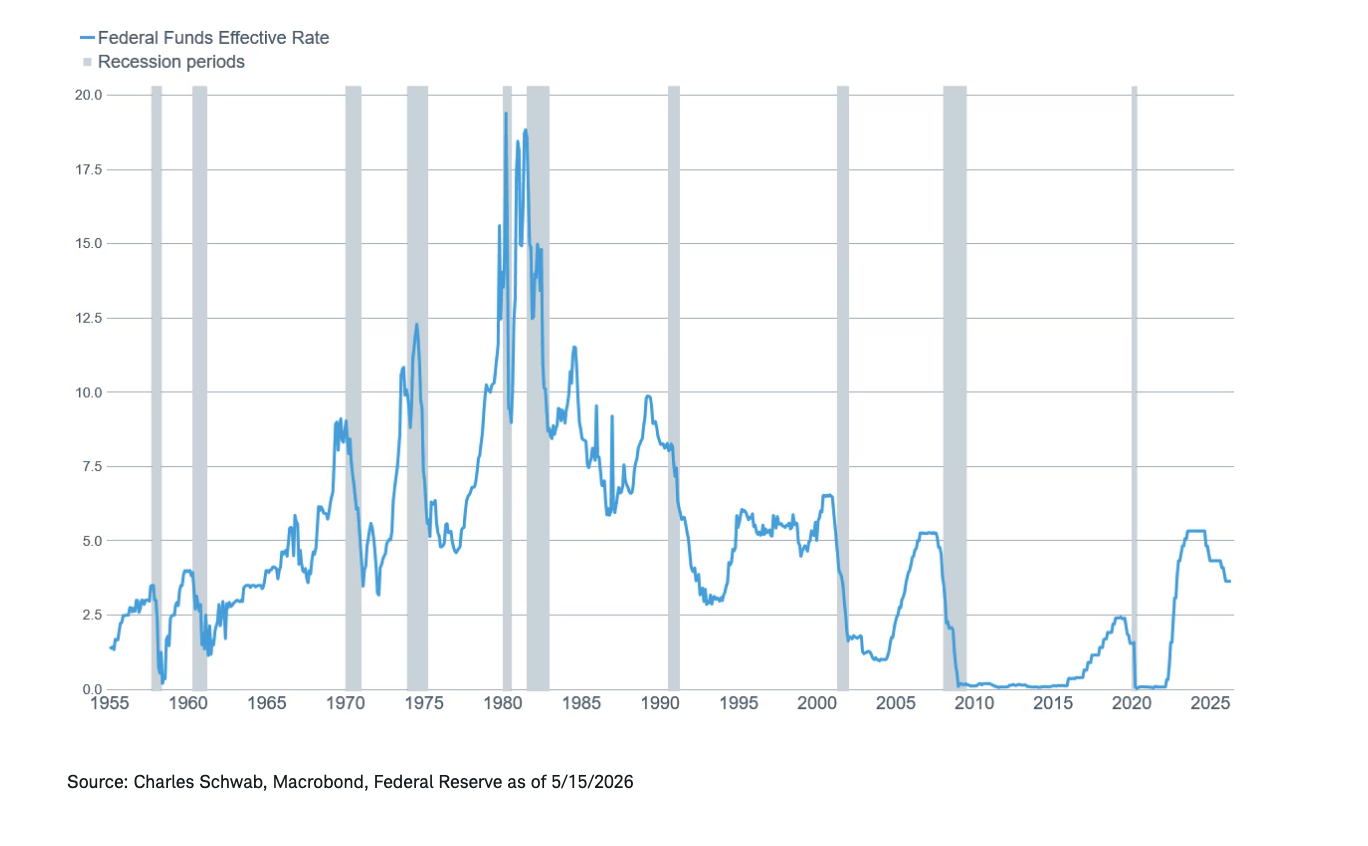
"The dissents could represent an acknowledgment that the risks to higher inflation are greater than the statement implies," Martin said. "With inflation above the Fed's 2% target for five years and counting, the committee can't be complacent."
Warsh, a hawk when he served on the Fed during the Great Financial Crisis 20 years ago, became more dovish over the years. He thinks the Fed can keep rates lower based on AI-driven productivity improvements.
Read more: Schwab Market Perspective
The AI boom is "the most productivity-enhancing wave of our lifetimes—past, present and future," Warsh said, according to a recent New York Times article. He called AI "structurally disinflationary."
This theory triggered debate about whether the Fed could let the economy safely "run hot" under an AI-driven productivity surge by lowering rates. Not all Fed policymakers share his views.
"I expect that the AI boom is unlikely to be a reason for lowering policy rates," Fed Governor Michael S. Barr said in February.
Barr was one of eight FOMC members voting to keep rates paused at the April meeting. With eight members voting to pause and three others opposing any sign of easing bias, it seems unlikely Warsh can change the paradigm right away, barring some sort of massive collapse in employment.
"It's a reminder to Warsh that the most important letter in FOMC is the last one: C for committee," said Michael Towsnend, managing director of legislative and regulatory affairs at Schwab.
As of May 15, the CME FedWatch Tool shows almost no chance for a 2026 rate cut and—after the recent bearish April Consumer Price Index (CPI) and Producer Price Index (PPI)—factors in a much higher chances of an inflation-fighting rate hike. This would be an ironic turn if that's Warsh's first move after he stressed the need for rate cuts.
His challenge intensified with news that Powell plans to stay on the board, meaning the former Fed chair will continue to have a vote on rate policy. That makes Warsh the first new Fed chairman in more than 70 years to inherit an active predecessor.
Powell promised he'll keep a low profile, but any public remarks he makes arguably carry more weight than words from any other Fed policymaker besides Warsh himself.
Powell's decision to stay also means the exit of Fed Governor Stephen Miran, who voted several times to lower rates.
"That's another important facet of this looking ahead, is that the uber-dove is now not a member of the Fed anymore," said Liz Ann Sonders, chief investment strategist at SCFR.
Cutting the Fed's balance sheet
The balance sheet is somewhat esoteric and more of a background buzz than a headline maker. That said, it can affect rates, and Warsh's hopes of taking a knife to it may raise resistance.
The Fed's quantitative easing, or QE, program following the Great Recession (and again after the pandemic) added trillions of dollars to Fed holdings in hopes of keeping rates down and stimulating economic growth. At its peak in 2022, the balance sheet reached almost $9 trillion before falling to around $7 trillion by the beginning of May 2026.
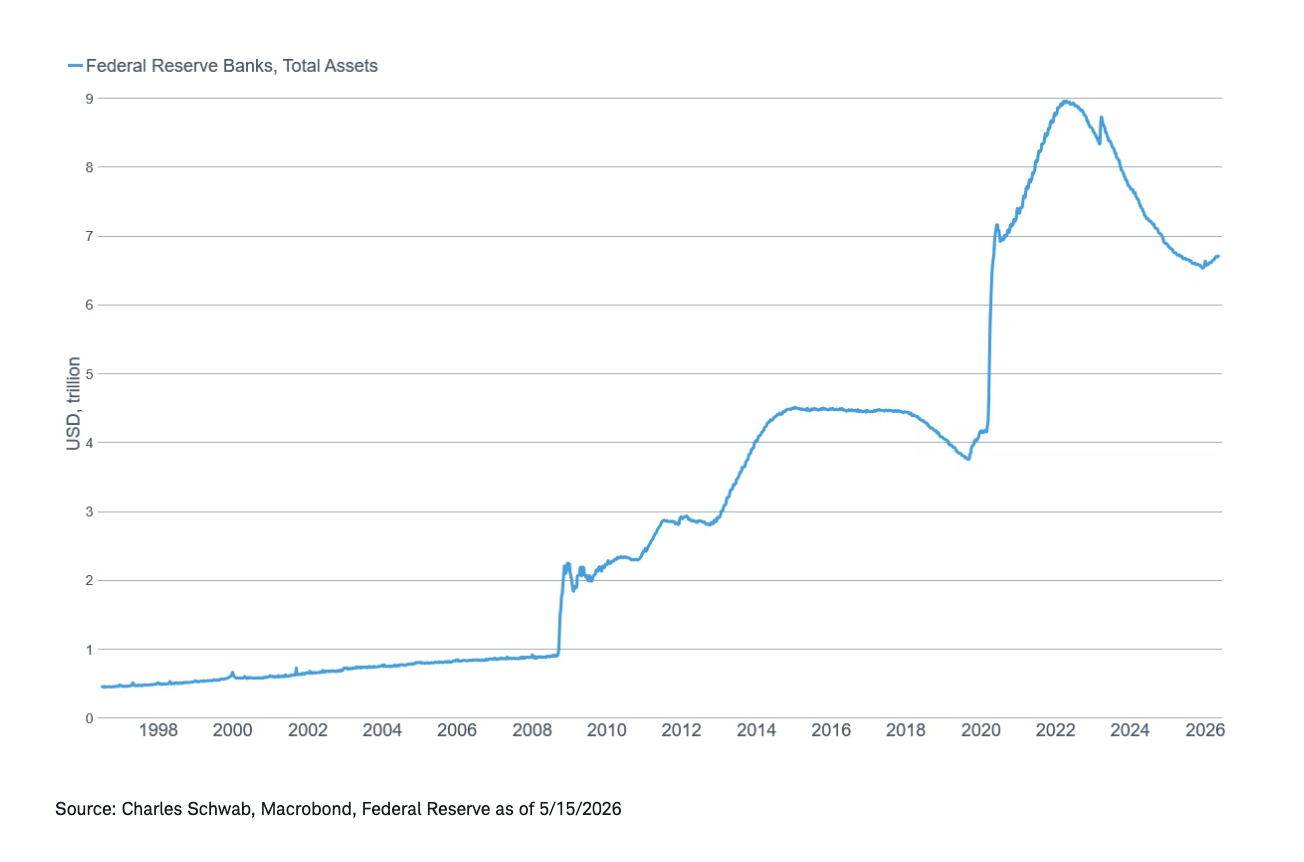
This gradual diminishment, or Quantitative Tightening (QT), was an effort to ease inflation when it surged in 2022 and 2023, but the balance sheet remains well above 2010s levels near $4 trillion and the under-$1 trillion it sat at before the 2008 financial crisis. It's off its recent high as a percentage of gross domestic product, or GDP, but remains elevated by historical standards.
The balance sheet mainly consists of financial securities that the Fed buys and sells in the open market. When it adds longer-duration securities to the balance sheet under QE, Treasury yields can fall, reducing corporate and consumer borrowing costs. When it reduces holdings, yields tend to rise, but it's a delicate balance. Sometimes the signal is more important the actual implementation.
Warsh wants to see the balance sheet fall, saying it gives the Fed too much presence in financial markets. He called it "bloated" in a 2025 Wall Street Journal opinion piece. But shrinking it too quickly might trigger market volatility by causing bank reserves to decline.
Even during the recent shrinking, the Fed late last year had to commit to buying $40 billion a month in Treasury bills through April to keep reserves ample. This was in hope of avoiding a repeat of 2019 when volatility surged in the so-called "repo," or repurchase agreements, market where the Fed provides temporary liquidity to banks and other lenders.
"Warsh has long been a proponent of a smaller balance sheet," Martin said in a recent On Investing podcast. "If the Fed were to reduce its holdings of Treasuries, that could send yields higher, and new buyers would need to step up. That would go against the current administration's preference for lower yields."
From comments that Warsh made at his Senate Banking Committee confirmation hearing last month, he knows he can't make an immediate impact on his balance sheet goals.
"What's important is that Warsh mentioned that it'll take a lot of time, and it should be well communicated," Martin said. "He said something along the lines of 'What was done over 18 years can't be undone in 18 minutes.' So, if there is a plan to shrink the balance sheet, it will likely take time so that the markets don't react or see a pickup in volatility."
Shifting communications
Those who began following the markets over the last 15 years may not realize that press conferences by the Fed chairman after FOMC meetings weren't always part of the scenery. They only began regularly in April 2011 under Fed Chairman Ben Bernanke, a tradition continued by Fed Chairs Janet Yellen and Powell.
The media and investors pay close attention, and the market often moves on the chair's observations. Not everyone is a fan, and Warsh apparently doesn't relish the idea. In his nomination hearing, he declined to commit to holding press conferences after every policy meeting, CNBC reported.
Warsh may also want to rein in the number of economic projections the Fed issues, currently four times a year. Additionally, Fed policymakers frequently speak publicly, but that might be reduced if Warsh has his way.
"It seems like he really wants to change how the Fed communicates and the frequency of communications," Martin said.
In speeches and articles, Warsh has said too many economic predictions and speeches by Fed policymakers can make them "prisoners" of their predictions.
"There's pros and cons to all the communications we hear," Martin said. "We get a very open look at what everyone's thinking at a given point in time. But then when a given official gives a speech, that can move markets. Now if we lose that, maybe we focus more on the economic data and our own analysis as opposed to everything they're telling us."
In an even more dramatic move, Warsh even discussed having the FOMC meet just four times a year instead of eight.
"I'd be hard pressed to see an outcome where they only meet four times a year, but never say never," Martin said. "I don't think it's in the cards."
Though Warsh has almost complete control over his press conferences and isn't required to hold any, the dot plot might be harder to chip away. Even an attempt to cut back on his own press conferences might trigger criticism from investors who've grown used to hearing journalists try to pin down Fed chairs on their thought processes.
"It has been must-see TV, but I guess we'll get more time back, more time to dissect the statement and such," Martin said. "But who knows? There's no firm plans just yet. There'll probably be a period where maybe it could create some uncertainty and maybe some volatility, given that it's going to be a little bit different if these changes come to fruition, but we'll see."
Dot plot targeted, inflation changes proposed
Digging deeper into Fed processes, Warsh seems to have misgivings about the dot plot, a quarterly tool shared by the FOMC mapping out where each policymaker expects rates to head in coming years.
"The Fed tells the whole world what their dots are going to be, what their forecasts are going to be," Warsh told the Senate Banking Committee at his hearing, according to Barron's. "I think if the Fed were to wait until it gets into a meeting before making a decision, that incremental deliberation can keep the central bank from compounding its errors."
The dot plot is popular with investors and analysts, however, and there may be resistance to throwing it away. Central bank transparency has been frequently emphasized since the financial crisis, and the dot plot is an important tool many use to model the future rate environment.
In another proposal that may face backlash, Warsh discussed changing how the Fed calculates inflation.
"What I'm most interested in is: What's the underlying inflation rate?" Warsh told the committee, according to CNBC. "Not: What's the one-time change in prices because of a change in geopolitics or change in beef [prices]. The measures I prefer are looking at things that are called trimmed averages. We take out all of the tail-risks, all of the one-off items, and we ask ourselves whether the generalized change in prices is having second-order effects on the economy."
Measuring that way might lead to lower inflation numbers than what's out there recently. The counter argument is that changing calculations to focus on long-term impacts might make it harder to understand shorter-term fluctuations affecting consumers and businesses.
Independence day
Last and certainly not least, Warsh faces the challenge of proving he's his own man. He was nominated by President Trump, who's made no secret of wanting rates to fall, and Warsh himself has advocated dovish policy for some time.
He's probably the first Fed chair nominee to have a senator ask him if he'll be a "sock puppet" for a president, something he vigorously denied at his hearing.
Warsh told senators he didn't promise President Trump rate cuts in return for his nomination. In fact, he emphasized the importance of the central bank making decisions unharnessed to politics.
"I've known Kevin since 2003, so a long time," Sonders said. "I think he's very smart. I do believe he understands the importance of the independence of the institution."
Even so, if Warsh pushes through rate cuts, he may find himself second guessed and even face fresh "sock puppet" allegations.
Rate cuts the market doesn't believe in can generate howls of protest from the market in the form of higher Treasury yields, making the Fed's job even tougher if economic growth slows in an inflationary climate. If Warsh doesn't want an appointment with so-called "bond market vigilantes," he'll likely have to stick to his promise of Fed independence so long as inflation remains elevated, risking presidential backlash.
It's quite a tightrope, as The Wall Street Journal observed in a recent headline, even for a Fed chairman who's anything but a rookie as he arrives in Washington and takes the gavel.
This material is intended for general informational and educational purposes only. This should not be considered an individualized recommendation or personalized investment advice. The {securities, investment products and investment strategies mentioned are not suitable for everyone. Each investor needs to review an investment strategy for his or her own particular situation before making any investment decisions.
For illustrative purpose(s) only.
Past performance is no guarantee of future results.
Schwab Center for Financial Research ("SCFR") is a division of Charles Schwab & Co., Inc.
Supporting documentation for any claims or statistical information is available upon request.
Investing involves risk, including loss of principal, and for some products and strategies, loss of more than your initial investment.
Diversification strategies do not ensure a profit and do not protect against losses in declining markets.
Indexes are unmanaged, do not incur management fees, costs, and expenses and cannot be invested in directly. For more information on indexes, please see schwab.com/indexdefinitions.
The policy analysis provided by the Charles Schwab & Co., Inc., does not constitute and should not be interpreted as an endorsement of any political party.
Fixed income securities are subject to increased loss of principal during periods of rising interest rates. Fixed-income investments are subject to various other risks including changes in credit quality, market valuations, liquidity, prepayments, early redemption, corporate events, tax ramifications, and other factors.
All expressions of opinion are subject to change without notice in reaction to shifting market, economic or political conditions. Data contained herein from third party providers is obtained from what are considered reliable sources. However, its accuracy, completeness or reliability cannot be guaranteed.
A message from Advisor Perspectives and VettaFi: Discover something new! Click here to register for our upcoming webcasts.
Membership required
Membership is now required to use this feature. To learn more:
View Membership Benefits