Dear fellow investors,
During and after World War II, Allied forces established airbases across remote Pacific Islands, bringing with them food, medicine, tools, and machinery that the indigenous people had never encountered before. When the war ended and the bases closed, the cargo stopped coming. But some Islanders, having observed the relationship between certain rituals performed by the soldiers and the subsequent appearance of planes, concluded that all they needed to do was mimic those rituals, with the end result being the planes and their cargo returned.
So, they built wooden control towers, fashioned headsets from coconut shells, lit torches along jungle clearings, and marched in formation with bamboo rifles, replicating each element of the process that had previously brought supplies to the island. To their surprise, the planes never came.1
Richard Feynman used this metaphor to describe pseudoscience, the appearance of rigor without its substance. The cargo cult scientist replicates every observable form of the scientific process while missing the one thing that makes it work. Cargo cult thinking is the precise and sincere replication of the forms of a process whose underlying mechanism no longer operates. We believe it is the most accurate description of how a generation of investors has come to approach investing in today’s financial markets.
Read more: Tax-Aware Investing for Institutional Portfolios
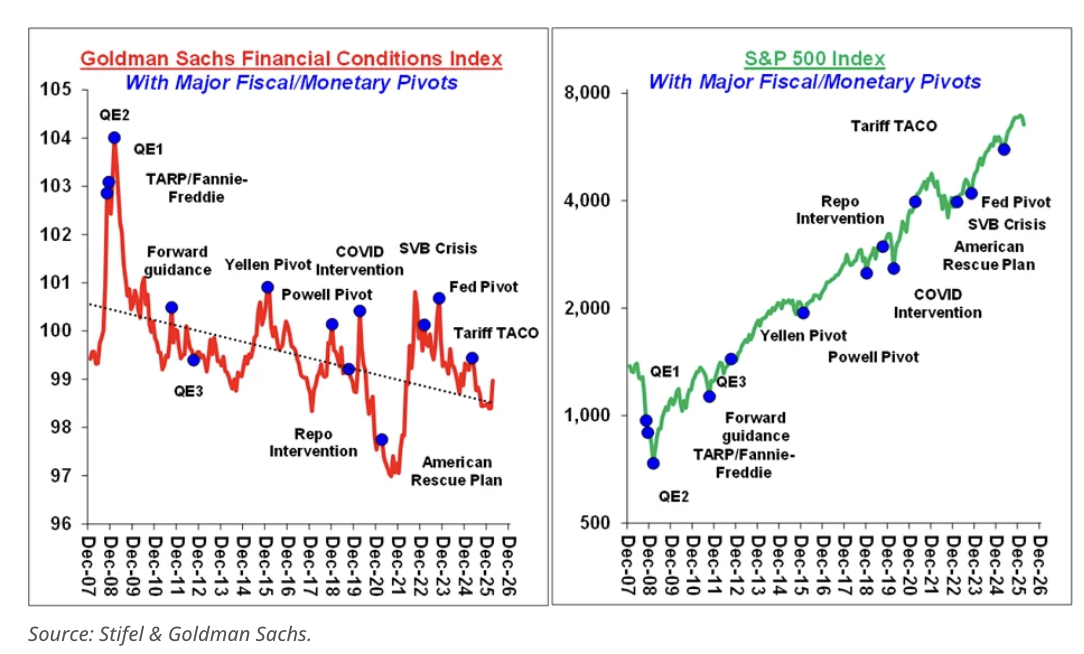
For fifteen years, a clearly validated relationship has existed between market stress and policy intervention. Each time markets faltered, the Federal Reserve cut rates, launched quantitative easing, or provided emergency liquidity, and markets recovered. Investors observed this relationship, internalized it, and have been replicating it with increasing faith: buy every dip, because the mechanism that produced recoveries is permanent and reliable.

What the fidelity to ritual has obscured is how radically the object of the ritual has changed. As passive investment has grown to nearly half the market, buying the dip is no longer an act of broad-based conviction in the American economy; it is a concentrated bet on seven companies that now represent 35–40% of the entire S&P 500 Index.
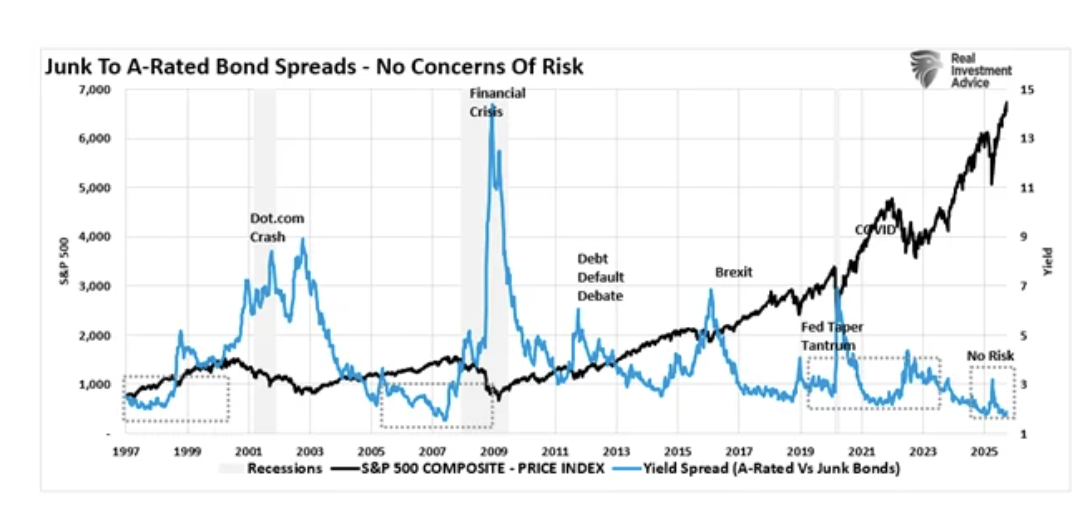
The conditioning shows up across every measurable dimension of investor behavior. Household equity allocations are near their highest levels on record, surpassing even the peaks of 1999. Credit spreads between investment-grade and junk bonds have compressed to near-record lows, with investors pricing in a near-zero probability of default. It is not because corporate balance sheets have never been stronger, but because investors have stopped believing that defaults are a risk that the mechanism will permit.
The conditioning was not irrational; it was a learned response to a genuine mechanism built on structural pillars that made Federal Reserve intervention both possible and reliably effective for decades.
The first was the forty-year decline in interest rates. From a peak of nearly 20% in 1981, the Federal funds rate gravitated toward zero. Every intervention could be more powerful than the last, because there was always more room to cut. To say that room is now limited would be an understatement.
The second was the effect of the Triffin dilemma. To supply the global economy with sufficient dollar liquidity, the US must run persistent current account deficits, exporting dollars by consuming more than it produces. Those deficits generate the capital inflows that fund US asset markets: foreign central banks and sovereign wealth funds recycling trade surpluses back into Treasuries and US equities, suppressing yields and inflating valuations. The cargo was not coming because the ritual worked. It was coming because the plumbing required it.
Third was the rise of passive investing, procrustean by design. Capital is not allocated to fit the quality of the underlying business; it is cut or stretched to fit the index, regardless of valuation. As index funds grew to nearly half of all equity assets, price discovery weakened. Rising prices validate the ritual, which attracts more capital, which produces more rising prices.
Fourth was the nature of the businesses that came to dominate the index. The MAG-7 stocks were genuinely exceptional, asset-light, high-margin, capital-efficient, with near-monopoly positions. The concentration of passive capital into these names reflected real and durable earnings power. This is what made the cargo cult so seductive: the planes did arrive, reliably, for a long time. The error is not in having observed the relationship. It is in assuming it is permanent.
Each pillar is now under pressure.
The Fed cannot return rates to zero without reigniting inflation. The policy space that made each prior intervention larger than the last has been consumed.
The Triffin architecture is being actively dismantled. Michael Every of Rabobank’s “reverse perestroika” framework argues that Trump’s program, tariffs, capital controls, and a Treasury-subservient Fed with dollar stablecoins to fragment the Eurodollar system, is a direct assault on the recycling mechanism. The independent Fed is being replaced with an institution oriented towards national security objectives. The open capital account is being subjected to controls. If the current account deficit narrows, the structural bid for US assets weakens.
The world is becoming less global. Supply chains are being reoriented around security rather than efficiency. The international architecture that enabled the Triffin mechanism is being deliberately unwound.
And the businesses at the center of passive concentration are undergoing a transformation most investors have not priced in. The MAG-7 are no longer purely asset-light compounders. The demands of AI infrastructure, data centers, custom silicon, and energy capacity are converting them from the high-return businesses that justified their valuations into capital-intensive enterprises whose returns on invested capital could be structurally lower than in the past.
Each pillar is cracking simultaneously. The runway is built. The headsets are on. The decade ahead will be defined not by the faithfulness of the ritual, but by the quality and independence of your thinking.
A final word on what this letter is not. We are not bears on America, or on the capacity of markets to generate wealth over time. We are optimists about the arc of human enterprise, the ingenuity of capital markets, and the compounding power of patient ownership in exceptional businesses. We are not optimists about the near term, not because we enjoy that position, but because the evidence requires it. We believe the most likely outcome is not a catastrophe but a prolonged period of flat to modestly negative real returns for the passive index investor.
Play The Long Game,
Seamus Sullivan
1 Philip Skogsberg, “Cargo Cults Are Everywhere,” Substack, 2024.
The information contained in this missive represents Smead Capital Management’s opinions, and should not be construed as personalized or individualized investment advice and are subject to change. Past performance is no guarantee of future results. Seamus Sullivan, Senior Analyst, wrote this article. It should not be assumed that investing in any securities mentioned above will or will not be profitable. Portfolio composition is subject to change at any time and references to specific securities, industries and sectors in this letter are not recommendations to purchase or sell any particular security. Current and future portfolio holdings are subject to risk. In preparing this document, SCM has relied upon and assumed, without independent verification, the accuracy and completeness of all information available from public sources. A list of all recommendations made by Smead Capital Management within the past twelve-month period is available upon request.
A message from Advisor Perspectives and VettaFi: Discover something new! Click here to register for our upcoming webcasts.
© Smead Capital Management
Read more commentaries by Smead Capital Management