Key Takeaways
-
Investors took a defensive stance in March. They funneled a record $29 billion into short-term government bond ETFs to seek safety amid geopolitical tensions. The month saw a 40% drop in average monthly inflows.
-
While the tech sector saw $3.3 billion in outflows due to valuation concerns, energy ETFs achieved a record $5 billion in monthly inflows and robotics & AI captured 95% of all thematic interest.
-
The traditional dominance of U.S. exposure is fading as investors seek regional balance. That was evidenced by non-U.S. equity ETFs attracting $31 billion in new capital — nearly rivaling U.S. equity inflows.
In addition to busted brackets, madness in March stemmed from ongoing volatility. The CBOE Volatility Index (VIX) rising above 20% evidenced as much. Nonetheless, U.S.-listed exchange-traded funds (ETFs) managed to churn out $104 billion in monthly inflows based on the latest report from State Street Investment Management (SSIM).
This came amid a backdrop of escalating conflict in the Middle East, stubborn inflation, and other macro factors. The $104 billion inflows registered 40% below the recent six-month average, which signaled that investors have taken a more defensive stance with restrained buying behavior.
"For now, markets are contending with more questions than answers as higher yields, wider risk premia, and elevated macro risks have forced a recalibration—just as uncertainty did at the outset of Liberation Day a year ago," noted Matthew Bartolini, global head of research strategists at SSIM, noted in the report.
True, the inflows into ETFs weren't a proverbial full-court press. However, there were areas that did see heightened inflows amid March's volatility.
See More: Value ETFs See Record Inflows as Investors Abandon Growth
Short Duration and Broad Commodities
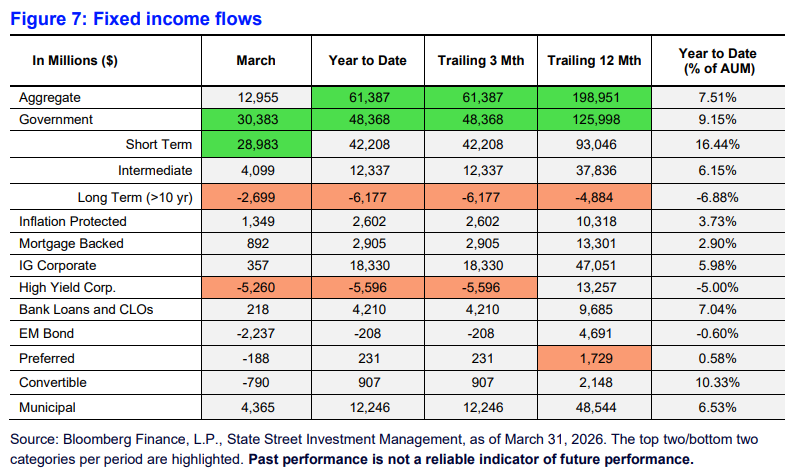
One of the more pronounced trends in March was a pivot towards defensive fixed income. Bond ETFs attracted $42 billion, but inflows and outflows into various portions of the yield curve told a story centered on concern over rising rates.
After three consecutive rate cuts to end 2025, the first quarter of 2026 saw the "higher-for-longer" narrative return with sticky inflation and the Fed standing pat on interest rates. As as a result, short-term government bond ETFs saw a record-breaking $29 billion in inflows as investors sought the safety and liquidity of the short end of the yield curve.
On the opposing side of the yield curve, long-term government bond ETFs posted $3 billion in outflows. Additionally, credit-sensitive sectors saw $6 billion exit, thanks to widening risk premia. As Bartolini noted, this "bear-flattening bias" suggests that investors are becoming more wary of the fiscal consequences from a prolonged conflict in Iran as well as the potential for defense spending to be debt-financed, which only applies pressure to current deficits.
As mentioned, inflation concerns remain front-and-center. That said, this helped inflation-linked bond ETFs add $1.3 billion inflows, which marked their 12th month of inflows in the last 13.

That $1.3 billion number was mirrored in broad commodity funds, which also saw their inflow streak extended to 10 consecutive months as investors sought resilience against the tandem of supply chain disruptions and price shocks. On the commodities front, gold lost its luster in March. The month saw $13 billion in outflows from ETFs tied to the precious metal amid renewed dollar strength. However, this came after gold ETFs saw sustained inflows of $34 billion the past year.
See More: Record January ETF Flows Highlight Rotation Away From Concentration
Energy's Slam Dunk
Sector flows revealed a risk-off sentiment with $5 billion outflows. The tech sector was the hardest hit with $3.3 billion outflows as investors questioned valuations of mega-cap tech names, and whether heavy capital expenditures (CapEx) into AI investments could translate into tangible revenue in the future.
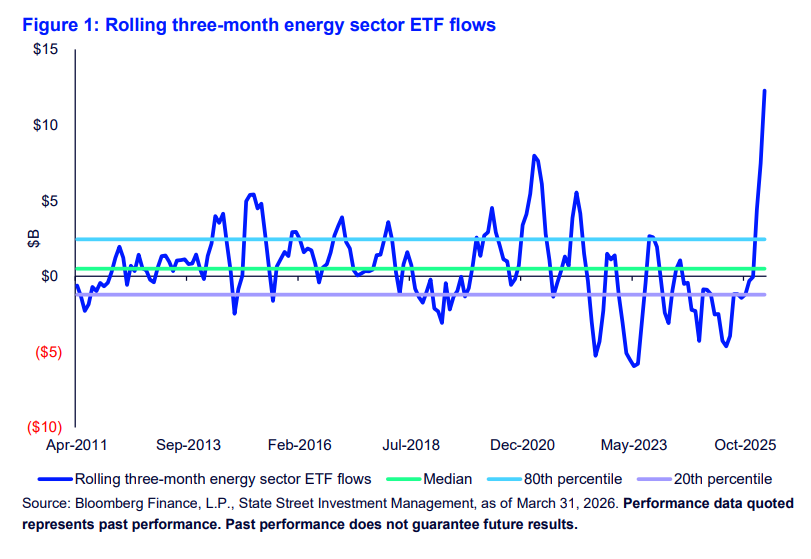
The energy sector, however, was a slam dunk amongst investors as oil prices went parabolic — a great catalyst for earnings. Energy ETFs attracted a record $5 billion inflows during the month of March. Additionally, the sector closed out a record Q1 with $12 billion rolling three-month flows.
International equities continue to bring in more investors. The dominance of U.S. exposure continues to fade as more investors are seeking regional diversification for their portfolios. With that, non-U.S. equity ETFs took in $31 billion, which was just $8 billion less than the inflows into U.S. equities.
Thematics and Lingering Uncertainty
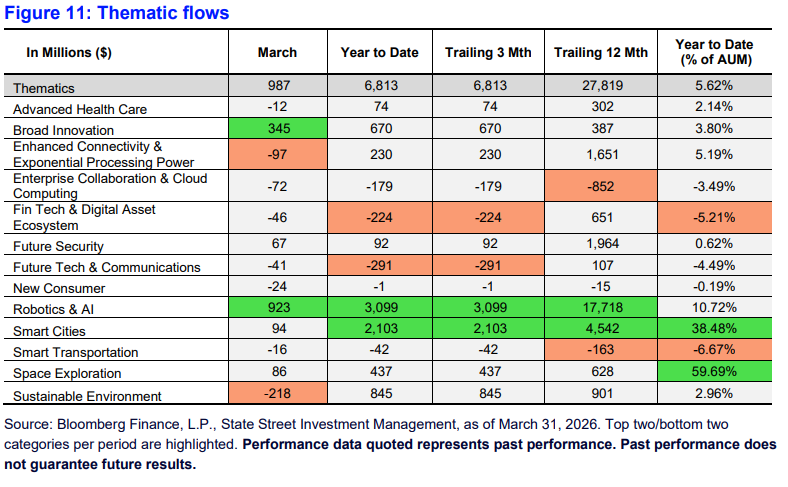
Just a few years ago, ETF themes became memes, but they're back in vogue. Even amid the current risk-off sentiment, thematic ETFs are registering their strongest start to a year since 2021. Thematic ETFs took in $1 billion in March, reaching a yearly total of $6 billion. Investment themes that piqued the interest of investors were robotics & AI , which accounted for 95% of March’s thematic inflows.
On the topic of themes — as markets embark on Q2, uncertainty remains the primary theme. The State Street report noted that S&P 500 earnings estimates have been revised higher, which is a historical anomaly given the current macro environment. Q1 earnings reports may be able to help provide clarity, but for now, the inflows data suggests that investors are favoring a balanced, diversified mix of assets over timing a market turn.
A message from Advisor Perspectives and VettaFi: To learn more about this and other topics, check out some of our videos.
Read more commentaries by VettaFi