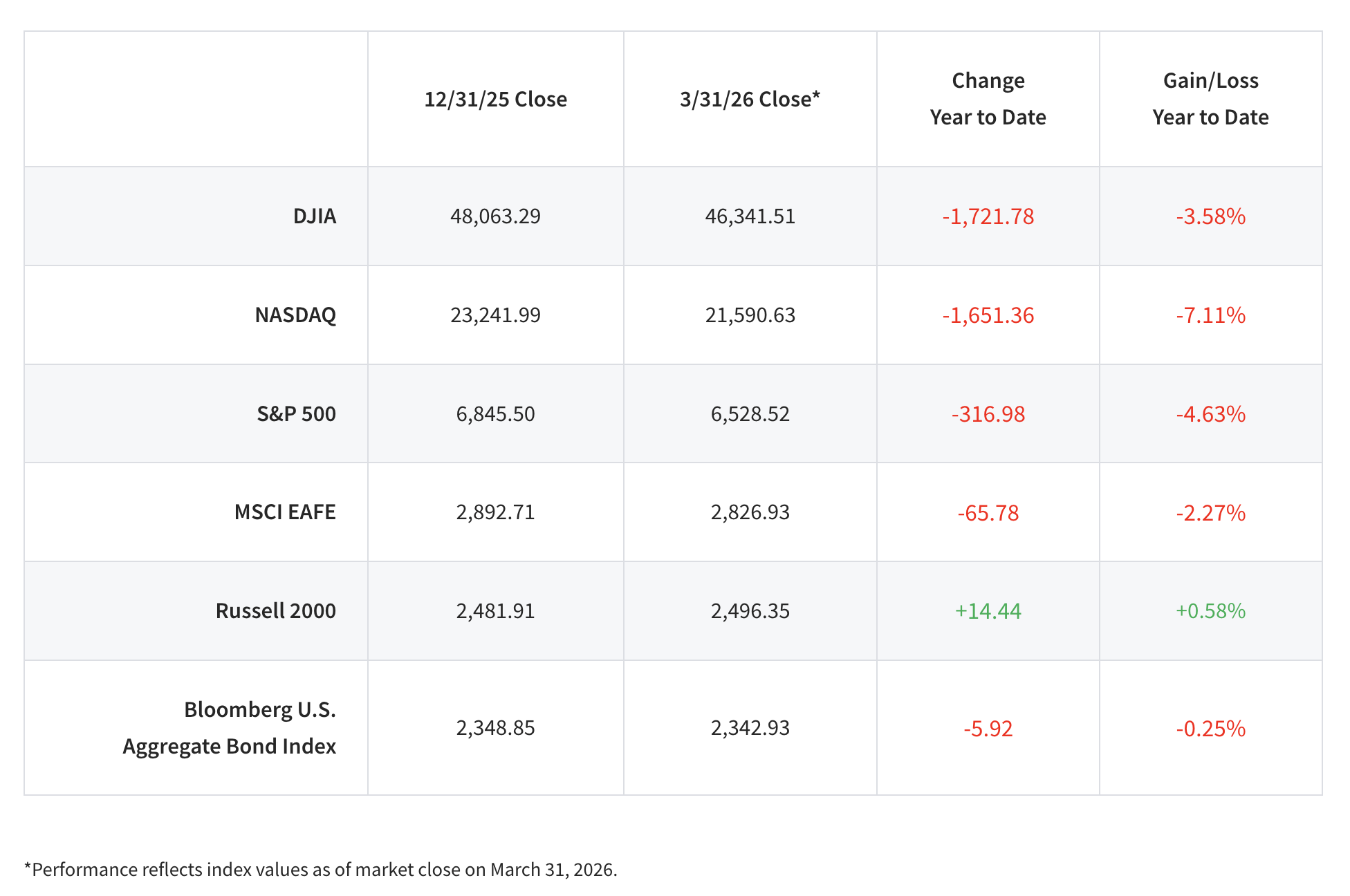
All eyes were turned toward the Middle East throughout the month of March, with the US and Israel’s ongoing conflict with Iran causing energy prices to surge. The closure of the Strait of Hormuz, alongside damage to energy infrastructure across the gulf region, caused crude to rise above $100 a barrel for the first time since 2022.
Equity mar kets were notably resilient early in the conflict, but by the end of the month showed increased concern for prolonged global energy turmoil. Bond markets shifted meaningfully as investors repriced future inflation risk and reassessed expectations for Federal Reserve (Fed) activity later in the year. The major US indices ended the month down in their first major pullback of the year. Looking ahead, the markets are likely to follow the headlines and remain volatile until some clarity emerges regarding the endgame for the current hostilities.
“At its core, the Iran conflict is a standoff between US and Israeli efforts to degrade Iran’s military capabilities and Iran’s ability to inflict global economic pain by disrupting the Strait of Hormuz,” said Raymond James Chief Investment Officer Larry Adam. “That’s why oil remains the key swing factor, with the potential to influence Fed policy, the economy and equity markets. The longer this conflict persists into April without deescalation, the greater the likelihood we’ll need to sharpen our pencils and revisit our year-end economic and asset class forecasts. As always, we’re closely monitoring developments.”
We’ll dive into more details below, but first, let’s look at how the month of March ended.

Cushion for US equities
Despite chaos with oil markets and foreign wars, the homefront has some breathing room. This is thanks to upcoming tax refunds, which stand to inject purchasing power into the domestic economy. Time will tell if that buffer is enough to stave off the negative consequences of the conflict, which could hamper the economy and the markets if not resolved quickly.
Inflation risk jeopardized rate cuts
Treasuries fell notably this past month as yields rose between 40 and 50 basis points across most of the yield curve. Oil prices, inflation risk and newly revised expectations regarding rate cuts were the driving forces at play. Projections are still showing a 25-point cut later in the year, but Fed Chair Jerome Powell made it clear that further inflation pressures could lead to no cut at all.
A worst-case scenario for monetary policy
With gas prices on the rise and inflation likely to follow, last month’s disappointing employment numbers from the Bureau of Labor Statistics present a serious challenge to the Fed when it comes to monetary policy. The Fed’s dual mandate of minimizing both inflation and unemployment is further complicated when both are on the rise. A negotiated settlement of the conflict with Iran, leading to lower oil prices and cooling inflationary pressure, would provide the most optimal resolution.
Disrupted supply lines aren’t just for oil
Average gasoline prices topping $4 a gallon in the US have illustrated that no country is immune to the largest oil supply disruption since World War II. While the oil market is dominating headlines, other supply chains with exposure to the Persian Gulf are also facing challenges. Curtailed exports of natural gas, helium, urea, sulfur and aluminum are affecting industries such as semiconductors, autos and agriculture.
Key steps toward bank deregulation
On the domestic politics front, the revised Basel III capital proposal signaled incoming capital relief for banks who, on the other side, continue to fight separate battles over the CLARITY Act and the fate of stablecoin yields. A framework for a compromise was reached in late March, but the path toward a breakthrough and material steps forward remains cloudy given key industry opposition.
The bottom line
For now, much remains bound to the outcomes of the war in the Middle East. While hoping for a swift end to hostilities and a return to normalcy for the energy sector, only time will tell how much damage has been done and its long-term effects on oil and its many derivatives. Investors should expect heightened volatility in the short term, but remain confident that temporary geopolitical issues rarely shake the overall macro trends of long-term positions.
Investing involves risk, and investors may incur a profit or a loss. All expressions of opinion reflect the judgment of the Raymond James Chief Investment Officer and are subject to change. There is no assurance the trends mentioned will continue or that the forecasts discussed will be realized. Past performance may not be indicative of future results. Economic and market conditions are subject to change. Diversification does not guarantee a profit nor protect against loss.
The Dow Jones Industrial Average is an unmanaged index of 30 widely held stocks. The NASDAQ Composite Index is an unmanaged index of all common stocks listed on the NASDAQ National Stock Market. The S&P 500 is an unmanaged index of 500 widely held stocks. The MSCI EAFE (Europe, Australasia and Far East) index is an unmanaged index that is generally considered representative of the international stock market. The Russell 2000 is an unmanaged index of small-cap securities. The Bloomberg Barclays US Aggregate Bond Index is a broad-based flagship benchmark that measures the investment grade, US dollar-denominated, fixed-rate taxable bond market. An investment cannot be made in these indexes. The performance mentioned does not include fees and charges, which would reduce an investor’s returns.
Companies engaged in business related to a specific sector are subject to fierce competition and their products and services may be subject to rapid obsolescence. There are additional risks associated with investing in an individual sector, including limited diversification. A credit rating of a security is not a recommendation to buy, sell or hold the security and may be subject to review, revision, suspension, reduction or withdrawal at any time by the assigning Rating Agency. Bond prices and yields are subject to change based upon market conditions and availability. If bonds are sold prior to maturity, you may receive more or less than your initial investment. Income from municipal bonds is not subject to federal income taxation; however, it may be subject to state and local taxes and, for certain investors, to the alternative minimum tax. Income from taxable municipal bonds is subject to federal income taxation, and it may be subject to state and local taxes.
Investing in commodities is generally considered speculative because of the significant potential for investment loss. Their markets are likely to be volatile and there may be sharp price fluctuations even during periods when prices overall are rising. International investing involves special risks, including currency fluctuations, differing financial accounting standards, and possible political and economic volatility. The Consumer Price Index is a measure of inflation compiled by the US Bureau of Labor Studies. The Leading Economic Index (LEI) provides an early indication of significant turning points in the business cycle and where the economy is heading in the near term. GDP (Gross Domestic Product) is the annual total market value of all final goods and services produced domestically by the US.
Investing in small-cap stocks generally involves greater risks, and therefore, may not be appropriate for every investor. The prices of small company stocks may be subject to more volatility than those of large company stocks. The ISM Services Index is an economic index based on surveys of more than 400 non-manufacturing (or services) firms' purchasing and supply executives. The ISM Manufacturing Index, also known as the purchasing managers' index (PMI), is a monthly indicator of US economic activity based on a survey of purchasing managers at more than 300 manufacturing firms.
Material created by Raymond James for use by its advisors.
© 2026 Raymond James Financial, Inc. All rights reserved.
Links are being provided for information purposes only. Raymond James is not affiliated with and does not endorse, authorize or sponsor any of the listed websites or their respective sponsors. Raymond James is not responsible for the content of any website or the collection or use of information regarding any website's users and/or members.
Raymond James & Associates, Inc., member New York Stock Exchange / SIPC, and Raymond James Financial Services, Inc., member FINRA / SIPC, are subsidiaries of Raymond James Financial, Inc.
Raymond James® and Raymond James Financial® and power of personal® are registered trademarks of Raymond James Financial, Inc.
Raymond James & Associates Statement of Financial Condition - September 2025 (PDF)
A message from Advisor Perspectives and VettaFi: Discover something new! Click here to register for our upcoming webcasts.
© Raymond James
Read more commentaries by Raymond James