At the height of the meme stock craze, investors made and lost fortunes as their speculative trades made headlines. This trend was so dramatic and so widespread that reporting on it moved beyond financial publications into the mainstream press and even into a few movie scripts. The number of retail investors who focused on stocks with high levels of short interest—in such a coordinated way—presented a new and rapidly evolving risk for professional money managers.
The meme stock craze should remind all investors that risk is not a static concept. It evolves along with global events, technological advances, policy changes, and other dynamics. Portfolio managers need to cut through the noise and focus on the material risks. Traditional risk metrics, such as volatility and beta, remain relevant, but they often fail to capture thematic risks, such as meme stock mania, that emerge suddenly and affect specific sectors or companies disproportionately. Effective risk measurement and mitigation are foundational to portfolio management to help control unintended exposures while enabling informed decision-making in security selection.
Mitigating thematic risks requires proactivity, combining quantitative analysis with qualitative insights, bolstered by cutting-edge approaches instead of off-the-shelf risk models.
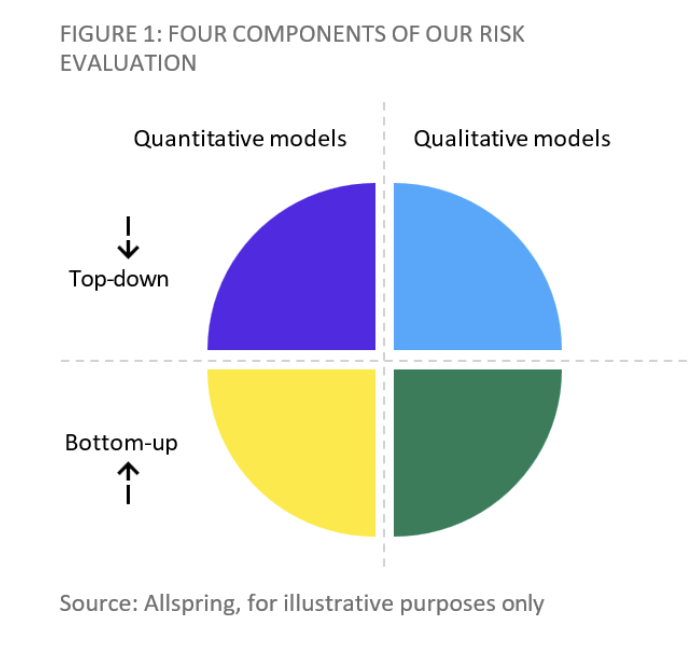
By identifying vulnerabilities early, our portfolio managers can adjust exposures, hedge positions, and maintain resilience against shocks. Identifying the impact of emerging risks such as geopolitical tensions, supply chain disruptions, artificial intelligence (AI), or tariffs, to name a few, is a part of top-down qualitative analysis on how markets can shift overnight. This top-down qualitative lens is just one of four ways our Systematic Core Equity team evaluates risk (Figure 1).

What makes thematic risks unique?
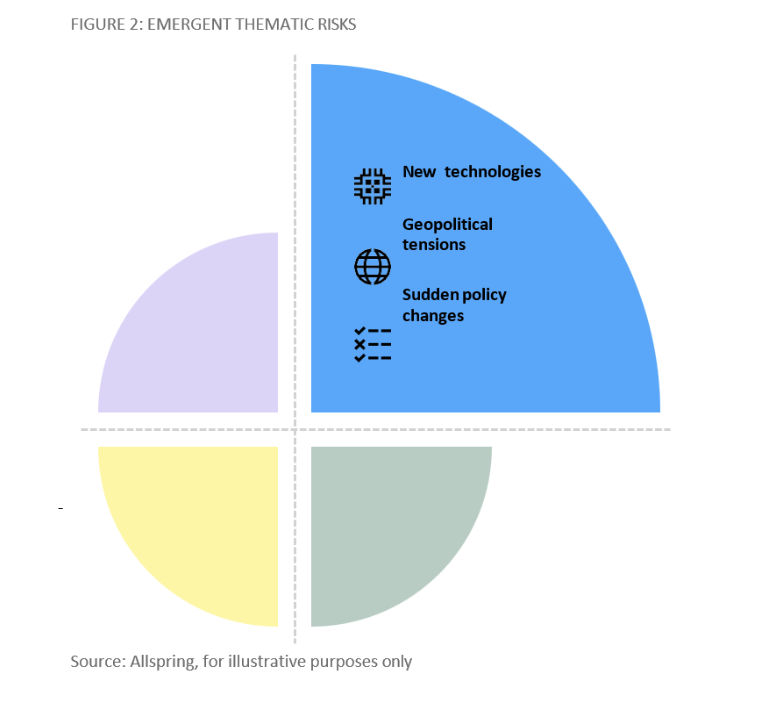
Thematic risks often materialize abruptly and exert concentrated pressure on certain sectors, industries, or companies, making them unique compared with how other market risks develop (Figure 2). Examples include:
-
COVID lockdown: Global shutdowns disrupted supply chains, retail sales, and travel, creating unprecedented operational and financial stress.
-
COVID reopening: The reopening phase introduced volatility in sectors such as hospitality and energy, driven by pent-up demand and inflationary pressures.
-
Tariffs: Trade wars and tariffs can reshape cost structures for manufacturers and exporters, affecting margins and competitiveness.
-
AI: The rapid adoption of AI is expected to create winners and losers, with firms that lack exposure potentially underperforming peers. Recently, this has been most notable in the software industry. Interestingly, the possible extreme impact of AI leads us to consider sub-themes such as AI enablers, AI adopters, and AI infrastructure.
Identifying and monitoring these risks helps ensure that portfolio decisions reflect granular realities rather than broad sector assumptions.
Natural language processing helps isolate emergent risks
Allspring’s dedicated Systematic Research team has a mandate to refine and evolve our approaches to security selection and portfolio and risk management. One key advancement over the past decade was adding natural language processing (NLP) into the evaluation of emergent risks. NLP is a branch of AI that enables machines to interpret and analyze human language.
In analyzing securities, NLP is a highly useful tool to transform unstructured text—such as earnings transcripts, regulatory filings, and press releases—into actionable research insights.
How we employ NLP to generate better thematic exposures
Using third-party NLP scoring, we can associate companies with themes, even when these themes are event-driven and come on suddenly as emerging risks. For instance:
- Identifying language shifts around supply chain vulnerabilities or tariff impacts
- Tracking sentiment changes in management commentary regarding AI adoption
- Recognizing the long-term impact on commercial real estate of the remote-work culture that began with the COVID lockdown
- Other black swan events as they occur
This approach enhances transparency into the fundamental drivers of company performance and allows portfolio managers to make data-driven adjustments, aiming to reduce or eliminate unintended exposures that may be a natural outgrowth of our company-specific views.
NLP data in action
Case in point, the two examples below illustrate how our team has used NLP data to inform our portfolio management decisions.
1. MetLife: commercial real estate exposure
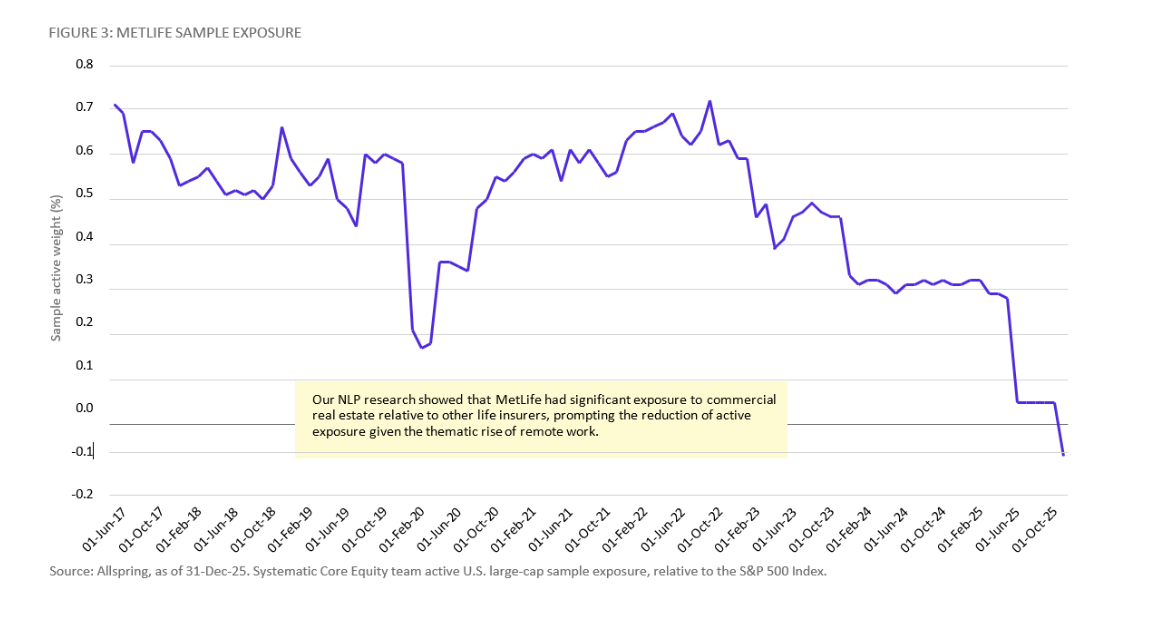
MetLife, Inc., is a global insurer offering annuities and life, auto, and homeowner’s insurance. Among life insurers, our NLP data research indicated that the company was the most office concentrated investor in the space, with offices representing 39% of its commercial mortgage loan (CML) portfolio. This exposure created investment risk following the COVID pandemic, which accelerated remote work trends and drove a structural decline in office demand, contributing to a sharp correction in real estate valuations across major U.S. markets. With CML credit metrics softening, including an increase in loan-to-value, debt-service coverage ratios, and past-due balances increasing, possible real estate losses were expected to increase loan loss reserve ratios, creating a drag on earnings. In line with prudent risk management, the position was trimmed and reallocated to another name with a more attractive risk/ reward trade-off (Figure 3).
2. EMCOR: catching up on AI exposure
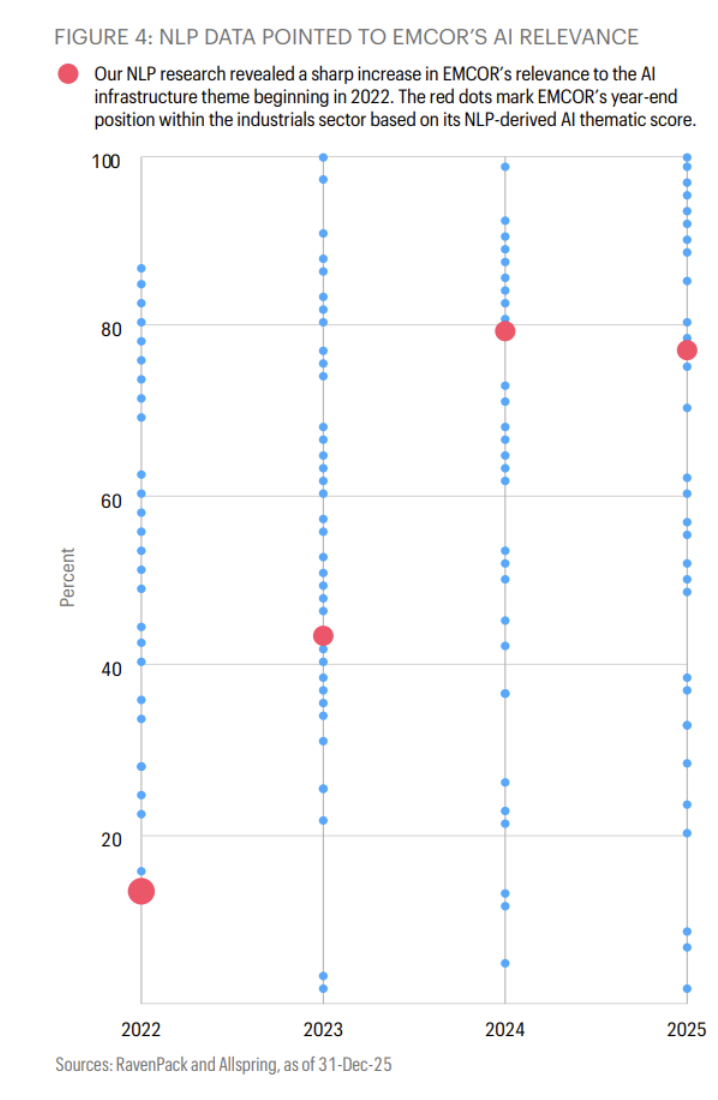
Risk management isn’t always about trimming positions; aiming for better portfolio balance sometimes leads us to increase thematic exposures—especially when there’s a material underweight to that theme relative to the appropriate benchmark. Our use of NLP signals showed that a name we already liked and owned, EMCOR Group (a leading specialty contractor and provider of electrical and mechanical construction and facilities services), was seeing a particular benefit in its U.S. electrical segment from the AI-driven build-out of data centers. Along with attractive stock-specific characteristics that made the name a prime candidate due to attractive valuation, quality, and momentum scoring, the portfolio construction benefit of correcting for an underweight to our AI infrastructure thematic basket makes EMCOR a key holding in our portfolios (Figure 4). Our inclusion in the AI infrastructure basket will be particularly surprising to those who know of EMCOR’s classification in the industrials sector.
Future directions
Our current approach to thematic basket identification blends 1) the scalable clarity possible through NLP as a tool with 2) the experienced insights of our senior portfolio managers to identify themes of interest. Today, we analyze thousands of documents each hour to surface potential investment themes, further refined through experienced human judgment. As we evolve our approach to using NLP data, we aim to continue developing more sophisticated statistical processes to identify which themes are truly foundational market dynamics and to what extent these quantitatively derived themes complement traditional risk models.
Meme stocks and other investment trends often highlight the fact risk management should go beyond traditional metrics. Integrating advanced tools like NLP and monitoring thematic risks at the stock level help portfolio managers anticipate disruptions and position portfolios for resilience and growth. This proactive approach is essential for delivering superior client outcomes in an era defined by rapid change and associated disruption.
--
CFA® and Chartered Financial Analyst® are trademarks owned by CFA Institute.
Standard & Poor’s 500 Index (S&P 500 Index): The S&P 500 Index consists of 500 stocks chosen for market size, liquidity, and industry group representation. It is a market-value-weighted index with each stock’s weight in the index proportionate to its market value. You cannot invest directly in an index.
Portfolio holdings are subject to change and may have changed since the date specified. The holdings listed should not be considered recommendations to purchase or sell a particular security. This material is provided for informational purposes only and is intended for retail public distribution in the United States. Use outside the United States is for professional/qualified investors only.
THIS CONTENT AND THE INFORMATION WITHIN DO NOT CONSTITUTE AN OFFER OR SOLICITATION IN ANY JURISDICTION WHERE OR TO ANY PERSON TO WHOM IT WOULD BE UNAUTHORIZED OR UNLAWFUL TO DO SO. IT SHOULD NOT BE CONSIDERED INVESTMENT ADVICE, AN INVESTMENT RECOMMENDATION, OR INVESTMENT RESEARCH IN ANY JURISDICTION.
INVESTMENT RISKS: All investments contain risk. Your capital may be at risk. The value, price, or income of investments or financial instruments can fall as well as rise and is not guaranteed. You may not get back the amount originally invested. Past performance is not a guarantee or reliable indicator of future results. Returns may increase or decrease as a result of currency fluctuations.
Allspring Global Investments™ (Allspring) is the trade name for the asset management firms of Allspring Global Investments Holdings, LLC, a holding company indirectly owned by certain private funds of GTCR LLC and Reverence Capital Partners, L.P. These firms include but are not limited to Allspring Global Investments Luxembourg, S.A.; Allspring Funds Management, LLC; Allspring Global Investments, LLC; Allspring Global Investments (UK) Ltd.; Allspring Global Investments (Singapore) Pte. Ltd.; Allspring Global Investments (Hong Kong) Ltd.; Allspring Global Investments (Japan) Ltd.; and Galliard Capital Management, LLC.
Unless otherwise stated, Allspring is the source of all data (which is current or as of the date stated). Content is provided for informational purposes only. Views, opinions, assumptions, or estimates are not necessarily those of Allspring or its affiliates, and there is no representation regarding their adequacy, accuracy, or completeness. They should not be relied upon and may be subject to change without notice.
FOR RETAIL USE WITHIN THE U.S. AND PROFESSIONAL/QUALIFIED INVESTOR USE ONLY WHEN USED OUTSIDE OF THE U.S.
© 2026 Allspring Global Investments Holdings, LLC. All rights reserved.
A message from Advisor Perspectives and VettaFi: Discover something new! Click here to register for our upcoming webcasts.
© Allspring Global Investments
Read more commentaries by Allspring Global Investments