Investment strategy is never easy, but we have started this year with a remarkable confluence of shifting factors: technological, economic and geopolitical. Understanding how they will play out and interact becomes crucial to asset allocation.
The artificial intelligence (AI) revolution and its potential impact is currently playing a dominant role in asset markets. It has the potential to reshape our economy and disrupt most industries, but it is subject to profound genuine uncertainty, and it moves at high speed. Even for nimble-footed financial investors, it’s hard to keep up.
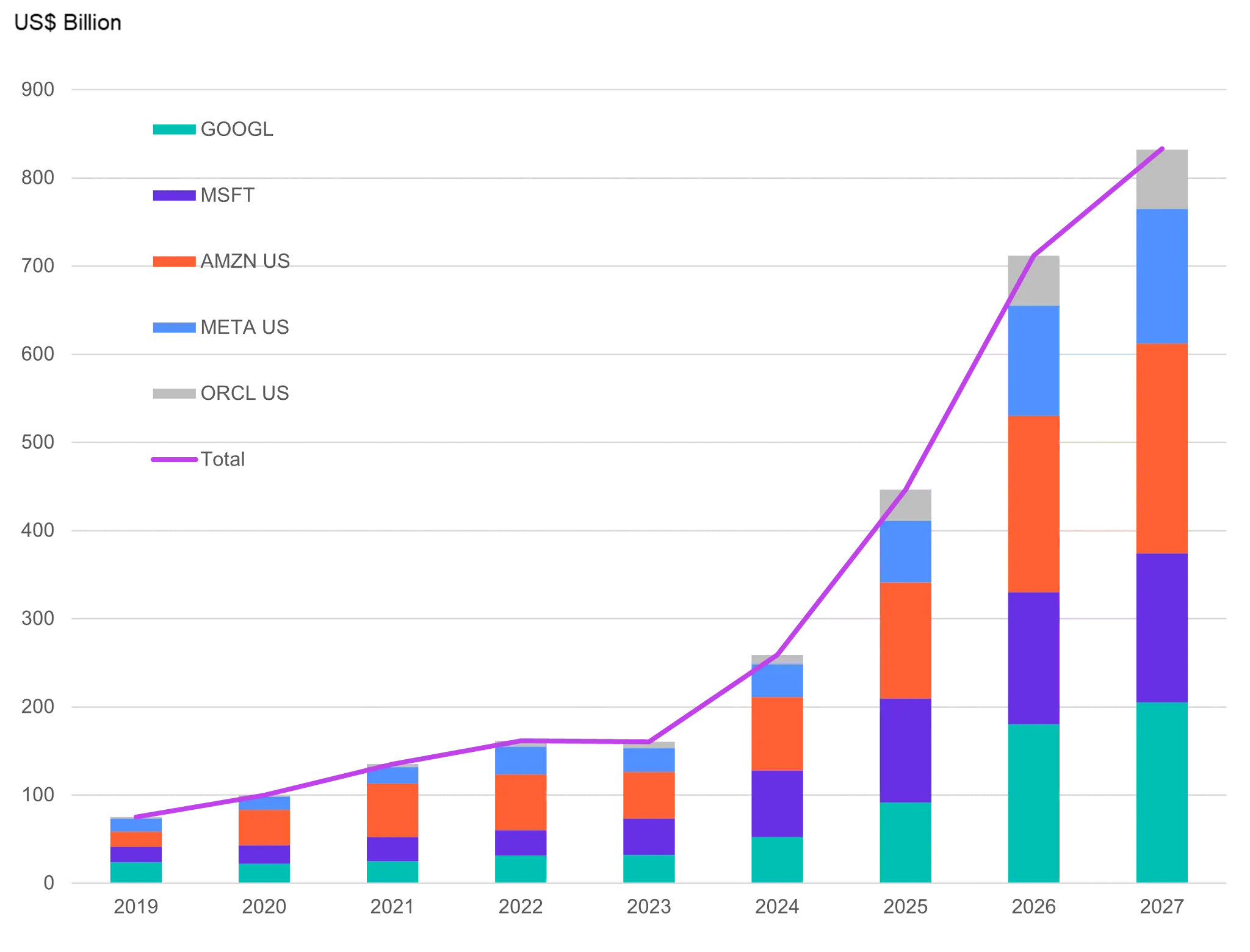
Through most of last year, the main story was the massive investment to build AI models and capabilities. Investors quickly bid up the valuations of the companies providing the “picks and shovels” for the AI revolution: Nvidia and the tech giants developing AI models. More recently, however, the sheer size of debt issuance underpinning this AI investment wave is becoming an important concern for markets. The focus has also shifted to the companies and industries that might suffer from AI competition, like software. Here there is high uncertainty, and obvious risks of short-term over-reactions.
Hyperscalers' Capex Guidance

The focus on the potential losers comes partly from the fact that it’s hard so far to identify the companies and industries that can reap major efficiency gains thanks to AI. That’s because adoption of AI solutions at scale is likely to require more time. Companies need to identify the right AI models and solutions for their mission-critical areas; they will need to reorganize processes and operations and socialize the adoption. Adoption will also likely be uneven across both companies and industries.
As AI evolves at a faster pace, this will remain a fluid situation, but identifying the industries and companies likely to win or lose in the AI revolution is a key priority for asset allocation.
A second crucial factor is the differential distribution of investment opportunities across the world economy. Here the biggest structural story is the persistent rise of emerging markets. Over the past decade, and especially post-COVID-19, many emerging markets (EMs) have run prudent fiscal and monetary policies—in stark contrast with advanced economies. As a result, the EM asset class has already proved resilient to global macro disruption and should now find a more supportive macro environment in 2026. Therefore, on the EM sovereign side I see scope for some further spread tightening, as fiscal policies remain generally prudent and economic reform momentum continues. Meanwhile, I think EM corporate debt is likely to trade range-bound.
Europe looks attractive, but whether this is going to be just a cyclical story or turns into a structural one remains to be determined. In the near future, European economies should benefit from a revival of investment policies and defense spending. Geopolitics plays an important role, as European leaders have converged on the need to bolster the continent’s own defense capabilities. For this to turn into a structural story, however, European governments will need to tackle long-overdue structural reforms, including reforms related to public spending. Rationalizing social safety nets seems indispensable to create the fiscal space for a prolonged public investment push. And simplifying regulations could go a long way toward unleashing the innovation and investment potential of the private sector. On both fronts, Europe has consistently disappointed. Courtesy of geopolitics, there is somewhat greater hope that this time might be different.
I remain more bullish than consensus on the US economy. Households have demonstrated reliable resilience. The AI investment boom continues, and corporate investment seems to be broadening out from just AI. Productivity growth has accelerated. Last but not least, a new bout of fiscal stimulus should provide a boost in the first half of the year.
Fiscal policy, however, is also the main cause of caution for the longer term. The fiscal deficit is projected to remain at around 6% of gross domestic product (GDP) for years to come. With debt held by the public nearing 100% of GDP and upside risks to interest rates, this is the Achilles’ Heel of the US economy. It can undermine confidence, puts upward pressure on funding costs, and raises the risk of a significant tax hike down the road.
The US dollar has remained under pressure on the back of its still-strong valuation and concerns about political polarization and the strength of US institutions, along with geopolitics. A more aggressive US foreign policy stance, which often relies on financial sanctions, has strengthened incentives for more countries to reduce their reliance on US dollar (USD) foreign currency (FX) reserves and on the dollar-dominated financial system. There are limits to the extent any country can decouple from the dollar, which still has a dominant share in global FX reserves, financial flows and trade payments. But at the margin it does reduce the USD’s attractiveness.
Overall therefore, I believe the macro and geopolitical environment will continue to favor some diversification outside the US in sovereign, corporate and currency exposure, with EMs offering some of the most interesting opportunities. I would not take this case too far, however, given the lack of a credible alternative to the depth and liquidity of US asset markets, especially while they are supported by a robust growth story.
To close, I would also like to reiterate my view that inflation is likely to remain stubbornly above target; with growth robust and the labor market showing signs of stabilization, this suggests that the Federal Reserve’s easing cycle has already come to an end.
A message from Advisor Perspectives and VettaFi: Discover something new! Click here to register for our upcoming webcasts.
WHAT ARE THE RISKS?
All investments involve risks, including possible loss of principal.
The allocation of assets among different strategies, asset classes and investments may not prove beneficial or produce the desired results.
Equity securities are subject to price fluctuation and possible loss of principal.
Fixed income securities involve interest rate, credit, inflation and reinvestment risks, and possible loss of principal. As interest rates rise, the value of fixed income securities falls.
International investments are subject to special risks, including currency fluctuations and social, economic and political uncertainties, which could increase volatility. These risks are magnified in emerging markets.
Any companies and/or case studies referenced herein are used solely for illustrative purposes; any investment may or may not be currently held by any portfolio advised by Franklin Templeton. The information provided is not a recommendation or individual investment advice for any particular security, strategy, or investment product and is not an indication of the trading intent of any Franklin Templeton managed portfolio.
There is no assurance that any estimate, forecast or projection will be realized.
© Franklin Templeton
Read more commentaries by Franklin Templeton