Nuclear power tends to be attractive for its reliability, longevity, and emission free-power generation. Despite these benefits, nuclear energy represents a relatively small portion of worldwide power generation. In 2024, nuclear accounted for 9% of the global electricity mix.
Nuclear in the Electricity Mix Varies Significantly by Country
Over 30 countries have nuclear power. The chart below shows select countries with and without nuclear power in their energy mix. Nuclear is a much greater portion of the electricity mix for some countries, particularly France (68%), South Korea (30%), Russia (18%), and the U.S. (18%). By capacity, the U.S. leads the world with 97 gigawatts (GW), followed by France (63 GW) and China (58 GW).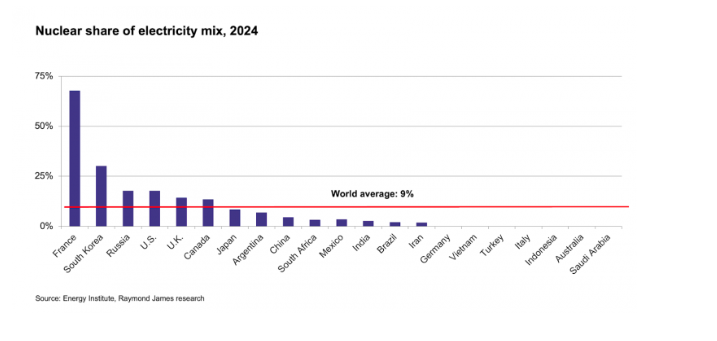
Nuclear power is a relatively small portion of the electricity mix for China and India. Both countries rely heavily on coal, which accounted for more than 60% of each country’s power generation in 2023. However, both are focused on adding more nuclear capacity. Just over half of the 71 GW of reactors under construction globally are located in China.
India currently has six reactors under construction. The government is targeting 100 GW in capacity by 2047. In mid-December, legislation was introduced to open India’s nuclear sector to private operators, which could support future development.
Countries Without Nuclear Capacity: A Mix of Nuclear Aspirations and Bans
The countries without nuclear power capacity include a mix of those with nuclear ambitions and those who have banned nuclear power. Germany closed its last nuclear plants in 2023 as part of a long-term policy to phase out nuclear power driven by public disapproval. Australia is the fourth-largest uranium miner globally but has no nuclear power due to legislation prohibiting it.
Turkey has four reactors under construction at the Akkuyu facility, with Russia financing and building the plant. The reactors are expected to be brought online over time, with the goal to have all four reactors running by the end of 2028.
Saudi Arabia, which remains heavily dependent on fossil fuels for its power generation, plans to develop a civil nuclear industry. Saudi Arabia and the U.S. agreed to cooperate on civil nuclear development in November 2025. This could pave the way for U.S. nuclear technology to be deployed in Saudi Arabia, but it remains early days.
