Key takeaways
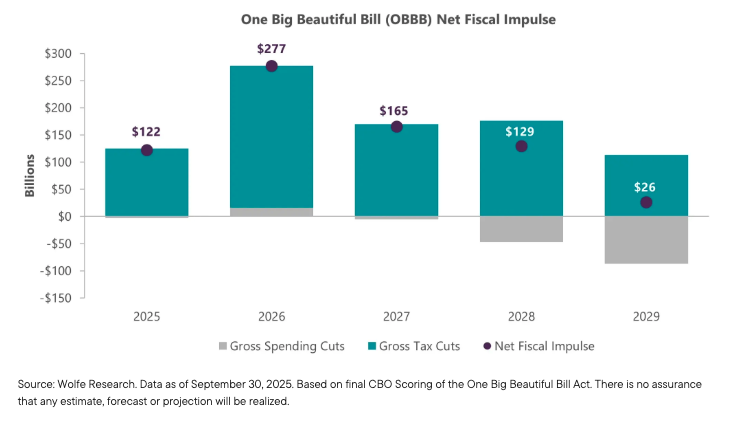
- While the labor market has decelerated, job creation could pick up next year on the back of Federal Reserve (Fed) cuts, the peak fiscal impulse of the One Big Beautiful Bill (OBBB) and more visibility on the tariff front. Personal income tax cuts could also help consumers manage higher prices.
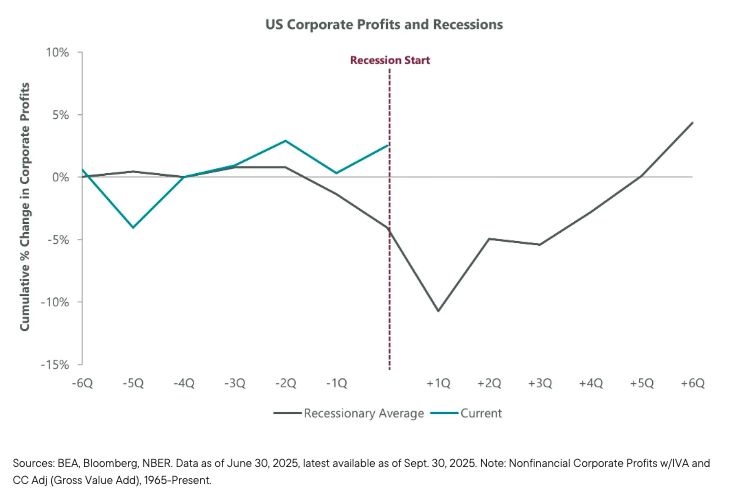
- Companies have been delivering record margins with healthy results across the market; this is indicative of the broadening of earnings participation we have been anticipating and a distinctly non-recessionary corporate environment.
- An easing cycle for monetary policy is likely to counteract risks such as artificial intelligence (AI) disintermediation, trade flareups and stress in private credit markets, keeping the current expansion intact.
Resilience should continue as 2026 path gets smoother
The US economy maintained its post-pandemic expansionary path in 2025, although it took a less straightforward route than over the previous few years. The Trump administration’s aggressive trade rhetoric and onslaught of tariffs in the first half of the year sent consumer sentiment to multiyear lows, raised the risk of resurgent inflation and put corporate management teams on the defensive. Despite headwinds, households and businesses have embodied the words of Sir Elton John in his classic song “I'm Still Standing,” this year. Whether that resilience can continue as the United States emerges from the longest government shutdown in history is a key theme we will be watching in the year ahead.
We recently spoke with Jeff Schulze, ClearBridge’s Head of Economic and Market Strategy, about the key spending, employment and policy factors he is following as we turn the page to 2026.
Let’s start with your North Star on the economy, the ClearBridge Recession Risk Dashboard. What signal is the dashboard sending currently and how does that provide clues about the trajectory of economic activity?
While the government shutdown has caused us to rely on alternative data sources for five of the dashboard’s 12 indicators, our analysis shows consumer spending is holding steady and labor market trends remain mostly in place. Our favorite indicator for the health of the labor market, initial jobless claims, remains at a manageable level. The overall dashboard continues to flash a green expansionary signal; at the moment, the odds of a recession over the next 12 months look to be about 30%.
The labor market is an important gauge for consumer health. Are you concerned about the slowdown in hiring we have seen in 2025?
Hiring has decelerated but this is not an entirely new development. The September release of annual preliminary benchmark revisions to payrolls, which covered the period from April 2024 through March 2025, was the largest in history with a downward revision of 911,000.1 If the revision was evenly applied, it suggests the economy has been creating fewer than 50,000 jobs per month for the entirety of this year. While some of this weakness has come from reduced labor demand emanating from the uncertainty around tariffs, a lot of it is related to shifts in immigration. A huge tailwind of labor supply has dissipated with the steep drop in border encounters—which is a proxy for illegal immigration—as well as sharply lower legal immigration levels.
However, as we look forward to next year, we think job creation could pick up to 80,000 or 90,000 per month on the back of Fed cuts, the peak fiscal impulse of the OBBB and more visibility on the tariff front once we get the Supreme Court’s decision on the legality of the International Emergency Economic Powers Act (IEEPA) tariffs. Although this is lower than the past several years, it is certainly enough to keep this expansion moving forward.
Exhibit 1: Tax Tailwind

What are your thoughts on AI’s potential to disrupt labor markets? Is that a valid concern?
There is always some form of creative destruction going on in the economy, but AI can accelerate and broaden the trend. A big concern right now is how AI is making it harder for young people to get jobs. The unemployment rate for 16- to 24-year-olds was 10.5% in September, up from 9.6% in September 2024 and the recent low of 7.5% in August 2023.2 It has become a harder job market for young people, but this has been more than just the AI effect. Labor churn has fallen, meaning fewer workers are quitting, creating less of a need for employers to backfill jobs and making it harder for young people coming into the workforce.
Importantly, we are not seeing widespread job losses at a national level from AI, just pockets of it in specific industries. This was the same worry that we had in the 1990s, but at that time widespread job losses didn’t occur until the economy fell into recession in 2001. It may take a couple of years to see accelerated job losses, but they will likely come in the wake of an economic downturn, not during the current expansion.
What about the health of the corporate side of the economy? What are profit margins telling us about business activity?
Third-quarter earnings results were very strong with roughly two-thirds of companies beating revenue forecasts, and, overall, companies delivering record margins. All 11 sectors had healthy results, indicating a broadening of earnings participation that we had been anticipating. In short, corporate America is in good shape right now, and the environment looks distinctly non-recessionary.
Exhibit 2: Profits Don’t Look Recessionary
The Federal Reserve delivered its second interest-rate cut of the easing cycle in October, but Chairman Powell expressed caution on additional monetary action. What is your take on Fed policy in the new year?
Late summer into the fall, the Fed was concerned about increasing downside risks in the labor market and wanted some insurance against a meaningful weakening there. But jobless claims are not going up and now, in mid-November, we have yet to see downside risks in the labor market really materialize. A lot will depend on the coming release of official data as the federal government reopens.
Should the data show the labor market still holding up but underlying inflation continuing to build, the case for additional cuts faces a higher bar. The Fed "dots" (summary of Fed policymakers' projections) show two additional cuts as a baseline, while market expectations have come down but are still for an additional three 25 basis point cuts by the end of 2026. Our view continues to be that the Fed will cut less because the neutral rate is higher than commonly understood. That said, we see the potential for two additional rate cuts by the end of 2026.
What about inflation, how will that impact Fed decisions? Is the economy through the worst on the tariff-induced inflation front or is the threat of structurally higher prices still an issue?
We are not convinced inflation risks have been fully tamed. Most companies have been able to lessen the tariff blow so far because they stocked up on inventory ahead of time or have been absorbing most of the price pressure rather than passing it on to consumers. Given this we believe that the January effect, where companies take the opportunity to set prices around year-end, could be larger than normal in 2026.
These price increases may be easier to pass though because the outlook for the consumer looks healthy heading into the new year. Individuals, broadly speaking, will see materially larger than typical tax refunds next year considering the recent OBBB tax changes, for which the Internal Revenue Service didn’t end up adjusting withholding tables.
Conclusion
The US economy has consistently defied expectations over the last five years, and we see no reason why that resilience won’t continue. There are a lot of risks heading into 2026, including the buildup in private credit, disintermediation from AI, resurgent inflation and potential trade flareups. However, fiscal stimulus is coming online, corporate America looks solid and the consumer in aggregate has not shown signs of rolling over. An object in motion tends to stay in motion, and there is an adage that economic expansions don’t die of old age but are killed off by the Fed. This is a topic we discussed in 2025 and it’s central to our outlook for 2026. With the Fed clearly in easing mode, we choose not to fight the central bank and remain optimistic on the path forward.
A message from Advisor Perspectives and VettaFi: Discover something new! Click here to register for our upcoming webcasts.
Endnotes
1 Source: US Bureau of Labor Statistics, Current Employment Statistics Preliminary Benchmark (National) Summary, September 9, 2025.
2 Source: US Bureau of Labor Statistics, The Economics Daily, August 27, 2025.
DEFINITIONS
The One Big Beautiful Bill Act, or the Big Beautiful Bill, is a US federal statute passed by the 119th United States Congress containing tax and spending policies that form the core of President Donald Trump's second-term agenda. The bill was signed into law by President Trump on July 4, 2025.
The International Emergency Economic Powers Act (IEEPA) provides the President broad authority to regulate a variety of economic transactions following a declaration of national emergency.
The Internal Revenue Service (IRS) is the US government agency responsible for collecting federal taxes and enforcing tax laws.
WHAT ARE THE RISKS?
All investments involve risks, including possible loss of principal. Past performance is no guarantee of future results. Please note that an investor cannot invest directly in an index. Unmanaged index returns do not reflect any fees, expenses or sales charges.
Equity securities are subject to price fluctuation and possible loss of principal. Large-capitalization companies may fall out of favor with investors based on market and economic conditions. Small- and mid-cap stocks involve greater risks and volatility than large-cap stocks.
Commodities and currencies contain heightened risk that include market, political, regulatory, and natural conditions and may not be suitable for all investors.
US Treasuries are direct debt obligations issued and backed by the “full faith and credit” of the US government. The US government guarantees the principal and interest payments on US Treasuries when the securities are held to maturity. Unlike US Treasuries, debt securities issued by the federal agencies and instrumentalities and related investments may or may not be backed by the full faith and credit of the US government. Even when the US government guarantees principal and interest payments on securities, this guarantee does not apply to losses resulting from declines in the market value of these securities.
IMPORTANT LEGAL INFORMATION
This material is intended to be of general interest only and should not be construed as individual investment advice or a recommendation or solicitation to buy, sell or hold any security or to adopt any investment strategy. It does not constitute legal or tax advice. This material may not be reproduced, distributed or published without prior written permission from Franklin Templeton.
The views expressed are those of the investment manager and the comments, opinions and analyses are rendered as at publication date and may change without notice. The underlying assumptions and these views are subject to change based on market and other conditions and may differ from other portfolio managers or of the firm as a whole. The information provided in this material is not intended as a complete analysis of every material fact regarding any country, region or market. There is no assurance that any prediction, projection or forecast on the economy, stock market, bond market or the economic trends of the markets will be realized. The value of investments and the income from them can go down as well as up and you may not get back the full amount that you invested. Past performance is not necessarily indicative nor a guarantee of future performance. All investments involve risks, including possible loss of principal.
Any research and analysis contained in this material has been procured by Franklin Templeton for its own purposes and may be acted upon in that connection and, as such, is provided to you incidentally. Data from third party sources may have been used in the preparation of this material and Franklin Templeton ("FT") has not independently verified, validated or audited such data. Although information has been obtained from sources that Franklin Templeton believes to be reliable, no guarantee can be given as to its accuracy and such information may be incomplete or condensed and may be subject to change at any time without notice. The mention of any individual securities should neither constitute nor be construed as a recommendation to purchase, hold or sell any securities, and the information provided regarding such individual securities (if any) is not a sufficient basis upon which to make an investment decision. FT accepts no liability whatsoever for any loss arising from use of this information and reliance upon the comments, opinions and analyses in the material is at the sole discretion of the user.
Franklin Templeton has environmental, social and governance (ESG) capabilities; however, not all strategies or products for a strategy consider “ESG” as part of their investment process.
Products, services and information may not be available in all jurisdictions and are offered outside the U.S. by other FT affiliates and/or their distributors as local laws and regulation permits. Please consult your own financial professional or Franklin Templeton institutional contact for further information on availability of products and services in your jurisdiction.
Issued in the U.S. by Franklin Templeton, One Franklin Parkway, San Mateo, California 94403-1906, (800) DIAL BEN/342-5236, franklintempleton.com. Investments are not FDIC insured; may lose value; and are not bank guaranteed.
You need Adobe Acrobat Reader to view and print PDF documents. Download a free version from Adobe's website.
CFA® and Chartered Financial Analyst® are trademarks owned by CFA Institute.
© ClearBridge Investments
Read more commentaries by ClearBridge Investments