Reconstructing the Fed
Membership required
Membership is now required to use this feature. To learn more:
View Membership BenefitsThe Mariner S. Eccles Federal Reserve Board Building, completed in 1937, faces Washington’s stately Constitution Avenue. Its classical architecture presents an appearance of strength and stability. But as we all know, appearances can be deceiving.
In fact, the Eccles Building has been showing its age for many years. It is currently being renovated, a project that has proved far more expensive than anticipated. We could say the same for many most Fed policies: they take longer and cost more than they should.
But it’s not just the building. The Fed itself is changing in ways that may make its future decisions even more inscrutable. An incompetent central bank can be tolerable if it’s predictably incompetent. An unpredictably incompetent central bank is potentially far more dangerous.
The Fed is losing effectiveness in part due to the fiscal irresponsibility of Congress. $2 trillion and growing budget deficits have made effective monetary policy almost impossible. Markets expect the Federal Reserve to step into any crisis and fix things via lower rates, liquidity, balance sheet actions, QE, etc. But these tools no longer work as well because of the fiscal irresponsibility.
The Fed’s supposedly enormous power is why we hang on every speech. When/if that narrative fails, the bond market will grow chaotic (to say the least) and no matter what the Fed does, no matter what Treasury does, that genie is not going back into the bottle.
Today let’s look at some recent reports from top Fed-watchers, all of whom see big changes afoot in the Eccles Building. And not just moving a few walls and adding some doors.
Dissent Process
We’ll start with Jim Bianco of Bianco Research, who watches the Fed and bond markets closely. Lately he’s been talking about the increasingly open dissent on the Fed’s policy-setting committee. First, a little background.
You may recall a little stir back in July of this year when Fed governors Michelle Bowman and Christopher Waller dissented from the FOMC decision to hold rates steady. Both said they wanted a quarter-point cut. This was unusual because Board of Governors members almost never dissent. This was the first time two had dissented since 1993.
FOMC dissents, when they happen, usually come from the regional Fed presidents. And those aren’t especially common either. Federal Reserve decision making has long been by consensus, with the chair working behind the scenes to get everyone on the same page. Alan Greenspan pioneered this style in the early 1990s.
Bowman and Waller later got their wish with a rate cut at the September FOMC meeting, so neither had to dissent again. But it still wasn’t unanimous because newly confirmed governor Stephen Miran voted against the decision, saying he wanted a half-point cut instead of a quarter. He did it again at the October meeting. That one also included a dissent from Jeffrey Schmid, the Kansas City Fed president who wanted to hold rates steady.
So, it’s starting to look like the Fed’s “consensus” method is breaking down. Which brings us to Bianco, who wrote on Nov. 15:
“Monetary policy is no longer about what the Chairman thinks/wants. It's about tallying the 12 voters' opinions and seeing which view reaches 7 (a majority). If the Chairman disagrees, there might not be much he can do about it.
“This accounts for the probability of a rate cut on December 10 falling from 70% on Monday to 42% on Friday, in a week that saw no significant economic releases and with the Federal Reserve chairman not speaking. The tally of voters is swinging against another rate cut.
“This is a very good thing, as the groupthink/consensus voting led by the Chair has been the Fed's biggest problem. It is behind so many policy errors.”
Jim went on to describe how markets are now almost clueless about future Fed policy. Based on their public statements, it looks like four of the 12 voters will want another rate cut next month, five will want to hold steady and three (including Powell) are undecided or haven’t said. (And then we got NY Fed president John William’s statement Friday morning. More below.)
Keep in mind, FOMC votes are almost always 12-0 or maybe 11-1. Yet we are now on a path where 3-4 dissents may become normal. Jim Bianco says this is the result of Trump’s open pressure on the Fed along with the Miran appointment (more on him below).
Possibly. Ot it may be a result of competing and often conflicting needs in the economy. It’s tough to get groupthink when each choice has negatives and positives.
For 20 years I’ve been writing that we are going to reach a place with only bad choices and worse choices. There will be no good choices. As far as the Federal Reserve goes, I think we are there. In fact, you can say that about every major central bank. Europe, Japan? They, like the Federal Reserve, have lost control of the long end of the interest-rate curve. Short-term rate policy is losing the ability to influence long-term rates. And it will only get worse.
Jim argues that the dissents are actually a useful form of “forward guidance,” and maybe a better one than the Fed’s frequently confusing efforts to nudge the markets with speeches, dot plots and selective leaks to favored media outlets. Here he is again.
“Other central banks use the dissent process to communicate with markets.
“Meaning a 7-5 vote means the current policy (hike, hold, or cut) is close to changing. A 12-0 vote means the current policy will remain in place.
“This form of forward guidance has a history of working well. It's better than the Byzantine mess the Fed now has: FOMC statements, dot plots, summaries of economic projections (called the SEP), press conferences, and balance-of-risk statements.
“No one knows what any of this means (while getting paid a lot of money to pretend they do). And when the market reaches an interpretation the Fed does not like, they are told they have reached an erroneous conclusion, further confusing everything (usually Powell scolding the press for misunderstanding the dot plot).
“It is time for the Fed's ‘Byzantine era’ to end. Let everybody vote independently. Then let them explain themselves. (And while they are at it, get rid of the blackout period; it adds to volatility by going radio silent when communication is at its most crucial point.)
“The market will glean much more information from a 7-5 vote and the explanations that follow than an endless series of ‘rigged’ 12-0 votes and a Byzantine mess to decipher.
To be clear, I don’t think Jim is saying the votes are literally “rigged.” But they aren’t entirely honest, either, since they often don’t represent the voters’ actual preferences. Members vote with the chair because they want to show “unity,” or something.
As a sidebar, this is why the appointment of the next Fed chair is so important. It has to be someone fellow governors and Fed presidents will respect and want to work with. Some of the names I hear simply don’t fit that bill. The wrong appointment (and that is a real possibility) will create more chaos and problems for the Fed.
Post-QE World
The primary reason we pay attention to the FOMC is its control of the “Federal Funds Rate.” This is the rate at which banks loan each other their excess reserves held by the Fed. It also serves as a benchmark for other short-term debt.
Michael Lebowitz has an interesting piece at Real Investment Advice explaining how Fed Funds is not nearly as important as it was before 2008. Michael helpfully gives us some rationale for what I wrote above: the Fed is losing the narrative.
“The first graph below charts the size of the Fed’s balance sheet since 2002. Before 2008, the Fed’s assets were growing at a slow and steady 4% pace. Not surprisingly, the 4% growth was roughly in line with economic growth. After 2008, the amount of its assets surged, and the volatility of its holdings increased significantly. The second graph, showing bank reserves held at the Fed, tells a similar story —calm before the crisis, followed by growth and volatility after the crisis.
“We want to highlight two charts that illustrate the difference in Fed policies before and after 2008.
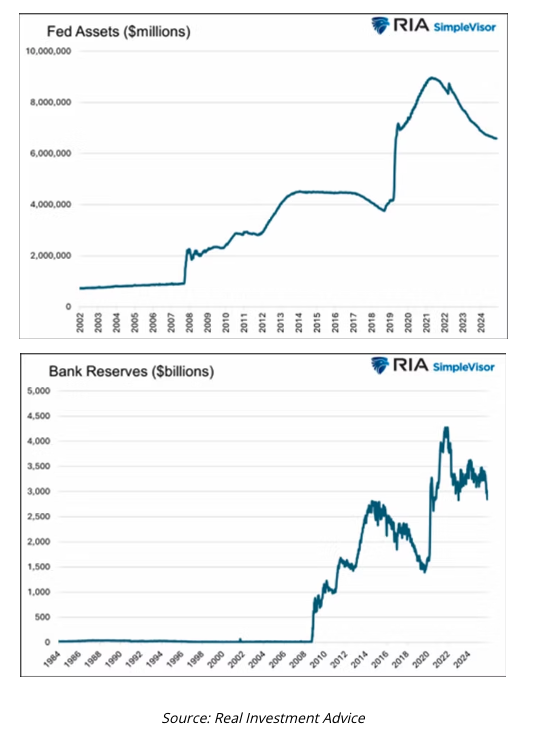
“Before 2008, banks held minimal excess reserves. Instead, they mainly met their liquidity needs by lending and borrowing reserves with other banks. Many of these transactions took place in the overnight Fed Funds market. The Fed did not set the Fed Funds rate back then, nor does it now. However, before the financial crisis, it guided banks toward its target rate through daily purchases and sales of Treasury securities.
“In 2008, the Fed introduced Quantitative Easing (QE). QE entails consistently purchasing securities regardless of liquidity conditions. Before QE, buying or selling was based on daily liquidity conditions. Because the Fed buys assets from banks with reserves, total reserves in the banking system have been grossly elevated since 2008…
“Today, to maintain control of the overnight financing markets, the Fed pays interest on reserve balances (IORB). The Fed sets the IORB rate, which serves as a floor for the Fed Funds rate because banks will not lend their reserves for less than they can earn risk-free from the Fed.
“Thus, in the post-QE world, the level of bank reserves and the Fed’s IORB rate are predominant determinants of overnight liquidity.”
As a practical matter, the IORB is now far more important than the Fed Funds rate, yet you rarely hear about it. That’s partly because the Board of Governors, not the FOMC, sets the IORB rate. It gets almost no media attention. We don’t get minutes of the meetings, voting positions, etc. Not much drama so the media doesn’t have much to breathlessly report.
The broader point is highlighted in Michael’s charts above. What happened in 2008 wasn’t just a severe recession; it was a radical change in how banks operate, mainly due to radical changes in the way the Fed operates and the way banks are regulated.
Some of these changes were well-intentioned. Obviously, we need a stable banking system consumers and businesses can trust and which doesn’t require bailouts every time people get overly enthusiastic. The problem is that the Fed burned our economic road map. The way things worked before 2008 became largely irrelevant, of interest only to historians.
I would argue the same thing happened again in 2020. The pre-COVID era is gone. The Fed now operates under new paradigms no one at the Fed (or anywhere else) fully understands.
Massive Swing
On Thursday night the odds of a rate cut at the December meeting were roughly 34%. Friday morning, New York Fed president John Williams said he now thinks Fed policy rates are too restrictive. The odds jumped to 56% and are now at 60% as I write.
Here is the key Williams quote, via Peter Boockvar:
“I view monetary policy as being modestly restrictive, although somewhat less so than before our recent actions. Therefore, I still see room for a further adjustment in the near term to the target range for the federal funds rate to move the stance of policy closer to the range of neutral, thereby maintaining the balance between the achievement of our two goals…
“My assessment is that the downside risks to employment have increased as the labor market has cooled, while the upside risks to inflation have lessened somewhat. Underlying inflation continues to trend downward, absent any evidence of second round effects emanating from tariffs.”
I talked with Peter about this. Neither of us can remember a time when rate cut odds moved so dramatically in a few hours. Markets had viewed Williams as more or less neutral. The New York Fed president has a much larger role and importance than other Fed presidents. He is an FOMC permanent voting member. It is paramount that the Fed chair and the New York Fed president cooperate and work together. Peter pointed out that it is unlikely that Williams would release that statement without Powell’s knowledge and consent. That’s why the rate cut odds changed so dramatically.
Rule By Models
I mentioned new Fed governor Stephen Miran above. I disagree with him on both tariffs (he is the main architect of Trump’s trade policy) and interest rates. I believe inflation is the bigger threat right now and the Fed shouldn’t ease in December. But I do appreciate the candor Miran is bringing to his role as a policymaker. He says what he thinks, publishes detailed explanations of why he thinks it, and then votes accordingly. It’s refreshing to see. I still disagree, but at least I can read why. And sometimes he makes good points.
This is from an excellent Miran profile (hat tip to Jim Bianco) which I suggest you read in full.
“Miran set his sights on the Fed’s abandonment of price stability after watching an uptick in inflation during the first two years of Biden’s presidency. Under Ben Bernanke in 2012, the central bank had introduced an explicit 2% inflation target as a way of reassuring markets that the Fed would prevent runaway inflation as well as deflation. While this may have been temporarily justified, it soon became a means to assert an alternative economic reality. For Miran, the near infinite ways of measuring inflation meant that any explicit inflation target would be subordinate to subjective ‘methodological quirks.’ Political pressure on the Federal Reserve soon became a way of gaslighting the public that the economy was doing well when consumers felt the sting of rising prices. When the White House insisted in 2021 that rising prices were ‘transitory,’ Miran called it ‘an exercise in data mining,’ with officials actively massaging data to suit their policy objectives.
“Behind this complaint is a deeper critique of technocracy. The neoliberal ideal of a politically neutral central bank, free of democratic pressures, had degraded into rule by models and backward-looking formulas that served to validate policies that no longer work. By committing to the 2 percent rule, one that was regularly challenged as increasingly irrational, the global economy fell into what Miran called an ‘overreliance on the Fed as an engine of growth.’ The supposed guardians of stability had become a major source of distortion.
“The overreliance on the Fed, Miran argues, meant that technocracy and politics became increasingly entangled. The Federal Reserve has been nominally independent since 1951. But following the 2008-2009 financial crisis, writes Miran, the bank’s mandate ‘expanded to include inherently political activities such as credit allocation, the selection of economic winners and losers, and bank supervision.’ The 2023 banking turmoil, for example, was not an isolated failure but the unintended result of reforms meant to fix the last one.”
This is exactly what I’ve been saying for years. The Fed’s mistakes are cumulative, each one compounding the damage of previous ones and gradually reducing the Fed’s ability to address future problems. It has reached the point where all the options are bad.
Former Fed governor Kevin Warsh, who is on the short list to replace Powell (and would be my first choice), seemed to agree. He said this in a WSJ guest column last week:
“[I]nflation is a choice, and the Fed’s track record under Chairman Jerome Powell is one of unwise choices. The Fed should re-examine its great mistakes that led to the great inflation. It should abandon the dogma that inflation is caused when the economy grows too much and workers get paid too much. Inflation is caused when government spends too much and prints too much. Money on Wall Street is too easy, and credit on Main Street is too tight. The Fed’s bloated balance sheet, designed to support the biggest firms in a bygone crisis era, can be reduced significantly. That largesse can be redeployed in the form of lower interest rates to support households and small and medium-size businesses.”
I agree with all this, but I want to zoom in on one part: “Money on Wall Street is too easy, and credit on Main Street is too tight.” This is exactly the problem. Since 2008, the Fed’s attempts to stimulate the economy have served mainly to stimulate asset prices, mainly stocks and real estate. Then, instead of recognizing this and finding new methods, they keep doubling down on the same failed policies. And we keep getting the same results: a wide and widening gap between those with assets and those without. I’ve been researching comparisons between what is happening now and the Gilded Age that began in the 1870s. There are a lot of differences, but also some striking similarities.
The Fed isn’t society’s only stuck-in-the-mud institution, of course. It is a long list that includes many universities, churches, media organizations, think tanks, political parties and others. Neil Howe describes the currently unfolding Fourth Turning as a time when all these institutions have to either reform or die. Since the odds of the Fed dying is vanishingly small, it will be fascinating to watch the process of reform and what a “reformed” Fed actually looks like.
Tulsa, Dallas and An Important Webinar
I will fly to Tulsa for Thanksgiving. Shane will stay in the Dallas area waiting on our new grandchild’s arrival, then I will return to Puerto Rico where we will open the Dorado Lifespan Edge clinic December 1. I will fly back at some point to see my new grandson and visit with others. I am still trying to figure out a time to get to Cleveland to do my annual checkup.
Dr. Mike Roizen and I will be doing a webinar on longevity on December 3. This will be 90% Mike doing a presentation and me asking questions. You will get a chance to ask questions as well. This is something that you really want to set aside and do. Register here.
And with that, I will hit the send button. You have a great week and don’t forget to follow me on X!
Your thinking about making prime and mushrooms for Thanksgiving analyst,
John Mauldin
A message from Advisor Perspectives and VettaFi: Stay ahead of market changes with our daily updates on key market and economic indicators. Visit the AP Charts and Analysis site for our expert insights.
Membership required
Membership is now required to use this feature. To learn more:
View Membership BenefitsSponsored Content
Upcoming Virtual Events View All












