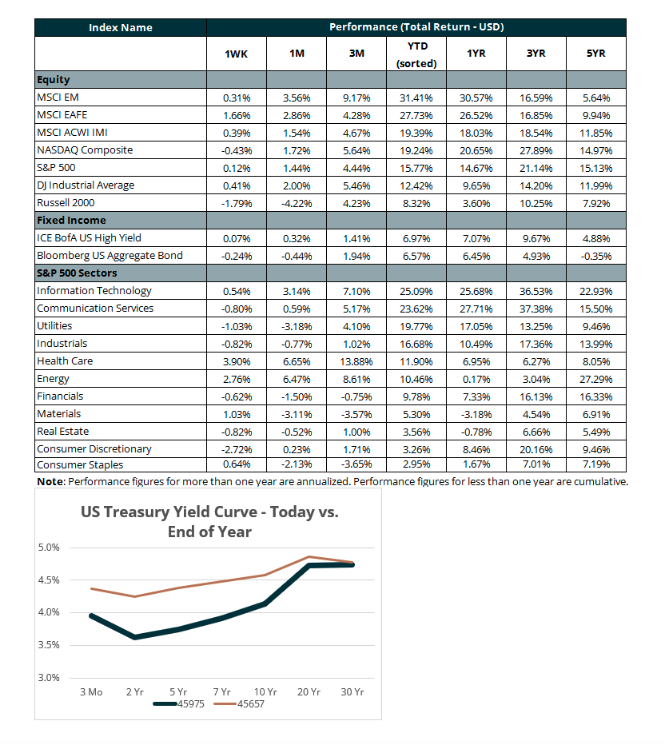
The stock market started last week strong after Senate lawmakers came to an agreement on reopening the government. On Monday the NASDAQ and the S&P 500 rallied more than two per cent and 1.5 per cent, respectively, as traders saw the reopening as providing relief to federal workers, and a possible boost to flagging consumer sentiment. The 30-member Dow Jones Industrial Average fared even better, topping 48,000 for the first time last week and marking a rebound of more than 30 per cent from the Index’s low in April. The Dow doesn’t get as much press as the S&P 500 or the NASDAQ as it’s no longer considered representative of the overall US stock market, but it’s still widely followed because it is the oldest continuous market barometer. The Dow’s rally was led by Goldman Sachs, its largest constituent, which jumped on news that it’s set to earn a record fee of $110 million for its role in the privatization of Electronic Arts.
The rally fizzled, however, on rate-cut concerns. Another Federal Reserve rate cut is seen as providing added support for the ongoing rallies in stocks and bonds. It is also viewed as providing needed support for the economy and the softening labor market. Indeed, BlackRock’s Rick Rieder, a candidate for Federal Reserve Chairman, argues rates should be lowered to three per cent from 3.75 per cent to address the weakness. However, recent remarks from Fed Chairman Powell and others hinted they are hesitant to cut rates given the lack of data on jobs and inflation – and that hesitancy pushed down the odds of a December rate cut to less than 50 per cent from more than 90 per cent a month ago. As the odds fell, the Dow’s record level quickly slipped away as the index dropped 800 points on Thursday and another 300 points on Friday.
The benchmarks ended the week mixed, with the Dow and the S&P 500 holding small gains and the NASDAQ ending the week with a 0.5 per cent loss. The tech-heavy NASDAQ endured its second losing week in a row, as concerns have grown about elevated valuations and inflated capital spending on AI. Cloud-provider Oracle has come under particular pressure. Its stock has lost more than one third of its value after peaking in September, as its plan to raise $38 million in debt to fund capex has come under scrutiny.
Looking ahead, the data drought is coming to an end as delayed economic reports start to trickle in. But all eyes and ears will remain on the Fed for signs that the December rate cut remains in play.

The views expressed represent the opinion of Sequoia Financial Group. The views are subject to change and are not intended as a forecast or guarantee of future results. This material is for informational purposes only. It does not constitute investment advice and is not intended as an endorsement of any specific investment. Stated information is derived from proprietary and nonproprietary sources that have not been independently verified for accuracy or completeness. While Sequoia believes the information to be accurate and reliable, we do not claim or have responsibility for its completeness, accuracy, or reliability. Statements of future expectations, estimates, projections, and other forward-looking statements are based on available information and Sequoia’s view as of the time of these statements. Accordingly, such statements are inherently speculative as they are based on assumptions that may involve known and unknown risks and uncertainties. Actual results, performance or events may differ materially from those expressed or implied in such statements. Investing in equity securities involves risks, including the potential loss of principal. While equities may offer the potential for greater long-term growth than most debt securities, they generally have higher volatility. Past performance is not an indication of future results. Investment advisory services offered through Sequoia Financial Advisors, LLC, an SEC Registered Investment Advisor. Registration as an investment advisor does not imply a certain level of skill or training.
A message from Advisor Perspectives and VettaFi: Discover something new! Click here to register for our upcoming webcasts.
© Sequoia Financial Group
Read more commentaries by Sequoia Financial Group