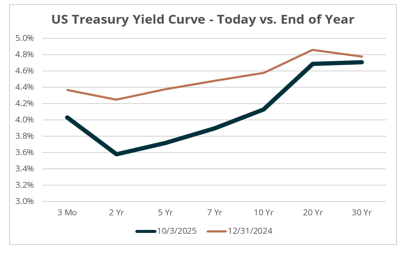
The US government shut its doors on October 1. Republicans and Democrats couldn’t agree on a spending bill, so non-essential portions of the government are closed until further notice. Notably, the Bureau of Labor Statistics said it will not collect, process, or share data during the shutdown. With no data, there was no September jobs report, and future readings on inflation and job creation are on hold. As such, the Federal Reserve will be flying a bit blind as it looks to keep inflation in check and the economy on track. The Fed will now be reliant on non-government data sources, such as payroll-provider ADP, which reported a decline in private payrolls in September. That report was likely soft enough to keep the Fed on track to cut rates by a quarter percentage point at its next meeting later this month.
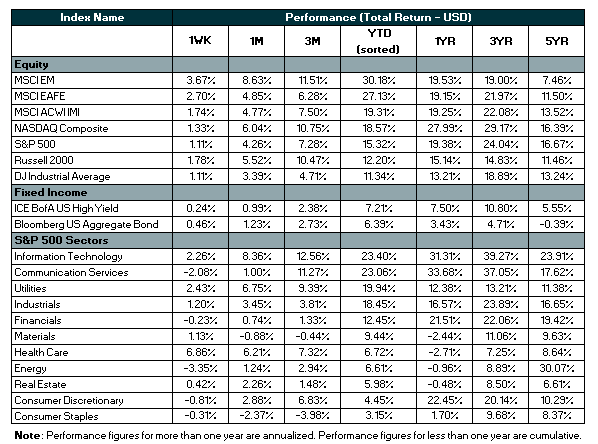
One would think the uncertainty surrounding a government shutdown would cause stock market angst – but historically that hasn’t been the case. During 20 shutdowns over the last 50 years, stocks have averaged a zero per cent return, with the market up 50 per cent of the time. And the early results for this shutdown have been positive: stocks ended the week higher, with both the S&P 500 and the NASDAQ reaching fresh all-time highs on Friday.
The market’s continued climb has been driven in part by the ongoing artificial intelligence (AI) boom. The AI rally has sparked comparisons to the dot-com days of the late 1990s. But unlike the dot-com rally, which saw money flood into start-ups with a good story but no earnings – think pets.com – the AI charge has been led by hugely profitable companies like NVIDIA, Microsoft, and Google. Chip leader NVIDIA recently announced deals with Intel and OpenAI that showcase its still-aggressive growth plans despite its massive size.
Outside of the tech sector, healthcare stocks also contributed to the week’s gain, enjoying their best week since 2022. Charles River Laboratories and Bio-Techne each jumped more than 20 per cent. Drug developer Charles River was upgraded by Barclays, which increased its target for the stock to $195/share from $155/share on stabilized bookings. Meanwhile, life-science company Bio-Techne announced new advancements in its portfolio of products. Pfizer also rallied, after striking a deal that will allow it to avoid tariffs for the next three years. In exchange, Pfizer will charge Medicaid lower drug prices by aligning prices with those paid by other countries. For the week, the healthcare sector jumped seven per cent.