Tariffs impact has been delayed
As of September 26, the Budget Lab at Yale estimates an average effective tariff rate of 17.9%, which includes the impact of sector tariffs that went into effect on October 1. However, the approximate effective tariff rate paid was only 9.7% at the end of July, up from 2.3% at the start of 2025, according to the most recent data from the U.S. International Trade Commission. This is just below the 10% across-the-board reciprocal U.S. tariffs on all goods from all countries instituted at the end of July.
Actions such as front-loading, or accelerating, the shipment of goods ahead of tariff increases, exemptions for certain goods like smartphones, the application of tariffs disproportionately to higher-end goods, the substitution of less expensive materials, as well as other mitigation methods, have reduced the amount of duties paid so far. Companies seem to have absorbed the increased prices but may need to increasingly pass along higher input prices to consumers. Additionally, the subsequent increase of across-the-board U.S. tariffs to 15% started in early August—which may be too recent to see effects cascade through the global economy.
Tariff evasion
The economic impact of higher tariffs has been mitigated through several means, including trade rerouting, trade diversion, and underreporting.
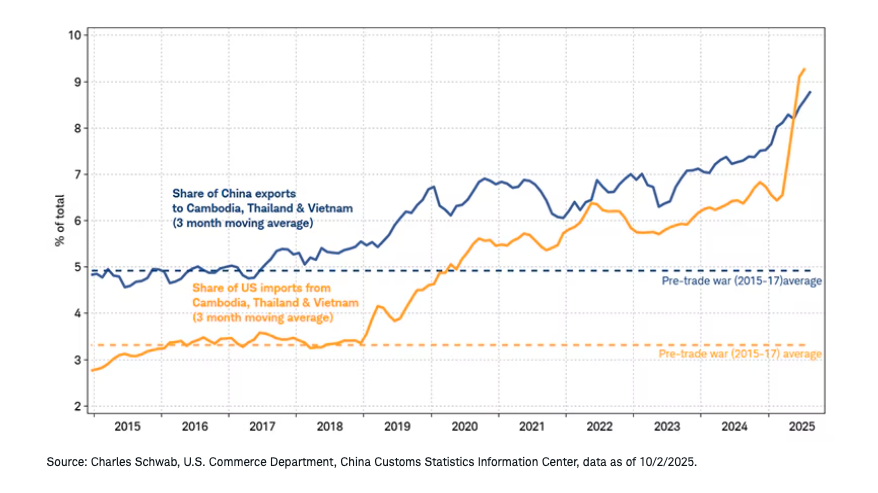
Trade rerouting (also known as transshipping) is when goods are sent from China to other Asian countries for minimal processing or repackaging before being exported from those countries to the U.S. to avoid the higher tariff on goods coming from China. We see evidence of rerouting in the increased exports from China to Cambodia, Thailand, and Vietnam—along with the corresponding increase in imports from these three countries into the U.S. While goods that are transshipped are subject to a new 40% tariff, it doesn't appear to have deterred this practice yet. The U.S. Trade Fraud Task Force launched in August may help increase enforcement of trade laws. However, staffing at the ports would likely need to increase dramatically to visually inspect every container arriving into the U.S.
Trade rerouting to avoid higher tariffs

Trade diversion is when countries import goods from China initially designed for use in their domestic market but instead export these goods to the U.S. This may not be happening much yet, as it takes time to change supply chains and retool factories and products to meet the needs of the U.S. market.
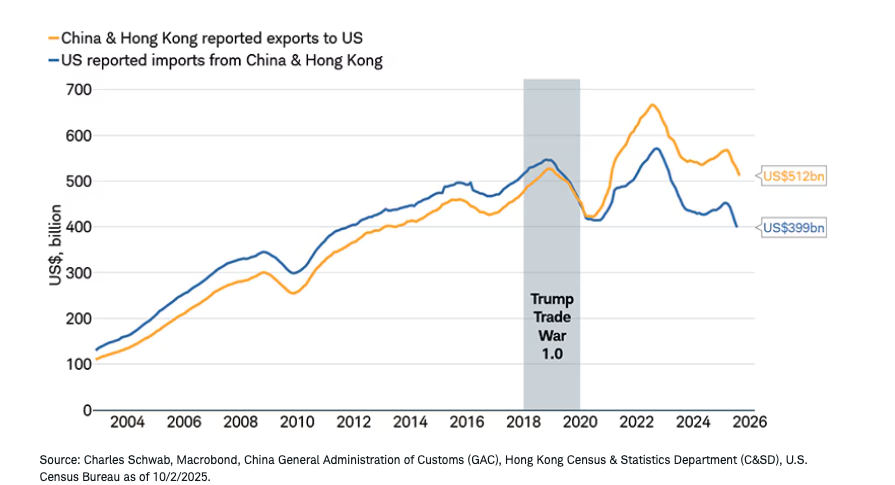
Lastly, underreporting, or underinvoicing, occurs when exporters declare to customs officials a lower value for their goods arriving at the U.S. borders, resulting in a lower tariff—even if the price to end customers isn't reduced. This year, Whirlpool accused other appliance makers of participating in this practice, although it appears to have started during the trade war in President Donald Trump's first term. The chart below compares the value of exports to the U.S. from China, as reported by China and Hong Kong in blue and as reported by the U.S. in gold. The blue line in the chart shows that before 2018-2019, Chinese exporters were overinvoicing—perhaps to evade capital controls and get money out of China—by inflating the declared value of those exports to China's officials relative to what was declared to U.S. Customs. The practice flipped beginning in 2018-2019. Now, we see that the declared value of goods from China and Hong Kong at U.S. ports is below what is being reported at Chinese ports, perhaps to avoid tariffs.
Underinvoicing to reduce tariffs paid
Where are all those Chinese goods going?
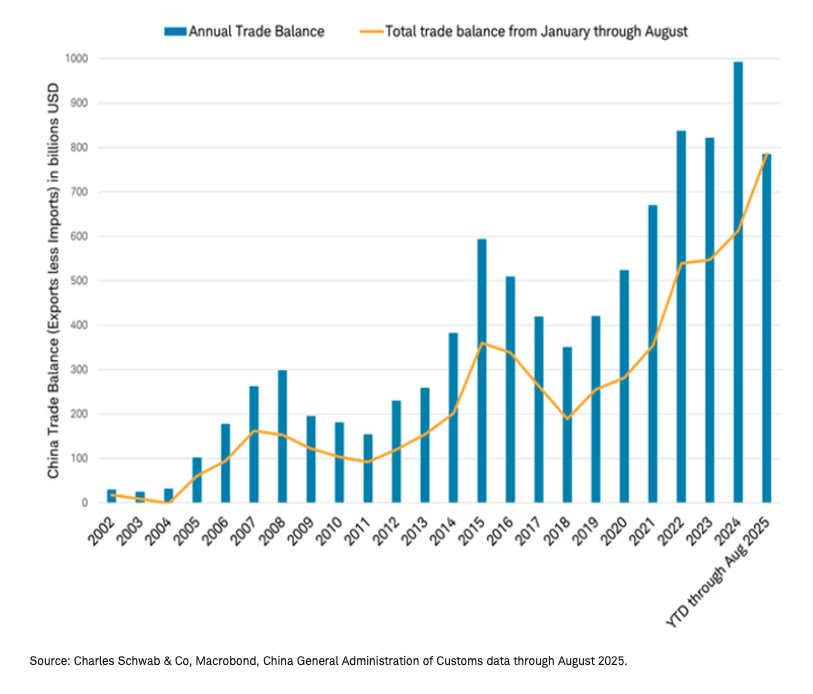
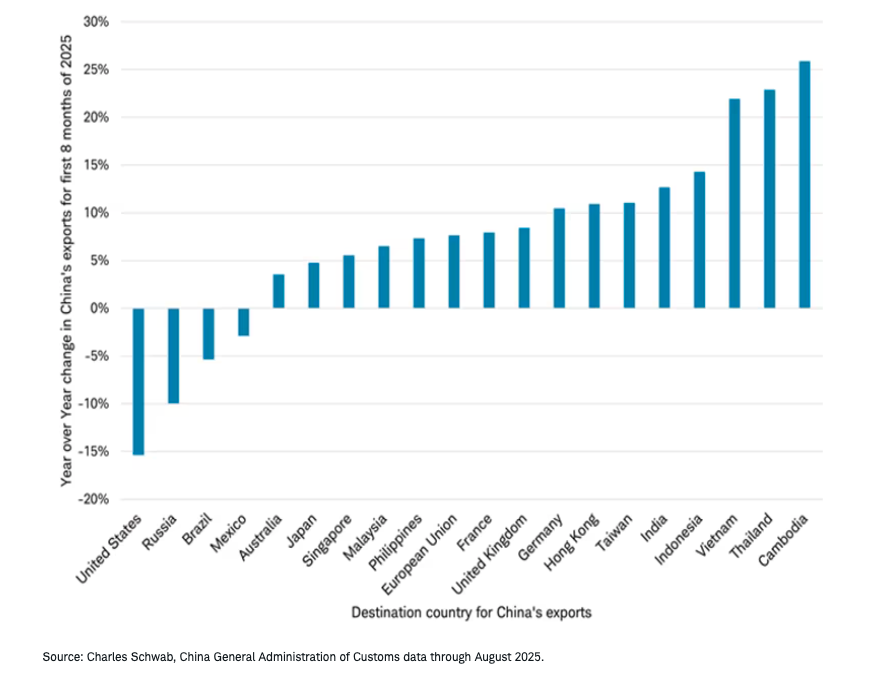
China's trade surplus with the world continues to grow as you can see in the first chart below despite a 15% drop in exports to the U.S. over the first eight months of this year, demonstrated by the second chart. It's not just other Asian countries that are buying more from China; exports to the European Union (EU) are up 7.6% according to China General Administration of Customs, with Germany, France, and the U.K. up even more.
China's trade surplus with the world is still rising
China is exporting less to the U.S. but more to other countries
There is some concern that Chinese exports initially destined for the U.S. could flood other countries, increase competition, and depress prices, harming the prospects of exporters in these countries. While individual industries or companies may be affected, the overall impact may not be that large. A July study by the European Central Bank noted that in a severe U.S. tariff scenario (135% effective rate on Chinese goods), the eurozone could see imports from China rise by up to 10% in 2026. While import prices could fall in the short term, the impact on consumer prices happens gradually over 12 to 18 months. Given the weight of these goods in the consumption basket, the study estimates a maximum peak negative impact on headline inflation of only 0.15% in 2026 in this severe scenario.
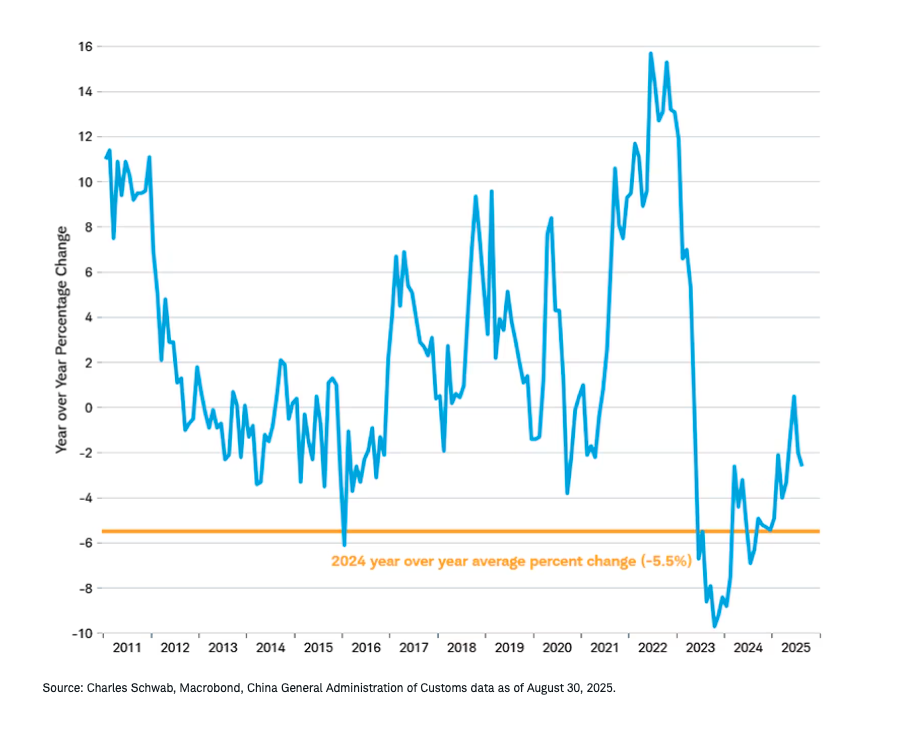
At this time, we don't see evidence that Chinese exporters are accelerating price reductions on goods shipped in 2025, despite the shift in destinations. China's export price index fell 2.6% year-over-year in August, less than the 5.5% average decline in 2024, as you can see in the chart below.
The decline in China's export prices has not worsened
Trade deals are not yet final
The announced trade deals with the EU, Japan, and South Korea establishing 15% tariff rates for those country's exports to the U.S. came with commitments to invest in the U.S. However, there are disagreements about the nature of these commitments between the U.S. and these countries. The Trump administration has described the investments as "signing bonuses" or "gifts." Meanwhile, the EU has characterized the investments as nonbinding intentions; Japan has suggested the commitment would be funded primarily through loans and loan guarantees; and South Korea has asked for a currency swap agreement to fund the commitment. Any perceived failure to comply with these trade deals may create the potential for further escalation in tariffs in coming months.
Court case unlikely to be the end of tariffs
The Trump administration used the International Emergency Economic Powers Act (IEEPA) to enact across-the-board reciprocal tariffs this year. However, the U.S. Court of International Trade (CIT) and the U.S. Court of Appeals for the Federal Circuit ruled that the IEEPA doesn't give the president tariff authority (taxing is the remit of Congress) and is not meant to be used unbounded in scope, amount, and duration. The case was stayed until October 14, keeping tariffs in place until the Supreme Court can hear the case. However, since oral arguments begin on November 5, it's possible the ruling will be stayed once again until a verdict can be reached in the weeks thereafter. The Trump administration has already stated it has a plan B for implementing tariffs should the Supreme Court rule against this use of the IEEPA. Among the statues the administration could use is Section 122 of the Trade Act of 1974, which permits the placement of universal tariffs of 10% to 15%, but for no more than 150 days. Another possibility is the use of more sector-specific tariffs, such as those currently on steel, aluminum, autos, and furniture, under Section 232 of the Trade Expansion Act of 1962. Regardless of the Supreme Court ruling, tariffs are likely here to stay.
The bottom line
Economic distortions from tariffs seem to be still filtering through the global economy. Growth and profits may eventually slow, but the inflation impact is already more gradual than initially expected. We believe tariffs hurt economic growth and cause an increase in prices, but fiscal and monetary stimulus, as well as other secular trends like spending on the artificial intelligence (AI) arms race could offset the impact.
Heather O'Leary, Senior Global Investment Research Analyst, contributed to this report.
A message from Advisor Perspectives and VettaFi: Discover something new! Click here to register for our upcoming webcasts.
This material is intended for general informational purposes only. This should not be considered an individualized recommendation or personalized investment advice. The investment strategies mentioned are not suitable for everyone. Each investor needs to review an investment strategy for his or her own particular situation before making any investment decisions.
All expressions of opinion are subject to change without notice in reaction to shifting market, economic, or political conditions. Data contained herein from third party providers is obtained from what are considered reliable sources. However, its accuracy, completeness or reliability cannot be guaranteed.
All corporate names and market data shown are for illustrative purposes only and are not a recommendation, offer to sell, or a solicitation of an offer to buy any security.
Investing involves risk, including loss of principal.
International investments involve additional risks, which include differences in financial accounting standards, currency fluctuations, geopolitical risk, foreign taxes and regulations, and the potential for illiquid markets. Investing in emerging markets may accentuate this risk.
The policy analysis provided by the Charles Schwab & Co., Inc., does not constitute and should not be interpreted as an endorsement of any political party.
The Schwab Center for Financial Research is a division of Charles Schwab & Co., Inc.
The Charles Schwab Corporation provides a full range of brokerage, banking and financial advisory services through its operating subsidiaries. Its broker-dealer subsidiary, Charles Schwab & Co. Inc. (Member SIPC), and its affiliates offer investment services and products. Its banking subsidiary, Charles Schwab Bank, SSB (member FDIC and an Equal Housing Lender), provides deposit and lending services and products.
This site is designed for U.S. residents. Non-U.S. residents are subject to country-specific restrictions. Learn more about our services for non-U.S. residents, Charles Schwab Hong Kong clients, Charles Schwab U.K. clients.
© 2025 Charles Schwab & Co., Inc. All rights reserved. Member SIPC. Unauthorized access is prohibited. Usage will be monitored.
© Charles Schwab
Read more commentaries by Charles Schwab