In 2006, Andrew Fire and Craig Mello shared the Nobel Prize in Physiology or Medicine for their discovery of RNA interference (RNAi), which they published in 1998. Since then, the potential of a technology capable of silencing disease-causing genes has been a very attractive proposition.
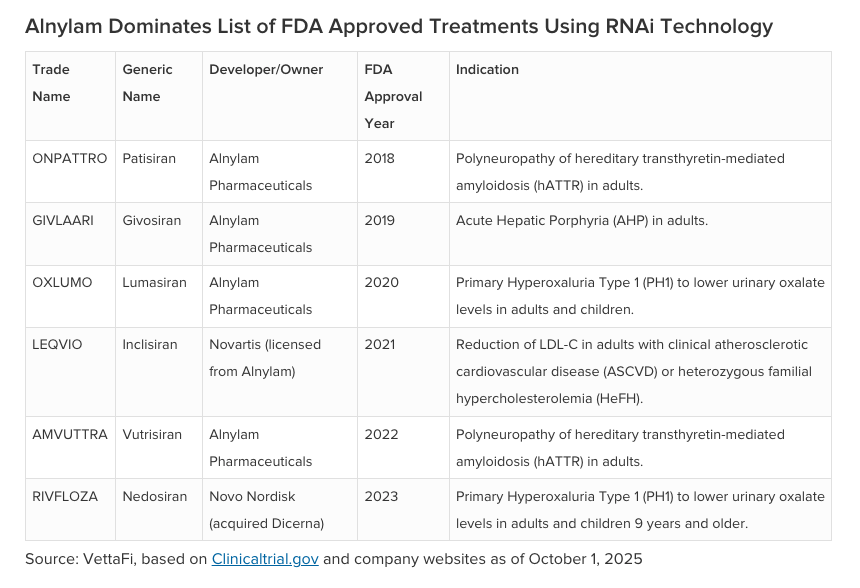
It was not until 2018 that the US Food and Drug Administration (FDA) approved the first therapy developed using the technique. Since then, there’s been a steady, but slow, number of RNAi treatments coming into the market. This November is likely to see the approval of Arrowhead Pharmaceutical’s (ARWR) first commercial product. This development marks a compelling point for precision medicine, as we may be about to see the floodgates open for a lot of previously untreatable diseases.
How RNAi Intercepts the Instructions
First, let’s start with a massively oversimplified biology lesson: Part of normal human function consists of molecules called messenger RNA (mRNA), which grab a copy from the DNA stored in the cell’s nucleus and bring those instructions to a ribosome. The ribosome then “prints” proteins required for day-to-day bodily functions.
By now, we have probably heard at some point that disease X is caused by a mutation in gene Y. In other words, the instructions have led to either faulty proteins or the overproduction of healthy ones. The solutions in these cases are three: We can edit the gene directly (gene therapy), address the wonky proteins being created by the printer (traditional small molecule/biologic drugs), or intercept the mRNA bringing those instructions before they get to the printer (RNAi).
Let’s use a leaky faucet analogy. Traditional therapies would mop up the puddle under the pipe on a fixed schedule, RNAi would tighten the faucet for the leak to temporarily stop, while gene therapies would replace the faucet altogether. It is then no secret why the therapeutic use of RNAi would be so attractive.
More Players, More Treatments
Next month’s anticipated FDA decision on Arrowhead’s plozasiran would mark the entrance of a new player into the RNAi market. The drug, which would be the company’s first commercial product, was developed to treat a rare lipid disorder called familial chylomicronemia syndrome (FCS). During clinical trials, the treatment showed an ∼80% median triglyceride reduction. The treatment could become the first one capable of significantly lowering the triglycerides, which in high enough concentrations can lead to pancreatitis. Furthermore, ongoing studies for a related condition could expand its reach to a much larger 2–3 million-patient population.
This alone is great news for the prospects of RNAi becoming another arrow in the quiver of precision medicine. The most important point worth highlighting is the proof of concept this provides. As of today, the only company with a viable commercial model around RNAi is Alnylam (ALNY), which currently has five commercially available therapies using the technology, as well as a very extensive pipeline treating a wide array of conditions. Arrowhead could be on the way to becoming another commercially successful player in this field.

RNAi Approval Is Ramping Up
As of now, both companies have a clear path to profitability, with very rich pipelines created using a technology that is increasingly trusted by healthcare providers and has better coverage by payers (insurers). Arrowhead plans to produce two to three drug candidates every year for the foreseeable future, a business model that relies on partnering with other companies to ensure all viable products achieve a commercial launch.
While Alnylam won the first-to-market prize, the companies currently have very diversified pipelines with little overlap. Both hold differentiated platforms capable of generating new, novel therapies going forward. Furthermore, the broader sector received a significant validation point from UniQure’s latest announcement regarding its AMT-130 treatment. The therapy, which employs a similar gene-silencing technology, has shown evidence of being the first disease-modifying treatment for Huntington’s disease. This is very good news for the field, as successful delivery of treatments to the brain has been a limiting factor so far. Both Alnylam and Arrowhead have Alzheimer’s Disease therapies in their pipeline, which would need to overcome the Blood-Brain Barrier.
Capturing Value in the RNAi Space
There lies the value of a research-based strategy like the ROBO Global Healthcare Technology and Innovation Index (HTEC). The index added Alnylam back in 2019, when it had just announced its second therapy for an orphan disease. At that point, the company generated $220 million in revenue, an order of magnitude less than last year’s $2.2 billion. Arrowhead, which was also added in 2019, is about to launch its first commercial product and undergo a similar transformation.
HTEC’s investment thesis consists of identifying needs in societies and the technologies and upcoming breakthroughs that would help societies address these problems. Our RNAi play came from the understanding that personalization and the development of curated therapies are the future of medicine. The days of “one therapy for many” are being replaced by “tailor-made therapies for each.”
For more on healthcare innovations, please join our upcoming webcast, “The Three-Body Framework: Artificial Intelligence, Human & Robotic Health,” on October 8 at 11 a.m. ET (register here).
A message from Advisor Perspectives and VettaFi: Discover something new! Click here to register for our upcoming webcasts.
Related Research
An AI Fix for Healthcare’s $2 Trillion Flaw
Looking for regular updates? Subscribe here for weekly insights on robotics, AI, and healthcare technology, delivered straight to your inbox.
Originally published on ETF Trends
For more news, information, and strategy, visit the Disruptive Technology Content Hub.
HTEC is the underlying index for the Robo Global Healthcare Technology & Innovation ETF (HTEC) and the L&G Healthcare Technology & Innovation UCITS ETF (DOCT.LN).
VettaFi is the index provider for HTEC ETF and DOCT.LN, for which it receives an index licensing fee. However, HTEC ETF and DOCT.LN are not issued, sponsored, endorsed, or sold by VettaFi. VettaFi and its affiliates have no obligation or liability in connection with the issuance, administration, marketing, or trading of HTEC ETF and DOCT.LN.
Read more commentaries by VettaFi