Why Stable Value Funds Matter for Retirement Savers
Membership required
Membership is now required to use this feature. To learn more:
View Membership BenefitsA turning point for capital preservation strategies
The Fed’s resumption of monetary easing could mark an end to the prolonged period of elevated short-term interest rates. This follows a challenging stretch for 401(k) advisors, plan sponsors, and retirement investors, where money market returns consistently outpaced longer-duration1 capital preservation options such as stable value funds.
As the yield curve begins to normalize, stable value funds may re-gain appeal for retirement plan fiduciaries and their participants. These funds can potentially provide the two outcomes plan participants seek for capital preservation: the price stability of a money market fund, along with inflation-beating long-term returns. As rates decline, stable value funds could represent a compelling alternative against traditional cash-like vehicles.
Many retirement plans use government money market funds which are required to invest in high-quality assets such as Treasuries, agencies and repurchase agreements. Money market funds are very short-term in nature, so their yields closely follow the federal funds rate.
With the interest-rate picture evolving, we believe it is a critical time for plan sponsors to reassess their capital preservation options. Ensuring that retirement portfolios remain resilient and aligned with long-term goals is more important than ever.
The role of stable value in retirement plans
Stable value funds offer distinct advantages for retirement investors. As we noted in a previous article on the importance of stable value in retirement plans, these funds offer unique structural advantages including:
- Price stability: Maintaining a consistent value despite market fluctuations
- Inflation-beating returns: Historically providing returns that outpace inflation
- Liquidity: Allowing savers to access their funds when needed
A historical analysis over the last 15 years demonstrates that these features have resulted in a favorable risk-reward profile for stable value funds compared to other investment options.
Stable Value’s Structural Advantages Result in the Stability of Cash with Bond-Like Returns
Annualized Risk-Return of Different Investments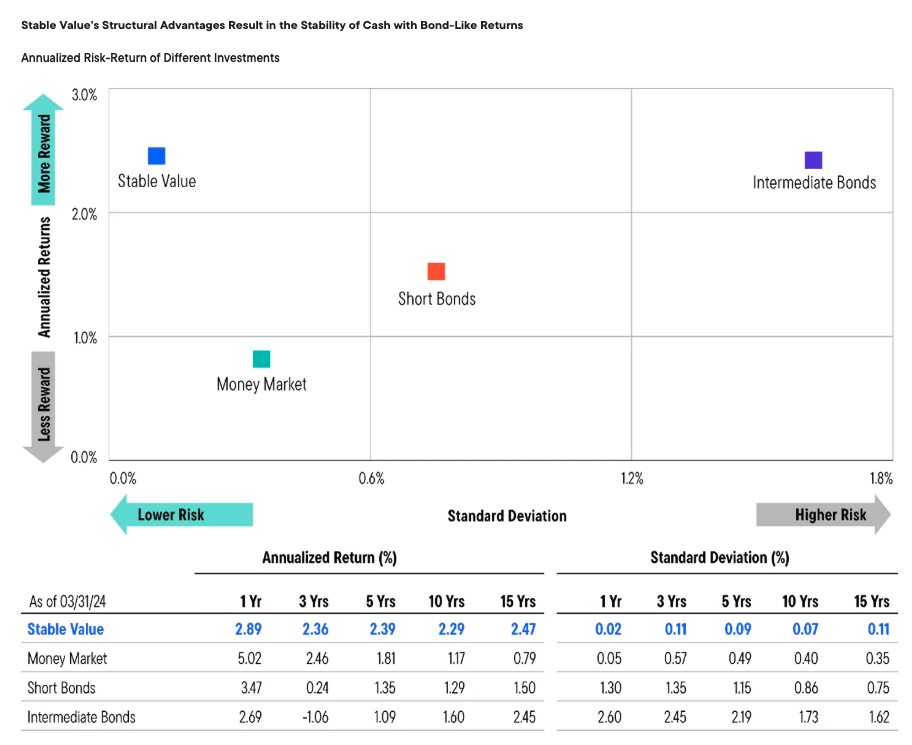

The structural strength behind steady performance
In an environment where market volatility and shifting interest rates challenge retirement savers, the structural design of stable value funds offers a compelling idea. One of the defining features of stable value is a specific accounting treatment that allows market value assets—which fluctuate daily—to be valued at book value. This approach keeps the fund’s net asset value (NAV) constant, providing stability for plan participants.
Stable value funds mitigate market value fluctuations by purchasing insurance contracts (commonly referred to as “wraps”) and/or guaranteed investment contracts (GICs). These instruments protect participant balances from daily price swings and allow for qualified transfers and withdrawals at book value rather than market value.
Beyond stability, return potential is another key benefit. Although stable value funds are distinctly different from money market funds and intermediate bond funds, they have delivered higher returns than money market funds and competitive performance compared to intermediate-term bonds.
Stable value funds typically invest in investment-grade rated bonds and generally have an average portfolio duration of two to four years, compared to approximately 60 days for money market funds. As a result, yields and returns of stable value funds are less sensitive to Fed activity, while the yields of money market funds adjust almost immediately following Fed decisions.
In typical interest-rate environments, the longer duration has helped stable value funds outperform money market funds—especially over three-year or longer time horizons.
The expanded opportunity set for stable value also introduces incremental credit risk, which investors are compensated for over time through potentially higher returns.
The role of the crediting rate
The crediting rate is a return mechanism similar to the “yield” metric on traditional fixed income portfolios.
- The crediting rate is formula-based and dynamically adjusts to changing market conditions.
- It “smooths” the return stream by amortizing gains or losses from the underlying bond portfolio.
- Unlike traditional bond portfolios, where daily market fluctuations impact NAV and principal balances, stable value funds reflect price changes through the crediting rate.
Over time, the crediting rate aims to align the market value and book value of the fund’s holdings. This smoothing effect helps the fund avoid short-term principal fluctuations and reinforces its role as a steady capital preservation tool.
Next steps for plan sponsors to consider
There are several key factors to consider when evaluating a retirement plans’ capital preservation goals.
Plan sponsors may want to consider these next steps:
- Review current capital preservation options, especially how stable value compares to money market and bond funds.
- Understand the mechanics behind stable value, including book value accounting and crediting rate dynamics.
- Evaluate fund resilience, particularly how stable value strategies have handled liquidity and redemption pressures during the inverted yield-curve environment over the past three years.
- Engage your investment committee or consultant to determine whether stable value remains a strategic fit for your plan.
By taking these steps, plan sponsors can help ensure their retirement plans continue to support participant goals—through both market shifts and long-term horizons
Endnotes
1Average effective duration provides a measure of a fund's interest-rate sensitivity. In general, the longer a fund's duration, the more sensitive the fund is to shifts in interest rates. The relationship among funds with different durations is straightforward: A fund with duration of 10 years is expected to be twice as volatile as a fund with a five-year duration. Duration also gives an indication of how a fund's net asset value (NAV) will change as interest rates change. A fund with a five-year duration would be expected to lose 5% of its NAV if interest rates rose by 1 percentage point, or gain 5% if interest rates fell by 1 percentage point.
A message from Advisor Perspectives and VettaFi: Discover something new! Click here to register for our upcoming webcasts.
WHAT ARE THE RISKS?
All investments involve risk, including loss of principle.
Stable value funds seek capital preservation, but there can be no assurances that they will achieve this goal. Stable value funds’ returns will fluctuate with interest rates and market conditions. The funds are not insured or guaranteed by any governmental agency. Funds that invest in bonds are subject to certain risks including interest-rate risk, credit risk, and inflation risk. As interest rates rise, the prices of bonds fall. Long-term bonds are more exposed to interest-rate risk than short-term bonds. Unlike bonds, bond funds have ongoing fees and expenses.
Government money market funds typically invest at least 99.5% of the fund’s total assets in cash, US government securities and repurchase agreements. You could lose money by investing in the fund. Although the fund seeks to preserve the value of your investment at $1.00 per share, it cannot guarantee it will do so. An investment in the fund is not a bank account and is not insured or guaranteed by the Federal Deposit Insurance Corporation or any other government agency. Interest rate increases can cause the price of a money market security to decrease. A decline in the credit quality of an issuer or a provider of credit support or a maturity-shortening structure for a security can cause the price of a money market security to decrease.
Retail money market funds: You could lose money by investing in the fund. Although the fund seeks to preserve the value of your investment at $1.00 per share, it cannot guarantee it will do so. An investment in the fund is not a bank account and is not insured or guaranteed by the Federal Deposit Insurance Corporation or any other government agency. The fund’s sponsor is not required to reimburse the fund for losses, and you should not expect that the sponsor will provide financial support to the fund at any time, including during periods of market stress.
Past performance is no guarantee of future results.
Any information, statement or opinion set forth herein is general in nature, is not directed to or based on the financial situation or needs of any particular investor, and does not constitute, and should not be construed as, investment advice, forecast of future events, a guarantee of future results, or a recommendation with respect to any particular security or investment strategy or type of retirement account. Investors seeking financial advice regarding the appropriateness of investing in any securities or investment strategies should consult their financial professional.
Franklin Templeton, its affiliates, and its employees are not in the business of providing tax or legal advice to taxpayers. These materials and any tax-related statements are not intended or written to be used, and cannot be used or relied upon, by any such taxpayer for the purpose of avoiding tax penalties or complying with any applicable tax laws or regulations. Tax-related statements, if any, may have been written in connection with the “promotion or marketing” of the transaction(s) or matter(s) addressed by these materials, to the extent allowed by applicable law. Any such taxpayer should seek advice based on the taxpayer’s particular circumstances from an independent tax professional.
IMPORTANT LEGAL INFORMATION
This material is intended to be of general interest only and should not be construed as individual investment advice or a recommendation or solicitation to buy, sell or hold any security or to adopt any investment strategy. It does not constitute legal or tax advice. This material may not be reproduced, distributed or published without prior written permission from Franklin Templeton.
The views expressed are those of the investment manager and the comments, opinions and analyses are rendered as at publication date and may change without notice. The underlying assumptions and these views are subject to change based on market and other conditions and may differ from other portfolio managers or of the firm as a whole. The information provided in this material is not intended as a complete analysis of every material fact regarding any country, region or market. There is no assurance that any prediction, projection or forecast on the economy, stock market, bond market or the economic trends of the markets will be realized. The value of investments and the income from them can go down as well as up and you may not get back the full amount that you invested. Past performance is not necessarily indicative nor a guarantee of future performance. All investments involve risks, including possible loss of principal.
Any research and analysis contained in this material has been procured by Franklin Templeton for its own purposes and may be acted upon in that connection and, as such, is provided to you incidentally. Data from third party sources may have been used in the preparation of this material and Franklin Templeton ("FT") has not independently verified, validated or audited such data. Although information has been obtained from sources that Franklin Templeton believes to be reliable, no guarantee can be given as to its accuracy and such information may be incomplete or condensed and may be subject to change at any time without notice. The mention of any individual securities should neither constitute nor be construed as a recommendation to purchase, hold or sell any securities, and the information provided regarding such individual securities (if any) is not a sufficient basis upon which to make an investment decision. FT accepts no liability whatsoever for any loss arising from use of this information and reliance upon the comments, opinions and analyses in the material is at the sole discretion of the user.
Franklin Templeton has environmental, social and governance (ESG) capabilities; however, not all strategies or products for a strategy consider “ESG” as part of their investment process.
Products, services and information may not be available in all jurisdictions and are offered outside the U.S. by other FT affiliates and/or their distributors as local laws and regulation permits. Please consult your own financial professional or Franklin Templeton institutional contact for further information on availability of products and services in your jurisdiction.
Issued in the U.S. by Franklin Templeton, One Franklin Parkway, San Mateo, California 94403-1906, (800) DIAL BEN/342-5236, franklintempleton.com. Investments are not FDIC insured; may lose value; and are not bank guaranteed.
You need Adobe Acrobat Reader to view and print PDF documents. Download a free version from Adobe's website.
CFA® and Chartered Financial Analyst® are trademarks owned by CFA Institute.
Membership required
Membership is now required to use this feature. To learn more:
View Membership BenefitsSponsored Content
Upcoming Virtual Events View All