An Active Manager’s Lens Into Private Investment Grade Credit
Membership required
Membership is now required to use this feature. To learn more:
View Membership BenefitsKey takeaways:
- We believe allocators should set a high threshold before giving up liquidity in today’s target-rich landscape for active fixed income.
- Evaluating private IG means more than just trusting a single credit rating. Understanding liquidity, credit quality, and structure helps investors determine adequate compensation and differentiate true IG quality from riskier deals.
- An active approach that rigorously analyzes such nuances can help create meaningful value compared with passive strategies focused solely on capital deployment and spread pickup.
- We find compelling value in well-structured private IG asset-based finance and select high-quality, large-scale corporate deals – particularly in sectors with bespoke capital needs such as digital and energy infrastructure.
The rise of private markets has brought new attention to private investment grade (IG) credit, which can offer investors a premium over public IG for giving borrowers customized terms – though that premium comes with certain risks.
Private IG ranges from corporate loans to asset-based finance (ABF). It’s a market that has existed for decades and one that can offer attractive opportunities today. Yet reduced liquidity, greater complexity, and less structural transparency compared with public IG markets mean investors should proceed with caution.
Despite perceptions of increased convergence between public and private markets, notable differences remain. Rapid growth and elevated complacency in many private credit areas continue to result in excessive focus on origination for the sake of capital deployment and insufficient examination of relative value.
With today’s markets offering abundant active public fixed income opportunities, investors should maintain a high bar before sacrificing liquidity, or the ability to easily trade assets. Public IG bonds trade in deep, well-established markets, while private IG deals are illiquid and often non-transactable without borrower consent. Significant obstacles remain to making private credit markets more liquid, and compensation for illiquidity in many areas remains insufficient.
That said, discerning investors can find value in well-structured private IG ABF and bespoke corporate financings for high-quality borrowers – particularly in sectors undergoing fundamental change, such as digital and energy infrastructure.
With increased attention on private IG, we find three questions often arise in client conversations:
- Why does private IG exist?
- How should investors think about relative value between public and private IG markets?
- What is the opportunity in private IG today?
These questions matter as private credit managers court a broader investor base. A maturing corporate direct-lending sector is reshaping the private credit playbook, enabling active investors to differentiate risk-adjusted returns across markets through relative value (for more, see our June 2025 Investment Strategies piece, “Active Management Comes for Private Credit”).
1. Why does private IG exist?
To better understand the purpose of private IG, it helps to look at the perceived benefits from both a borrower’s and an investor’s perspective.
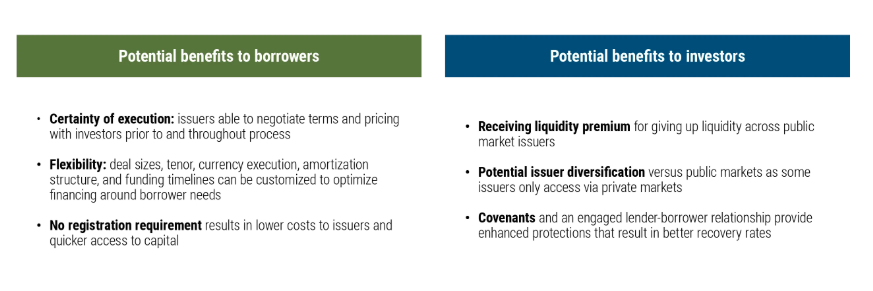
Borrower needs: In public credit markets, issuing bonds of varying maturities can allow companies to build a yield curve for their debt – an important tool for efficient pricing. Transparent financial reporting in public markets can further boost pricing efficiency and investor confidence.
When using private IG markets as a funding channel, corporate borrowers seek advantages that can include:
- Faster time to market
- Greater execution certainty
- Delayed-draw facilities, where the borrower doesn’t take all the funds up front but the lender agrees to make capital available over a set time
- Reduced reporting and registration requirements
- Highly structured financing that can allow companies to obtain funding without having to record the debt directly on their balance sheets, which can help improve leverage ratios, increase flexibility, and preserve ratings. This has become increasingly important as infrastructure requirements grow in a rapidly changing economy.
The largest private IG market is in ABF, where borrowers seek senior financing for pools of collateral that do not fit into common securitization structures, or that lack the data history for sufficient rating agency coverage. These can also include risk transfer arrangements – bespoke structures that banks use to offload risk without fully selling assets.
Investor needs: Private IG has long attracted investors seeking incremental spread above what’s available in public markets to compensate for greater illiquidity or complexity. An extended era of low interest rates after the global financial crisis resulted in more allocators seeking alternatives to traditional fixed income, fueling growth in various forms of private credit, including IG. Investors often seek certain advantages from private credit, including:
- Higher returns compared with public markets
- Lower volatility of returns, particularly after the post-pandemic period of elevated fixed income volatility
- Diversification versus their fixed income and equity exposures
The rise of ratings-sensitive capital targeting private markets, coupled with demand for capital-efficient spread that seeks to maximize spread or yield relative to rating – whether through assets with favorable credit ratings or those benefiting from preferential regulatory treatment – has been a key force. This is particularly true for buy-and-hold investors such as insurance companies (see Figure 1).
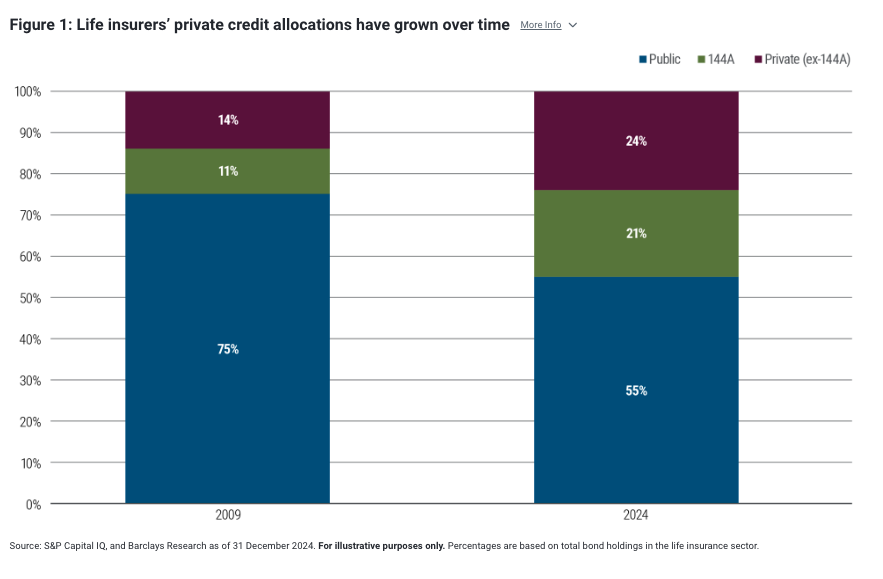
This helps explain private market sectors where spreads, either nominally or option-adjusted, are on par with – or even tighter than – those of comparable public credit.
2. How should investors think about moving between public and private IG markets?
Beyond credit quality, investors must consider three key factors when comparing public and private IG through a relative value lens: liquidity, spread, and structure.
Liquidity
Public IG bonds benefit from deep, liquid markets, with monthly trading volumes in the hundreds of billions of dollars (see Figure 2). This liquidity enables investors to buy or sell quickly, usually within minutes, with minimal price impact.
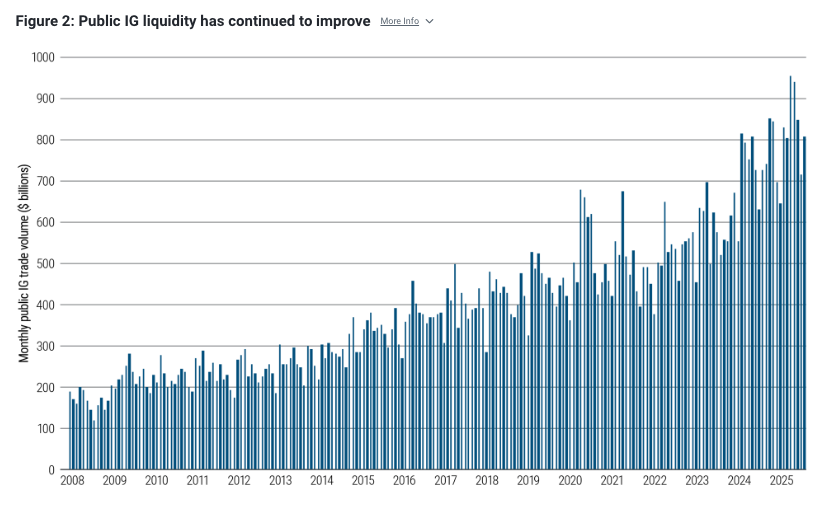
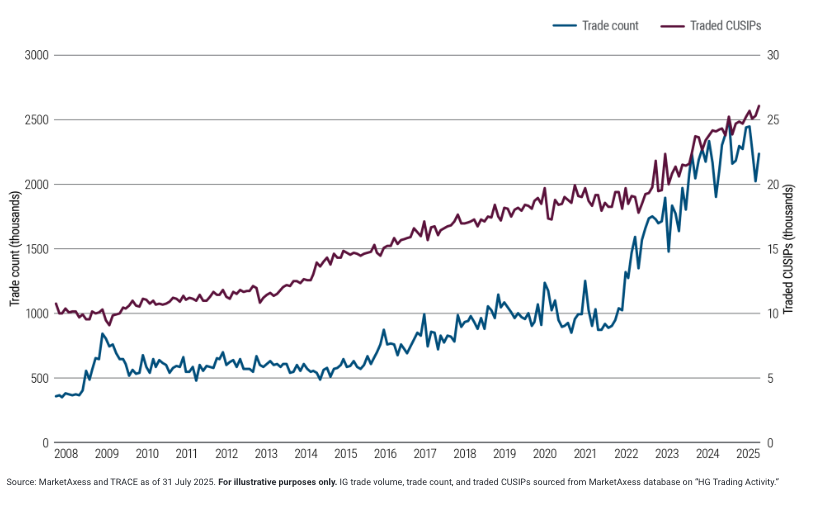
If the outlook on a company or a sector worsens over time, public IG markets allow an investor to reduce their risk before markets may have priced in that risk. With private IG, the investor is likely forced to hold that risk to maturity.
Transparent pricing, a broad investor base, and innovations including electronic trading, portfolio trading, and exchange-traded funds (ETFs) have driven significant improvements in market liquidity. This has reinforced public IG bonds’ appeal for strategies with flexibility to deliver excess returns above public credit benchmarks.
Claims of improving transactional liquidity in private markets overlook key obstacles. Once deals have been issued, many are not transferable unless the borrower consents to ownership changes.
Additionally, limited availability of information that helps new investors evaluate credit quality can restrict deal participation and further inhibit liquidity. This implies investors may face significant challenges when trying to exit positions promptly or may need to sell at steep discounts to meet unexpected liquidity needs.
Spread
Under normal market conditions, public IG bonds tend to trade with nominal spreads of about 80 to 120 basis points (bps) over risk-free benchmarks, according to Bloomberg data and PIMCO calculations. Private IG spreads tend to have a much wider range. Some are quite close to public IG bond spreads, while at times nominal spreads can reach 200 to 250 bps above similar-quality public credit.
When using spread to assess relative value, three takeaways stand out:
- Borrowers do not seek to pay a higher cost of capital than necessary. If private IG spreads are materially wider than public IG spreads, it’s critical to understand the underlying drivers. Is it purely illiquidity? Additional credit risk? Structure or complexity risks? Or some combination?
- Nominal spreads can be misleading. Many private IG deals with higher nominal spreads carry greater structural complexity than investors are used to seeing in public IG. Similar to public fixed income, investors should assess these financings on an option-adjusted spread (OAS) basis. We often find that the risk compensation – after accounting for these structural nuances – is far less compelling than may appear on the surface.
- Beauty is in the eye of the beholder. Private IG may be more attractive to buy-and-hold investors, such as insurers with liability-driven mandates, which likely have a lower bar to sacrifice liquidity to earn excess spread compared with public alternatives. By contrast, active investors tend to weigh the opportunity cost more heavily.
Structure
Public IG bonds are generally unsecured, standardized instruments with fixed covenants that aim to protect bondholders and broad investor bases. Private IG credit deals, by contrast, are often secured, customized financings or bonds with tailored covenants, maturities, and protections negotiated directly with lenders. Private deals often have complex structures and documentation and limited lender rights.
Common borrower-friendly private IG features including delayed draws and rights associated with breaking the deal or calling the deal early – coupled with the off-balance-sheet nature of many private IG deals – warrant investor scrutiny and risk compensation. Many private IG deals also carry idiosyncratic, single-asset risk.
Average credit ratings are among the characteristics that can differ across public IG bonds, private placement corporate IG deals – such as 144A and 4(a)(2) deal structures – and private IG ABF (see Figure 3). It is also common for private IG deals to have only one rating from a nationally recognized statistical rating organization (NRSRO), whereas public IG deals typically have more than one.
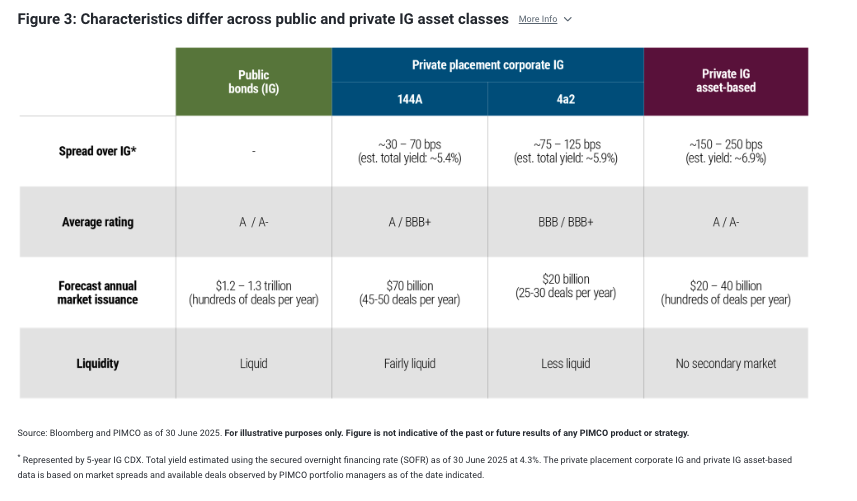
The potential for ratings shopping available to private IG issuers, particularly for deals with a single rating, can create a false sense of security for investors who rely on independent credit ratings as a barometer of risk. Investors should be wary that rating agency methodologies may not fully capture all the risks of a deal.
3. What is the opportunity in private IG today?
For investors, there are opportunity costs associated with sacrificing liquidity (for more, see our July 2024 Economic and Market Commentary, “Navigating Public and Private Credit Markets: Liquidity, Risk, and Return Potential”). Private IG should compensate investors for lost alpha opportunities in public markets, illiquidity, credit quality differences, and deal structure nuances. Certain private IG opportunities provide commensurate compensation, but most don’t.
Compensation for risk is important when underwriting these investments, especially entering a period where we expect more normalized cyclicality in credit markets, with less scope for government support in a downturn (for more, see our latest Secular Outlook, “The Fragmentation Era”).
Optimization exercises that focus on yield per unit of capital efficiency have long driven demand for various forms of less liquid IG or other capital-efficient credit. Assets such as collateralized loan obligations (CLOs) rated BBB and commercial mortgage-backed securities (CMBS) rated BBB are primary examples – thin pieces of the capital structure that can experience significant losses in adverse credit scenarios despite having IG ratings.
In both mezzanine structured credit and private IG, we often view the compensation for taking on this additional risk – credit, complexity, and illiquidity – as insufficient.
However, we see two primary areas where private IG often presents attractive relative value:
- Private IG ABF – Assets that do not fit into standard securitizations (yet) but are senior and secured in the capital structure. These can be attractive – examples include fund finance and senior financing of a variety of consumer, infrastructure, and other hard-asset portfolios.
- Select large-scale private corporate deals – Typically bespoke financings for well-known public IG unsecured issuers. These are often off-balance-sheet but can provide attractive and scalable ways to generate incremental spread compared with similar risk in public markets.
Just as in other markets, investors need to be selective and to carefully analyze structures, loan documents, and collateral when evaluating these deals.
Conclusion
- In a market with abundant public IG opportunities, private IG allocations should focus on opportunities where the risk-adjusted spread justifies illiquidity and complexity.
- Prioritize transparent deal documents, clear collateral, and pricing discipline. Investors should ensure they are getting a sufficient illiquidity premium when investing in illiquid assets.
- Investors may benefit from an active, relative-value approach to private IG that focuses on obtaining adequate compensation while maintaining the primary characteristic that investors seek in IG – limited risk of impairment.
A message from Advisor Perspectives and VettaFi: Stay ahead of market changes with our daily updates on key market and economic indicators. Visit the AP Charts and Analysis site for our expert insights.
Disclosures
This material is being provided for informational purposes only and does not constitute an offer to sell or a solicitation of an offer to buy interests in any fund or any trading strategy or investment product in any jurisdiction. Past performance is not a guarantee or a reliable indicator of future results.
All investments contain risk and may lose value. Investing in the bond market is subject to risks, including market, interest rate, issuer, credit, inflation risk, and liquidity risk. The value of most bonds and bond strategies are impacted by changes in interest rates. Bonds and bond strategies with longer durations tend to be more sensitive and volatile than those with shorter durations; bond prices generally fall as interest rates rise, and low interest rate environments increase this risk. Reductions in bond counterparty capacity may contribute to decreased market liquidity and increased price volatility. Bond investments may be worth more or less than the original cost when redeemed. Investments in residential/commercial mortgage loans and commercial real estate debt are subject to risks that include prepayment, delinquency, foreclosure, risks of loss, servicing risks and adverse regulatory developments, which risks may be heightened in the case of non-performing loans. Mortgage- and asset-backed securities may be sensitive to changes in interest rates, subject to early repayment risk, and while generally supported by a government, government-agency or private guarantor, there is no assurance that the guarantor will meet its obligations. Private credit involves an investment in non-publicly traded securities which may be subject to illiquidity risk. Portfolios that invest in private credit may be leveraged and may engage in speculative investment practices that increase the risk of investment loss. Private Credit may also be subject to real estate-related risks, which include new regulatory or legislative developments, the attractiveness and location of properties, the financial condition of tenants, potential liability under environmental and other laws, as well as natural disasters and other factors beyond the fund’s control. Real asset investments are subject to a variety of inherent risks that may have an adverse impact on the values of, and returns (if any) from such investments, including changes in the general economic climate, the quality and philosophy of management, physical condition of the properties, changes in operating costs, and illiquidity. Collateralized Loan Obligations (CLOs) involve a high degree of risk and are intended for sale to qualified investors only. The amount of distributions, if any, on CLOs will be affected by, among other things, the timing of purchases of loans, rates of repayment of or distributions on the underlying assets, the timing of reinvestment in substitute underlying assets and the interest rates available at the time of reinvestment. Investments in subordinated tranches of CLOs often represent highly leveraged investments in the underlying assets, and may lose all or a significant portion of their value, even if other tranches of the CLO do not. CLOs are typically illiquid, and holders may not be able to sell these securities at an attractive time or price, or at all. CLOs are also exposed to risks such as credit, default, liquidity, management, volatility, interest rate and credit risk. Derivatives may involve certain costs and risks, such as liquidity, interest rate, market, credit, management and the risk that a position could not be closed when most advantageous. Investing in derivatives could lose more than the amount invested.
The credit quality of a particular security or group of securities does not ensure the stability or safety of an overall portfolio. The quality ratings of individual issues/issuers are provided to indicate the credit-worthiness of such issues/issuer and generally range from AAA, Aaa, or AAA (highest) to D, C, or D (lowest) for S&P, Moody’s, and Fitch respectively.
Forecasts, estimates and certain information contained herein are based upon proprietary research and should not be interpreted as investment advice, as an offer or solicitation, nor as the purchase or sale of any financial instrument. Forecasts and estimates have certain inherent limitations, and unlike an actual performance record, do not reflect actual trading, liquidity constraints, fees, and/or other costs. In addition, references to future results should not be construed as an estimate or promise of results that a client portfolio may achieve.
Charts are provided for illustrative purposes and are not indicative of the past or future performance of any PIMCO product References to specific investments are for illustrative purposes only and are not intended to be, and should not be interpreted as, recommendations to purchase or sell such securities. PIMCO may or may not own or have owned the securities referenced and, if such securities are owned, no representation is being made that such securities will continue to be held or that the investments were or will be profitable.
Statements concerning financial market trends or portfolio strategies are based on current market conditions, which will fluctuate. There is no guarantee that these investment strategies will work under all market conditions or are appropriate for all investors and each investor should evaluate their ability to invest for the long term, especially during periods of downturn in the market. Outlook and strategies are subject to change without notice.
PIMCO as a general matter provides services to qualified institutions, financial intermediaries and institutional investors. Individual investors should contact their own financial professional to determine the most appropriate investment options for their financial situation. This material contains the opinions of the manager and such opinions are subject to change without notice. This material has been distributed for informational purposes only and should not be considered as investment advice or a recommendation of any particular security, strategy or investment product. Information contained herein has been obtained from sources believed to be reliable, but not guaranteed. No part of this material may be reproduced in any form, or referred to in any other publication, without express written permission. PIMCO is a trademark of Allianz Asset Management of America LLC in the United States and throughout the world.
CMR2025-0822-4770704
© PIMCO
Membership required
Membership is now required to use this feature. To learn more:
View Membership BenefitsSponsored Content
Upcoming Virtual Events View All












