Looking for a Bond Portfolio Diversifier? Go International
Membership required
Membership is now required to use this feature. To learn more:
View Membership BenefitsWith talk of rate cuts getting more audible, they almost seem inevitable. Indeed, the CME FedWatch is forecasting an almost 90% chance of cuts. That said, in the bond market, investors may need to look elsewhere to supplant income lost from falling yields — they may want to try heading overseas.
It's not just a weaker dollar that's been diverting attention to international bonds, but U.S. debt itself. In May, credit rating agency Moody's downgraded U.S. debt, making investors rethink their exposure to U.S. Treasuries.
Depressed Dollar Spikes Appeal
The recent appeal of international assets has been negatively correlating with a weaker dollar. As such, more investors have been allocating into international assets more often this year, with funds garnering assets at a feverish pace.
"Diversification into non-US assets has been a common theme in recent months, following years of US outperformance," Morningstar noted, adding that more U.S. investors are moving into global bond funds.
It's not just developed markets seeing inflows, but even riskier emerging markets bonds are amassing flows.
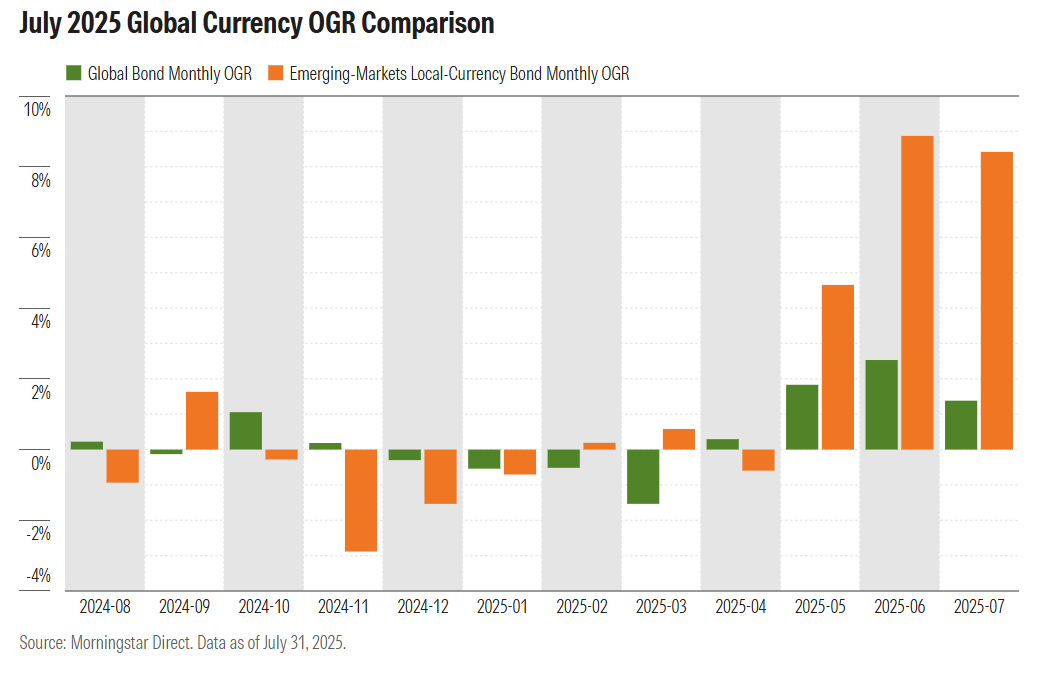
"Investor flows into these categories correlate well with the US dollar’s strength," Morningstar added. "A weakening US dollar helped drive the most pronounced and consistent inflows into both categories in years. Both categories had seen assets shrink fairly consistently since 2013."
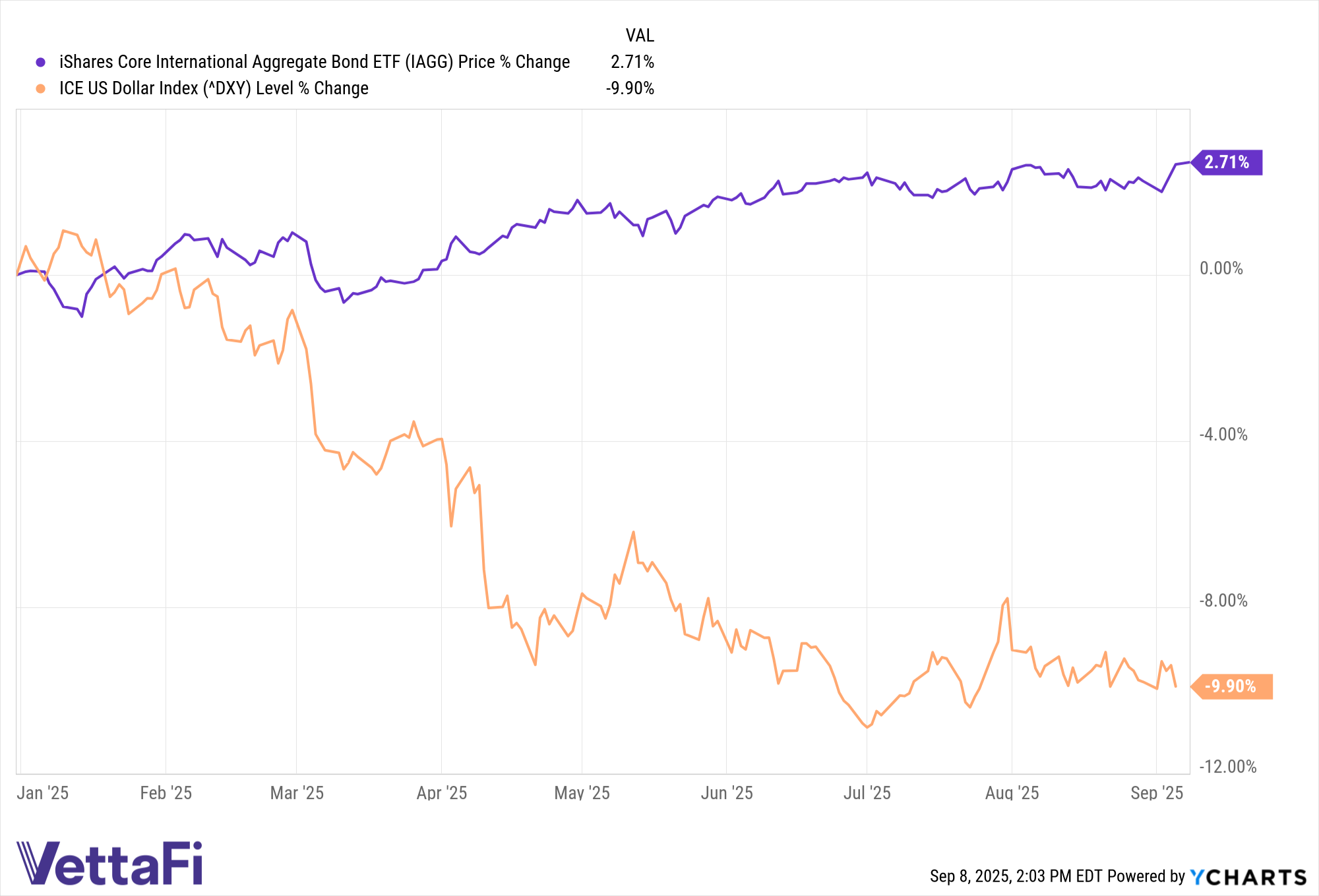
The divergence in the greenback and international bonds is also apparent in the performance disparity of the iShares Core International Aggregate Bond ETF (IAGG) year-to-date when placed side-by-side with the ICE U.S. Dollar Index. The IAGG is similar to the popular iShares Core U.S. Aggregate Bond ETF (AGG), but of course, with an international flavor.
International Bond Benefits
One of the prime benefits of investing in international assets is that different countries can be in varying stages of the economic cycle. While one country could be at its peak, another could be at a trough, one expanding, and another contracting. This is where investors can exploit the strength of one country over the other by investing in its assets at these various stages. Timing the market, though, can always be difficult, if not impossible.
International bonds can also offer higher yields, especially if investors start tilting exposure into emerging markets. A prime benefit is the diversification of bond exposure — it's an ideal complement to a fixed income portfolio that skews heavily towards U.S. bonds.
"Allocating to global bonds provides potential diversification benefits through exposure to additional inflation risk factors, economic environments, and market cycles, as well as market, sector, and credit risk premiums," noted Vanguard portfolio manager Sarang Kulkarni.
Investors who are ready to allocate into international bonds have an abundance of options to choose from. Exchange-traded funds (ETFs) can provide a flexible, diversified, and tax-efficient entryway into this specific portal of the bond market. Rather than be country-specific and to avoid concentration risk, investors may opt to diversify the risk via broad exposure to international bonds.
International Bond ETFs Aplenty
That said, there's a sea of international bond ETFs to consider for exposure, and Vanguard is an ideal place to start. The ETF provider has the Vanguard Total International Bond Index Fund ETF Shares (BNDX), which has over 6000 holdings (primarily investment-grade) spread across various regions, namely Europe. Those who want to turn up the wick on yield and don't mind the additional credit risk can opt for emerging markets with the Vanguard Emerging Markets Government Bond ETF (VWOB).
Not looking to kick the U.S. bond market to the curb, but still want international exposure? Then the Vanguard Total World Bond ETF (BNDW) is ideal. It puts about 50% of its assets into the Vanguard Total Bond Market Index Fund ETF Shares (BND) for the U.S. bond market and the other half in BNDX, via a fund of funds structure.
Along with the aforementioned IAGG, another fund to consider is the iShares International Treasury Bond ETF (IGOV). It offers exposure to only the debt issued by international governments. Following that same level of exposure, another option to consider is the SPDR Bloomberg International Treasury Bond ETF (BWX). Two more options to throw into the proverbial hat are the JPMorgan International Bond Opportunities ETF (JPIB) and the Capital Group International Bond ETF (CGIB).
Like the U.S. bond market, ETFs can also offer tailored exposure to various corners of the bond market. The Invesco International Corporate Bond ETF (PICB) offers specific exposure to international corporate bonds for those looking for higher yields.
The aforementioned ETFs are just a smidgen of international bond funds in the growing ETF universe. Furthermore, these are just passive funds; active funds in the international bond market will be explored in a later article. Individual investors should consult with an advisor to determine which fund(s) work best for their portfolios.
A message from Advisor Perspectives and VettaFi: To learn more about this and other topics, check out some of our webcasts.
Membership required
Membership is now required to use this feature. To learn more:
View Membership BenefitsSponsored Content
Upcoming Virtual Events View All












