A world in transition
Much has changed in the world economy. Globalization, “the Washington consensus,” “the end of history” and long supply chains are bygones.1 Deglobalization, tariffs, populism, anti-immigration and regional conflict represent the present.
Globalization accelerated after the fall of the Berlin Wall in 1989, benefiting emerging economies, especially China and India. The expansion of trade, capital, services and labor flows boosted emerging economies from the early 1990s until recent times. For China and India, significant domestic reforms unleashed in the 1980s and 1990s abetted their rapid ascent onto the global stage.
But with globalization now stumbling, how will the emerging complex fare? Can emerging economies pivot away from goods exports and services outsourcing—activities at risk from de-globalization? How will they cope with lower levels of foreign investment? Can they find alternative sources of growth and profitability? Will their societies deliver sufficient innovation from within?
In short, can emerging markets (EMs) succeed where success factors must increasingly be homegrown?
For decades, emerging economies have relied on developed economies for access to capital and technology, while providing cheap land and labor. Foreign direct investments were incentivized through better returns from cheaper production in EMs, from which goods and services were exported to developed countries. This led to the establishment of long, cheap supply chains from countries such as China to the United States, Europe and Japan.
As tariffs, artificial intelligence and other trade barriers challenge these modes of production and distribution, emerging economies need to pivot. They must reorient trade with one another and rely on domestic drivers for their future growth.
New growth models: domestic demand and “South-South” trade
Fortunately, the export-led model has been a success, leading to rising income and prosperity in emerging economies in China and India, creating opportunities to grow from within. Global trade flows have already shifted to increased intra-EM commerce, reducing the risks from the US-dominated hub-and-spoke structure of the past. Many emerging economies, led by China and India, have begun to develop stronger, domestic technological capabilities, financial institutions and consumer markets that are accelerating the transition to sustainable domestic growth. We should not forget the importance of domestic reforms playing a vital role too, as we have seen in India, driven by Prime Minister Narendra Modi, or in Argentina by President Javier Milei.
Over the remainder of this decade (and beyond), we believe domestic demand is likely to be the strongest driver of economic activity in many emerging economies, and particularly in China and India, both of which boast growing middle-class households with rising purchasing power.
EMs are projected to see their middle-class households double from 350 million in 2024 to nearly 700 million by 2034, with China contributing almost half of that growth.2 Since 2010, India’s middle-class households have risen from 31 million to over 125 million, while China now has the world’s largest middle class after more than doubling its numbers in the past 15 years.
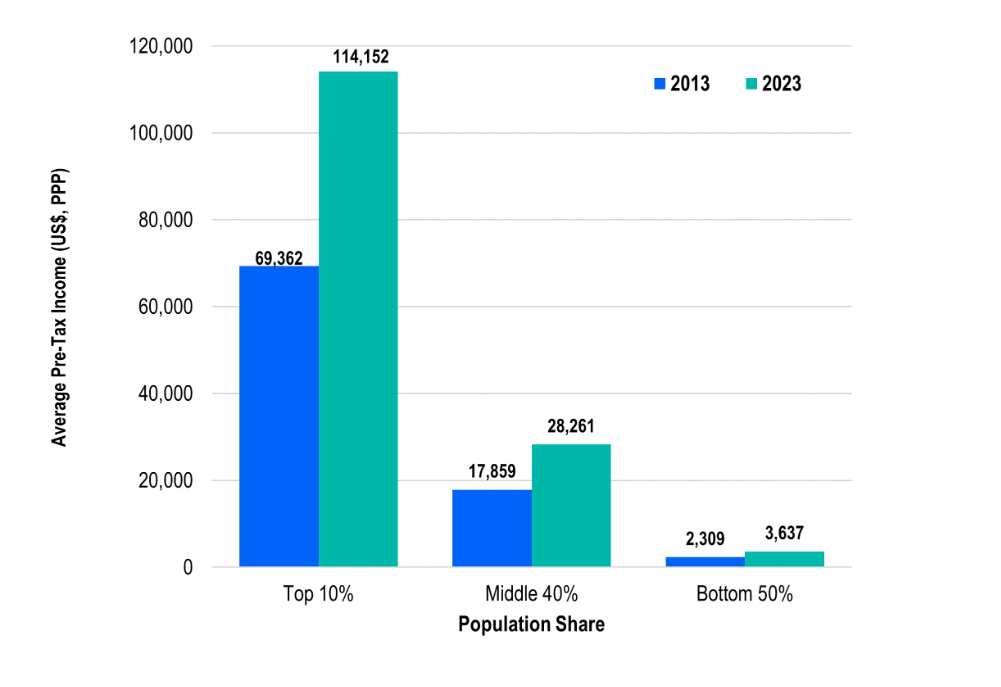
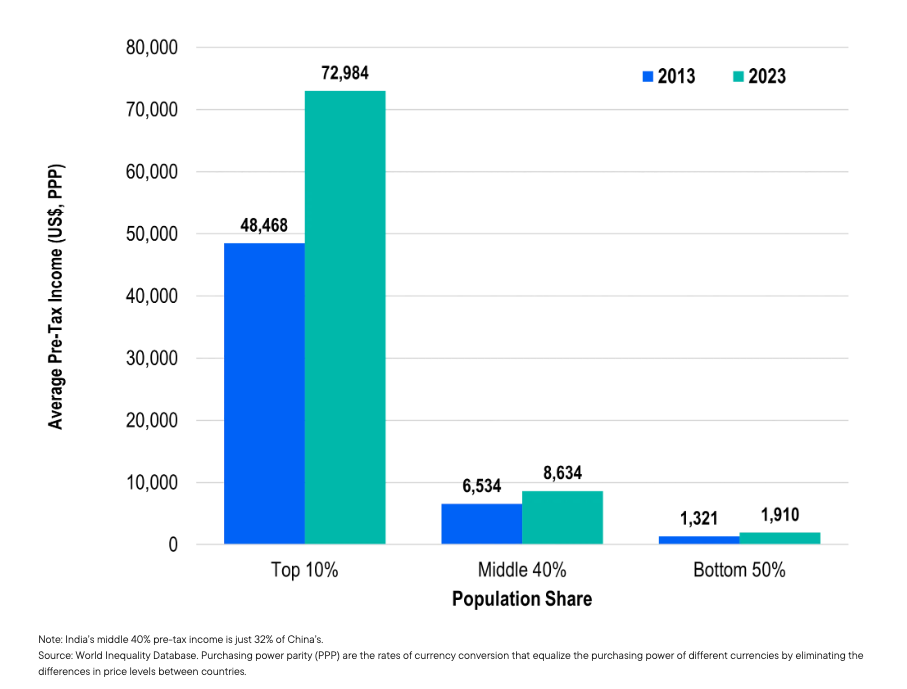
Those figures are only half the story. Median family income is also rising sharply in China and India and is on par to double every 15 years. Median per capita income in China grew from US$2,500 in 2010 to over US$5,000 last year; and in India, median incomes have also doubled since 2010.3 This is now the new source of growth.
Income and Wealth Distribution - China

Income and Wealth Distribution - India
Changes are also underway in terms of global trade flows. A quarter century ago, 80% of exports went to developed economies. According to studies from the Federal Reserve and the World Bank, that share has now fallen to 60%, with 40% of world exports now shipped between emerging economies. As a result, US tariffs and other, new import barriers are less damaging today to than would have been the case 25 years ago.
Increased intra-EM trade has given rise to more “South-South” dialogue and cooperation. China’s “Belt and Road” initiative, India’s “Act East” policies and BRICS4 forums are just some of the high-profile ways in which emerging economy collaboration is expanding.
Emerging countries are also making technological progress in areas such as mobile banking (M-Pesa in Kenya), telecommunications (e.g., widely available cellphone service in frontier economies) or biometric services (India). High rates of education, particularly in STEM (science, technology, engineering and mathematics) disciplines, bode well for a world where numeracy, engineering and science sow the seeds of invention.
Summary
Emerging economies face significant challenges in a world tired of globalization and not even the largest emerging economies of China and India can ever fully decouple from their developed counterparts. But given rising domestic prosperity, more diversified global markets and domestic sources of innovation, we believe they can reinvent themselves as attractive destinations for growth and investment, even in a less globalized world.
A message from Advisor Perspectives and VettaFi: To learn more about this and other topics, check out some of our webcasts.
Endnotes
1The Washington Consensus is playbook of free-market policies, like free trade and privatization, that many countries were encouraged to follow in the 1980s–1990s. End of History is the idea that, after the Cold War, democracy and capitalism had “won” and would be the world’s final system of government and economy.
2Source: Oxford Economics. October 2024 report. There is no assurance that any estimate, forecast or projection will be realized.
3Sources: National Bureau of Statistics of China per January 2025 report. World Bank as of 2024 and the Indian Ministry of Statistics and Programme Implementation as of 2018.
4BRICS is an intergovernmental organization comprising 10 countries—Brazil, Russia, India, China, South Africa, Egypt, Ethiopia, Indonesia, Iran and the United Arab Emirates.
WHAT ARE THE RISKS?
All investments involve risks, including possible loss of principal.
Equity securities are subject to price fluctuation and possible loss of principal.
International investments are subject to special risks, including currency fluctuations and social, economic and political uncertainties, which could increase volatility. These risks are magnified in emerging markets.
The government’s participation in the economy is still high and, therefore, investments in China will be subject to larger regulatory risk levels compared to many other countries.
IMPORTANT LEGAL INFORMATION
This material is intended to be of general interest only and should not be construed as individual investment advice or a recommendation or solicitation to buy, sell or hold any security or to adopt any investment strategy. It does not constitute legal or tax advice. This material may not be reproduced, distributed or published without prior written permission from Franklin Templeton.
The views expressed are those of the investment manager and the comments, opinions and analyses are rendered as at publication date and may change without notice. The underlying assumptions and these views are subject to change based on market and other conditions and may differ from other portfolio managers or of the firm as a whole. The information provided in this material is not intended as a complete analysis of every material fact regarding any country, region or market. There is no assurance that any prediction, projection or forecast on the economy, stock market, bond market or the economic trends of the markets will be realized. The value of investments and the income from them can go down as well as up and you may not get back the full amount that you invested. Past performance is not necessarily indicative nor a guarantee of future performance. All investments involve risks, including possible loss of principal.
Any research and analysis contained in this material has been procured by Franklin Templeton for its own purposes and may be acted upon in that connection and, as such, is provided to you incidentally. Data from third party sources may have been used in the preparation of this material and Franklin Templeton ("FT") has not independently verified, validated or audited such data. Although information has been obtained from sources that Franklin Templeton believes to be reliable, no guarantee can be given as to its accuracy and such information may be incomplete or condensed and may be subject to change at any time without notice. The mention of any individual securities should neither constitute nor be construed as a recommendation to purchase, hold or sell any securities, and the information provided regarding such individual securities (if any) is not a sufficient basis upon which to make an investment decision. FT accepts no liability whatsoever for any loss arising from use of this information and reliance upon the comments, opinions and analyses in the material is at the sole discretion of the user.
Franklin Templeton has environmental, social and governance (ESG) capabilities; however, not all strategies or products for a strategy consider “ESG” as part of their investment process.
Products, services and information may not be available in all jurisdictions and are offered outside the U.S. by other FT affiliates and/or their distributors as local laws and regulation permits. Please consult your own financial professional or Franklin Templeton institutional contact for further information on availability of products and services in your jurisdiction.
Issued in the U.S. by Franklin Templeton, One Franklin Parkway, San Mateo, California 94403-1906, (800) DIAL BEN/342-5236, franklintempleton.com. Investments are not FDIC insured; may lose value; and are not bank guaranteed.
You need Adobe Acrobat Reader to view and print PDF documents. Download a free version from Adobe's website.
CFA® and Chartered Financial Analyst® are trademarks owned by CFA Institute
© Franklin Templeton
Read more commentaries by Franklin Templeton