In the 2018 thriller A Quiet Place, silence masks imminent danger. Today's equity markets offer a similarly deceptive peace. In the film, the threat is ever present, hidden just out of sight. The family’s survival depends not on prediction but on preparation. Investors should apply the same lesson: It’s not about timing the noise; it’s about being ready for whatever breaks the silence.
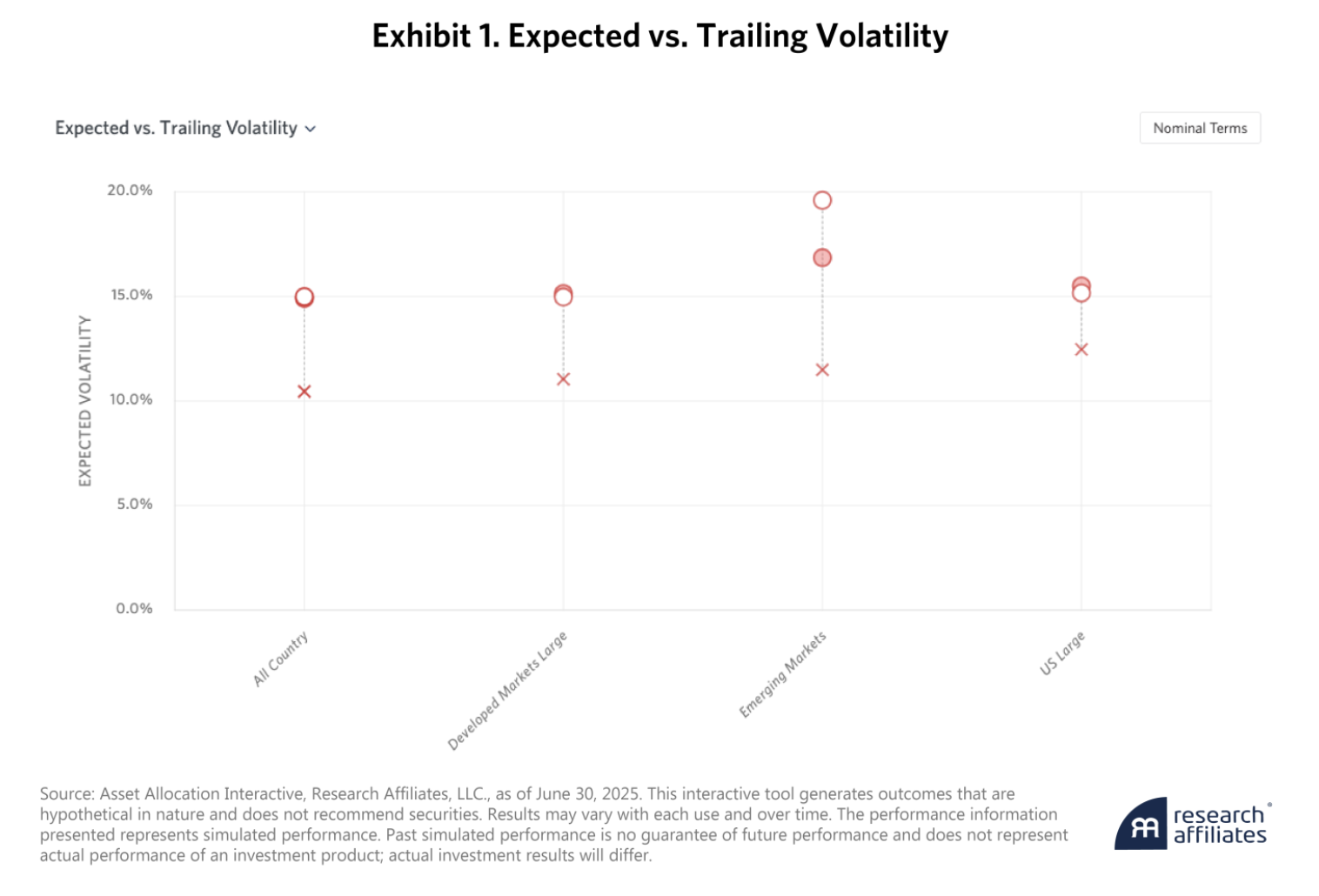
As of mid-2025, global financial markets are unusually tranquil, with low volatility relative to historic norms, and the S&P 500 and Nasdaq-100 near all-time highs. Constructed using Asset Allocation Interactive, Exhibit 1 shows trailing one-year and 10-year volatility as well as our expected 10-year volatility for US, Developed Ex-US, Emerging, and All Country equity indexes. It may surprise readers given the headline-grabbing, tariff-related market tumult in the first half of 2025, but the trailing one-year volatility has been quite subdued compared to historic norms. Over the past year, the All Country index has registered 10% volatility, nearly 5 percentage points below its 15% average over the previous 10 years.

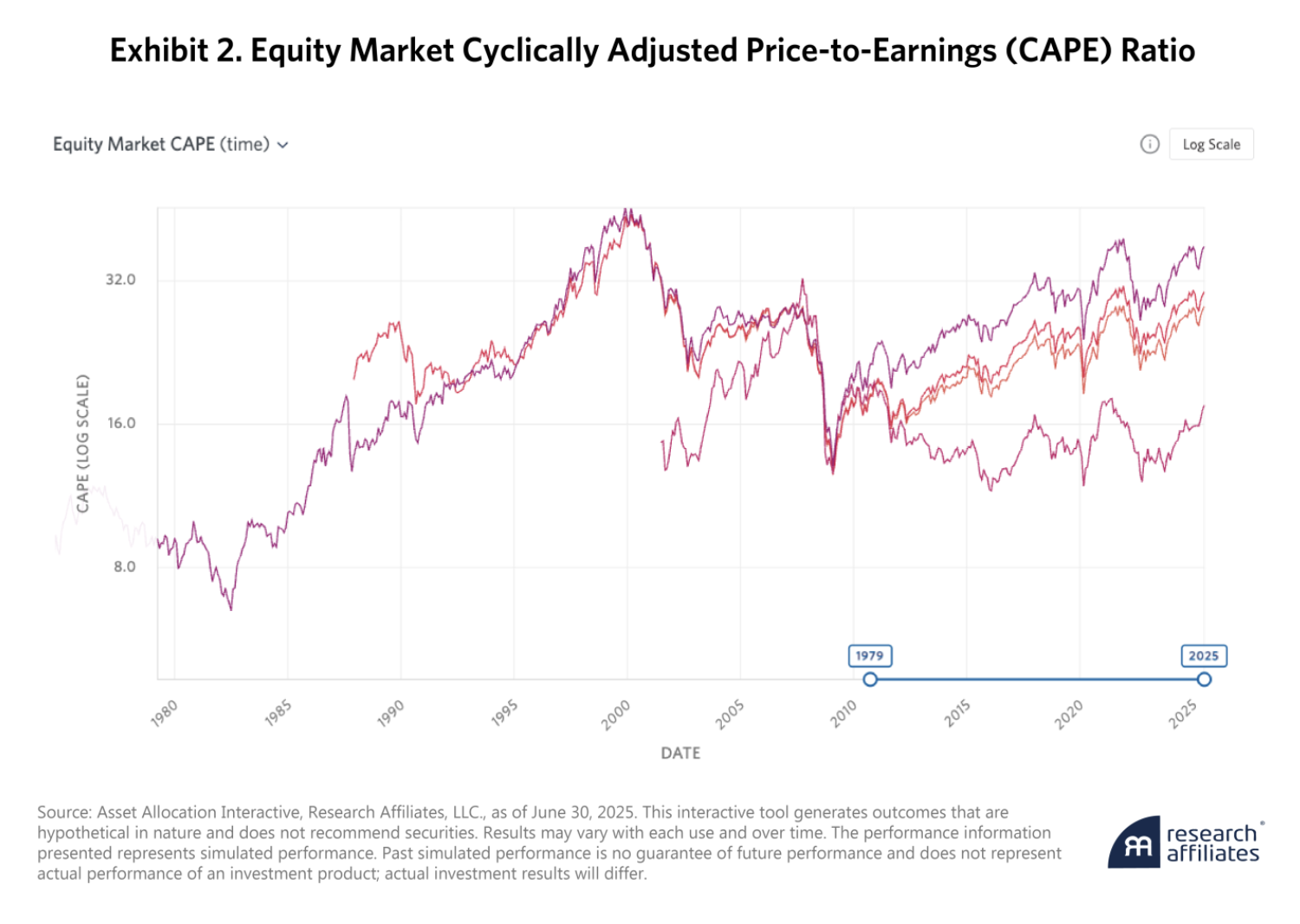
Periods of low volatility tend to engender complacency. Exhibit 2, also from Asset Allocation Interactive, shows the time series of the cyclically adjusted price-to-earnings (CAPE) ratios for the four regions. Since the global financial crisis (GFC), all except Emerging Markets have experienced rising valuations, with the US approaching its 2000 dot-com bubble peak.
Low volatility and record-high valuations should give investors pause. History suggests that when markets are priced for perfection, even modest surprises can trigger outsized reactions.
Volatility’s tendency to revert toward a long-term average is well established. Volatility doesn't drift aimlessly; it clusters and spikes. The longer it stays suppressed, the more likely it is to surge.
What might disrupt today’s calm? While we can’t know for certain, there are plenty of potential catalysts. Inflation, seemingly tamed, could return if tariffs or policy shifts revive pricing pressures. Geopolitical risks, whether in the Middle East or elsewhere, could cause commodity shocks. Structural market fragilities—mega-cap concentration in the “Magnificent Seven,” for example—could induce a downturn. Disruptive innovation may shake investor confidence. Indeed, revelations about the Chinese AI developer DeepSeek led to the largest single-day loss for a company in US stock market history, when the chip maker Nvidia dropped nearly $600 billion in market capitalization.
At these valuations, markets are vulnerable not because something must go wrong but because they have left little margin for error. Even good news can disappoint when expectations are too high. That’s especially dangerous for traditional 60/40 stock/bond portfolios. In 2022, rising inflation pushed stock and bond prices down simultaneously, breaking their usual negative correlation. If inflation volatility rises, the bonds in the 60/40 portfolio may fail to provide a diversification benefit just when it’s needed most.
So, what can investors do? Prepare—not by timing the spike but by making their portfolios more resilient:
-
Diversify Differently: Consider strategies that thrive in turbulence, including global macro and managed futures.
-
Add Inflation Protection: Incorporate real return-oriented asset classes, such as TIPS, REITs, and commodities.
-
Reduce Duration Risk: Shorten bond duration exposure to protect against sudden yield spikes.
-
Tilt Toward Defensiveness: Low-volatility and quality equities tend to hold up better when the tide turns.
In markets, stillness often masks risks quietly building beneath the surface. To be sure, markets may remain relatively calm, with equity valuations elevated, for years to come. But the most significant turning points rarely arrive with advanced notice. Prudent investors don’t necessarily try to guess when the next storm will hit; they build portfolios resilient enough to weather it.
Please read our disclosures concurrent with this publication: https://www.researchaffiliates.com/legal/disclosures#investment-adviser-disclosure-and-disclaimers.
Prepare your bond portfolio for changing market conditions. Register today for the Fixed Income Symposium on Sept. 18, 2025, 11AM ET / 8AM PT.
© Research Affiliates
Read more commentaries by Research Affiliates