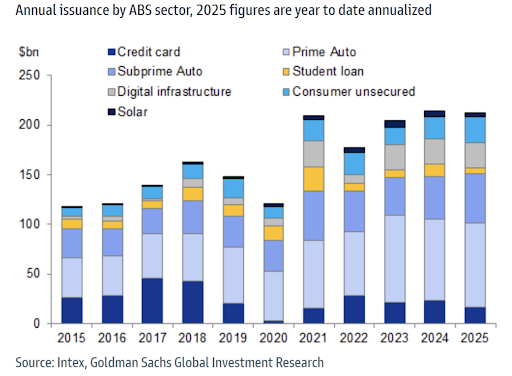
Ample volatility and shifting rate expectations have sent investors on an avid search for stability and diversification. Many investors are now looking to the next frontier of fixed income ETFs — asset-backed securities — as private lenders fill a big financing void created by the exit of traditional banks.
The top two categories seeing the highest global fund flows this year have been money market funds (more than $7 trillion outstanding) and fixed income funds — both at a record-breaking pace. In many ways, asset-backed securities fall neatly in the cross section of these two given their short-duration nature. Residential mortgage-backed securities (RMBS) make up the largest segment of this market, but CLOs have easily been the most explosive — as reflected by the success of the world’s largest CLO ETF, the Janus Henderson AAA CLO ETF (JAAA).
But beyond just CLOs, the growing appeal of these instruments — backed by pools of underlying collateral, like consumer loans, auto leases, credit card receivables, aviation and mortgages — has spilled over into the ETF space, with new product launches providing easier access to this niche yet resilient market.

Growing Allure of Asset-Backed Finance
Earlier at this year’s Morgan Stanley U.S. Financials Conference, one of the top investing themes discussed was the growing institutional demand for asset-backed finance. Two major pillars supporting asset-backed securities are relatively safe, predictable cash flows and flexible risk structuring. Both are catching institutional investor attention. Unlike direct lending, asset-backed finance is secured by pools of underlying assets and diversified across hundreds or thousands of loans — dampening the risk by spreading it out.
ETFs help circumvent the complexity of direct investments in instruments like CLOs, appealing to a broader range of investors. Out of 18 existing CLO ETFs, 17 are enjoying positive net inflows year-to-date. Historically, anywhere from half to up to two-thirds or more of the U.S. broadly syndicated loan market are held by CLOs. But as that market gets more crowded – especially across the AAA tranche — asset managers are looking to capitalize on CLOs’ success while branching out into the broader asset-backed market.
Asset-Backed ETFs: Latest Launches
Asset-backed ETFs now cover a diverse range of collateral, from mortgages and auto loans to royalties, art and even cryptocurrencies. The actively managed Janus Henderson Asset-Backed Securities ETF (JABS) invests primarily in investment-grade asset-backed securities. Fresh off its July launch, the fund has already garnered nearly $100 million in net inflows. Its goal is to provide investors with access to short-duration, high-quality, primarily fixed-rate securitized assets, like CLOs. Holdings include industry standout JAAA, along with corporate bonds and other types of securitized debt. The ETF charges an expense ratio of 0.33%.
“Having securitized assets in their portfolio is designed to help our clients diversify risk exposures, access better yield opportunities, manage duration, and improve credit quality,” said John Kerschner, global head of securitized products and portfolio manager at Janus Henderson. “We believe that JABS will build on the success of our leading securitized products franchise, with the potential to help clients achieve superior financial outcomes.”
This follows the debut of the DoubleLine Asset-Backed Securities ETF (DABS), which rolled out in February. Similarly, the $58 million fund operates by actively allocating to largely investment-grade, high-quality opportunities across the broader consumer lending and commercial market. Many of its 83 holdings are weighted in aviation, data centers, and consumer loans. The fund charges a comparable expense ratio of 0.39%.
Spreads Looking More Attractive
Both ETFs offer direct and transparent access to the growing and complex asset-backed securities market. Additionally, spreads are looking more attractive as they widen beyond their 10-year averages. This leaves asset-backed securities ripe for the picking.
Meanwhile, Victory Capital offers a bolder take with its newly minted VictoryShares Pioneer Asset-Based Income ETF (ABI). Unlike its peers, the fund primarily invests in below-investment-grade securities spanning auto receivables and residential mortgage loans. For those willing to take on more risk, the strategy aims to capture premium yields within specialized subsets of securitized credit.
According to Mannik Dhillon, president of investment franchises and solutions for Victory Capital, the fund “provides access to asset-based income that takes advantage of the same secular trends driving private credit markets with the benefits of an ETF.” ABI’s higher fee of 0.70% stems from the underlying debt covering a wider spectrum of credit quality.
A Transformative Shift
Asset-backed securities ETFs are emerging as carving out a distinctive space within the evolving landscape of private credit and alternative investments. They serve as a compelling complement to traditional pockets of fixed income, as institutional and retail investors alike look for ways to enhance income while managing risk. Their growth signals a transformative shift, bridging traditional finance with innovative securitized assets in a more accessible and transparent manner. For investors, the key is diversification across collateral types and partnering with legacy managers with expertise in niche markets. The era of “everything as collateral” has begun, and ETFs are leading the charge.
For more news, information, and analysis, visit VettaFi | ETF Trends.
Prepare your bond portfolio for changing market conditions. Register today for the Fixed Income Symposium on Sept. 18, 2025, 11AM ET / 8AM PT.
Read more commentaries by VettaFi