The past week was a significant moment for the crypto landscape, both in terms of legislation and market momentum. While not all the regulatory developments directly impact crypto ETFs, the effect of increased regulatory clarity and institutional adoption benefits the space broadly. Here’s a closer look at the evolving regulatory backdrop, fund flows, and new product developments across the crypto ETF ecosystem.
More regulatory support…
Last week was dubbed “Crypto Week.” Three major bills made headlines: the GENIUS Act, the Anti-CBDC Surveillance State Act, and the Clarity Act. Each of these represents a step toward building a more defined framework for digital assets. That is something that has been a persistent hurdle for the industry. Several of these bills are loosely related to crypto ETFs. Regardless, regulatory progress is contributing to overall optimistic sentiment in this space.
- The GENIUS Act (Guiding and Establishing National Innovation for U.S. Stablecoins) addresses the issuance and oversight of stablecoins. This act has officially been signed into law. Ethereum plays a major role in stablecoin operations and has reacted positively to this news.
- The Anti-CBDC Surveillance State Act prevents the Federal Reserve from issuing a central bank digital currency (CBDC) directly to consumers due to surveillance and privacy concerns.
- The CLARITY Act is particularly relevant to the ETF space, since it addresses the ongoing ambiguity over whether certain tokens fall under the jurisdiction of the SEC or CFTC — essentially the longstanding “security vs. commodity” debate.
- Additionally, the SEC made a statement in early July addressing some of the disclosure requirements for crypto asset exchange traded products.
The CLARITY Act and the Anti-CBDC Act still need Senate approval. But overall, these regulations have already contributed to improving investor sentiment. I expect to see an influx of approvals later this year — including spot ETFs, multi-token ETFs (discussed in more detail below), staking, and in-kind redemptions — after a period of internal alignment.
…leads to stronger institutional adoption…
Optimism around regulatory support discussed above has led to renewed enthusiasm in the cryptomarkets, particularly stronger institutional interest.
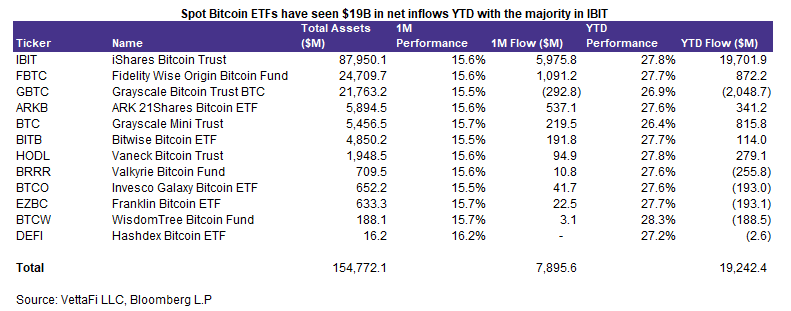
Bitcoin recently crossed $120,000, while spot bitcoin ETFs saw approximately $8 billion in net inflows over the past month. That brings the year-to-date total to over $19 billion. Most of this activity has been concentrated in the iShares Bitcoin Trust (IBIT), which saw around $6 billion in net inflows this past month.

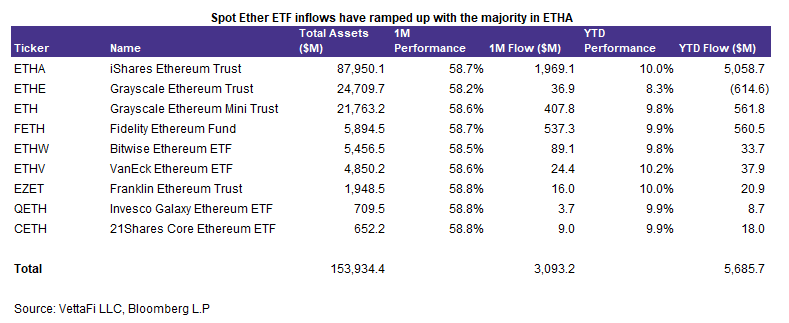
Similarly, ether has rebounded sharply, rising around 60% in the past month. While ether ETFs have seen a total of just under $6 billion in net inflows this year, over half of that — $3 billion — came in just the last month after a previously slow year.
…and product innovation including altcoin ETFs…
Along with more institutional adoption, investor interest is widening to include altcoins and multi-asset crypto exposure.
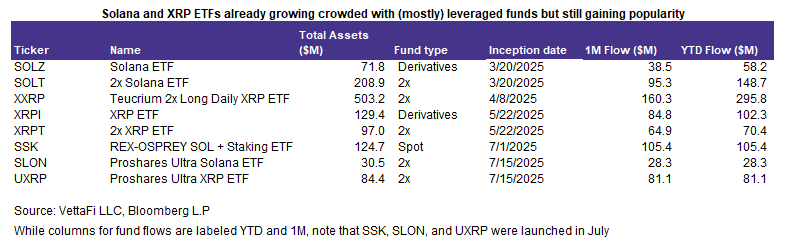
The REX-Osprey SOL + Staking ETF (SSK), which was launched earlier this month, is both the first spot Solana and the first to offer staking. The nine other proposed spot Solana ETFs were filed by the usual players like Fidelity, VanEck, and 21Shares under the ’33 Act — the same structure as both spot bitcoin and ether ETFs. SSK, however, is a ’40 Act fund. This requires it to invest through a diversified portfolio of other securities. Currently, it includes the 21Shares Solana ETP, at around 40% of the fund’s weight. While this means it’s not a “traditional spot product,” SSK gained early traction due to its first-mover advantage, with assets growing to around $100 million within less than a month.
In addition to SSK, leveraged and derivatives-based Solana and XRP products have entered the market including products from ProShares, Volatility Shares, and Teucrium. While these haven’t taken off significantly, they are still gathering a fair amount of attention especially given the already crowded market. The Teucrium 2x Long Daily XRP ETF (XXRP) recently saw over $160 million in net inflows over the past month.
…and multi-token ETFs.
The next step for crypto ETFs will likely be multitoken products. Grayscale’s Digital Large Cap Fund (GDLC), which includes approximately 75% bitcoin, 15% ether, and smaller allocations to Solana, XRP, and Cardano, received initial approval but was placed on hold by the SEC. A similar approval-then-hold process happened to Bitwise’s application to convert its Bitwise 10 Crypto Index Fund (BITW) into an ETF. Like GDLC, BITW also holds a large weight in bitcoin and ether (90%) with the remaining 10% in Solana, XRP, Cardano, Avalanche, Chainlink, Bitcoin Cash, Uniswap, and Polkadot.
These pauses aren’t denials. They more likely reflect the need to align with updated SEC regulations including the guidance issued in early July, which outlined disclosure standards for crypto products. The uniqueness of these multitoken funds stem from their structure since they include tokens that don’t yet have spot ETFs (XRP, Cardano, etc.). That creates two possibilities: 1) SEC approval of multitoken funds could signal green lights for several of these spot ETFs; or 2) alternatively, the small allocations may allow for approval without broader spot fund precedents.
Either way, GDLC and BITW present a test for how the SEC will treat diversified crypto exposure under the evolving framework. A filing for a similar product (Crypto Blue Chip ETF) tied to Trump Media in partnership with Yorkville and Crypto.com also recently made headlines. This product looks similar to GDLC but substitutes Cardano for Cronos (CRO).
Bottom Line: As more regulatory clarity emerges, I expect to see increasing product innovation and broader institutional adoption. Both of those could further solidify crypto’s role in the ETF ecosystem and traditional finance.
For more news, information, and analysis, visit VettaFi | ETF Trends.
A message from Advisor Perspectives and VettaFi: To learn more about this and other topics, check out some of our webcasts.
Read more commentaries by VettaFi