An option is a contract that gives you the right—but not the obligation—to buy or sell a specified amount of an underlying security—like a stock or ETF—at a specified price (the strike price) before a certain date (the expiration date). There are two basic types:
Call options give you the right, but not the obligation, to buy a security.
Put options give you the right, but not the obligation, to sell a security.
Options can be used in multiple ways—using either calls or puts, or in various combinations—to seek various investment objectives, such as generating income, hedging to mitigate risk, or speculation.
Why Options Are Growing in Popularity?
For decades, investors have relied on traditional securities for growth and income, while relying on diversification as their primary form of risk mitigation. However, since the Great Financial Crisis of 2007-09 (“GFC”), significant declines in interest rates and the convergence of asset correlations have redefined the investing landscape.
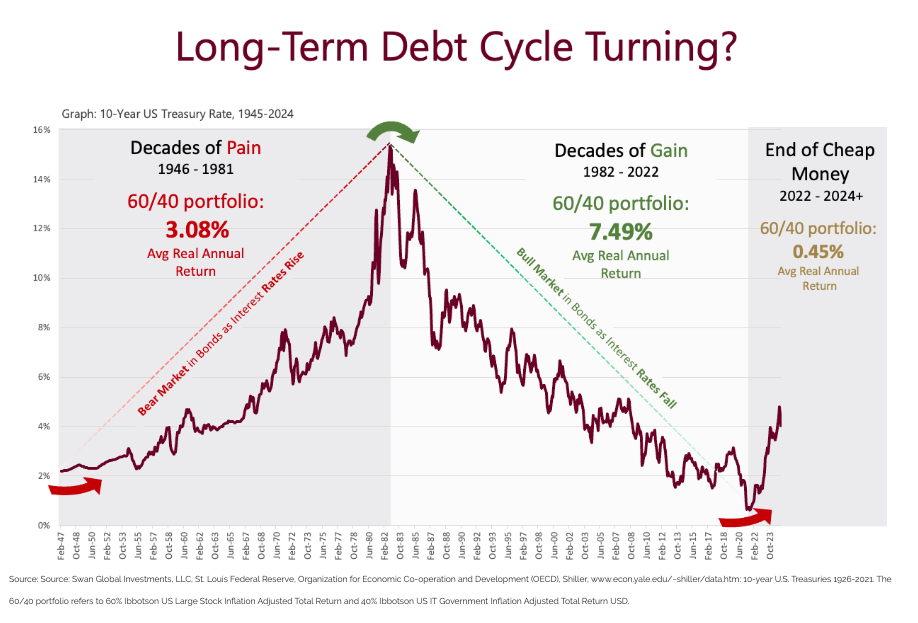
Years of near-zero real rates post-GFC offered little bond income. Then in 2022, rising rates and inflation drove sharp bond losses. As a result, bond investors had the worst of both worlds- little income and a lack of capital preservation during an equity market sell-off. Investors are now looking beyond traditional bonds for income and capital preservation.
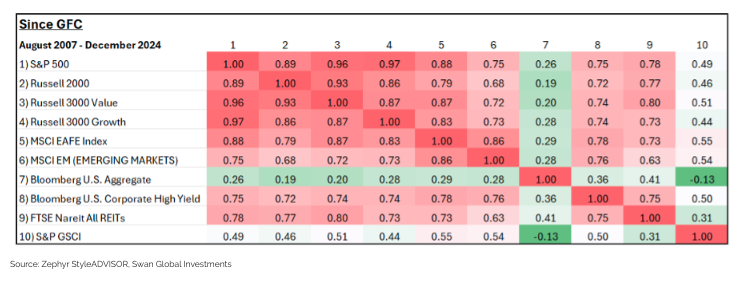
Diversification relies on low correlations. But since the GFC, major asset classes have moved more in sync, making diversification less effective at reducing risk.
Let’s dive into each of these reasons a little further:
First, the interest rate environment affects where investors seek income.
The long-term secular bull market in the 10-year U.S treasury yields has ended and it appears the cycle has shifted towards higher rates in a world awash in debt.
This creates a bit of a trap for investors seeking income. While higher interest rates seem intriguing for income investors, a prolonged, upward trend in rates threatens capital losses.
So investors seeking yield may continue to look to income alternatives, like dividend-paying stocks, REITs, MLPs, and options-based strategies, referred to as derivative income strategies. Derivative income strategies may pose lower duration risk than other alternatives, meaning less sensitivity to changes in interest rates.
Second, risk management has become more complicated after the Great Financial Crisis as well.
The convergence of asset classes has left investors looking for other ways to mitigate portfolio risk. The matrix below shows the correlations, or how assets move in relation to one another, of different assets since the Global Financial Crisis of 2007-09. In this matrix, a value of 1.0 means the two associated assets (row and column) move in the same proportion and in the same direction. Red and green hues are used to show high and low correlations, respectively.
The correlations between asset classes are much higher than they were previously. See our post on the correlation conundrum for a deeper discussion.
Asset Correlation Matrix
Faced with this new reality, investors are seeking new options.
Options and options-based strategies offer investors myriad ways to seek growth of capital, income, and risk mitigation. As such, options and options-based products have seen an explosion in popularity.
Why Swan Uses Options
At Swan, we view options as fundamental investment tools. As an innovative asset manager specializing in options strategies, we’ve been helping investors navigate uncertainty to achieve their long-term goals since 1997.
Our founder, Randy Swan, identified problems with assuming that historical correlations will remain consistent, especially during market crises. Thus, he pursued the use of options to directly mitigate risk and seek income generation.
We understand the power of options to serve core investor needs.
We see the limitations of traditional assets in this redefined landscape.
Options 101: Key Benefits of Options
1. Income Generation Derivative income, also called options income, can be generated by the sale of an options contract. Writing (selling) call options on existing stock holdings or a stock index—known as covered calls—can produce regular income from the premium collected via the sale of the call options.
2. Hedging Downside Risk Buying put options may provide downside protection. For example, hedged equity is an investment approach that pairs equity investing with put options to define risk—offering a layer of downside risk mitigation while maintaining equity exposure.
3. Structured or Defined Outcomes Strategies like zero-cost collars or put spread collars combine puts and calls to define both upside potential and downside risk in advance.
Options 101: Understanding the Risks of Using Options
While options bring flexibility, they also carry important risks to consider:
Limited upside when income strategies cap gains Covered calls or collars can limit your upside potential—if the market rallies strongly, you’ll forgo gains past the strike price.
Cost drag from hedging Buying puts isn’t free. During strong bull markets, the costs associated with protection can reduce overall returns.
Complex strategy management Deploying multi-leg options strategies (like collars or overlays) requires careful design and monitoring of option liquidity and risk controls. Evaluating the many factors that go into option pricing, or validating the expertise and operational wherewithal of a manager, is difficult for amateur investors to assess.
Leverage Leverage is inherent in options. Call or put options are usually applied to 100 shares of the underlying asset per contract. Therefore, less capital (investment) is needed to gain asset exposure than purchasing the stock outright. Some options strategies utilize excessive leverage to improve returns, but it can also exacerbate losses.
Options 101: How Options-Based Strategies May Fit into a Portfolio
Derivative or options income strategies or funds can be utilized:
alongside equity holdings to complement or replace dividend-focused holdings with portfolio income,
as an alternative to certain bond investments to seek current income with some capital growth potential, and
an alternative to large cash holdings to seek improved yield and growth potential.
Hedged equity strategies or funds can serve different roles in a portfolio, based on investor objectives, such as:
alongside equity holdings to reduce overall volatility and drawdown risk,
as a surrogate for bond investments to mitigate overall portfolio risk with less duration risk, and
as part of an alternative investment sleeve.
For investors with concentrated holdings or nuanced risk needs within a portfolio, custom option overlay strategies providing bespoke hedging and income solutions might be appropriate.
Final Thoughts
Options offer investors practical ways to generate portfolio income, define and hedge risk, and seek growth of capital.
At Swan Global Investments, we’ve been innovating and refining option-based strategies since 1997. We welcome the growth in popularity and use of options and options-based strategies. Whether through ETFs, mutual funds, or tailored SMAs and custom overlays, our goal is to help investors grow and preserve wealth.
A message from Advisor Perspectives and VettaFi: To learn more about this and other topics, check out some of our webcasts.
Important Disclosures:
Swan Global Investments, LLC is a SEC registered Investment Advisor that specializes in managing money using the proprietary Defined Risk Strategy (“DRS”). SEC registration does not denote any special training or qualification conferred by the SEC. Swan offers and manages the DRS for investors including individuals, institutions and other investment advisor firms.
All Swan products utilize the Defined Risk Strategy (“DRS”), but may vary by asset class, regulatory offering type, etc. Accordingly, all Swan DRS product offerings will have different performance results due to offering differences and comparing results among the Swan products and composites may be of limited use. All data used herein; including the statistical information, verification and performance reports are available upon request. The adviser’s dependence on its DRS process and judgments about the attractiveness, value and potential appreciation of particular ETFs and options in which the adviser invests or writes may prove to be incorrect and may not produce the desired results. There is no guarantee any investment or the DRS will meet its objectives. All investments involve the risk of potential investment losses as well as the potential for investment gains. Prior performance is not a guarantee of future results and there can be no assurance, and investors should not assume, that future performance will be comparable to past performance. Further information is available upon request by contacting the company directly at 970-382-8901 or www.swanglobalinvestments.com. 094-SGI-052825
1099 Main Avenue | Suite 206 | Durango, CO 81301 | 970.382.8901 Swan Global Investments is a SEC-registered investment advisor providing asset management services utilizing the Swan Defined Risk Strategy, allowing our clients to grow wealth while protecting capital. Please note that registration of the Advisor does not imply a certain level of skill or training. Swan Global Investments, LLC is affiliated with Swan Capital Management, LLC, Swan Global Management, LLC and Swan Wealth Advisors, LLC. Prior performance is not a guarantee of future results and there can be no assurance, and investors should not assume, that future performance will be comparable to past performance.