Last week, we covered my concerns about AI’s impact on jobs. This week, we’ll take a look at its impact on energy demand and who pays for that energy.
But first, I want to be clear. I see a lot of benefits to using AI. Productivity is going to ramp up. As AI is layered upon automation, lots of jobs that aren’t attractive will be done by robots. Remember Flippy the burger machine? It turns out Flippy is advancing quickly, and the company now has a sophisticated, usable automated fryer that is easy to install and could change the way quick-service restaurants operate.
I walked by a McDonald’s in the airport this week and noticed there was no one standing at the counter. You order at a touch-screen kiosk and then wait for your food to appear. Labor for this type of work is hard to come by. Soon it will be unnecessary.
AI and automation, electric vehicles, and a push in many states to ban gas cooktops and heat all have one thing in common: They require increasing amounts of electricity. And our grid and electricity generation system are ill-prepared after years of relatively flat demand.
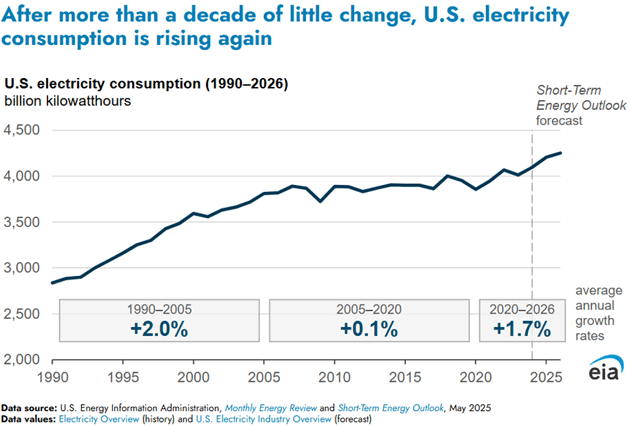
According to the US Energy Information Administration (EIA), demand for electricity increased by only 0.1% per year from 2005 to 2020. Since 2020, the annual rate of increase has been 1.7%. Here’s their chart:
 Source: US EIA
The biggest source of new demand is tied to AI. Data centers are big consumers of electricity and water.
Even the smallest data centers use about 18,000 gallons of water every day to cool their systems, with the largest data center complexes using up to 5 million gallons a day. Two-thirds of these new data centers are being built in places that already struggle with water scarcity—think Arizona, Nevada, Texas, and Utah.
Processing power has its cost. OpenAI CEO Sam Altman noted that one ChatGPT query “uses about 0.34 watt-hours [of electricity], about what an oven would use in a little over one second, or a high-efficiency lightbulb would use in a couple of minutes. It also uses about 0.000085 gallons of water; roughly one fifteenth of a teaspoon.”
OK. That sounds minuscule until you consider that this demand is additive. It’s new demand.122 million people use ChatGPT every day, with countless other platforms like Perplexity AI and Claude adding to the power demand. And Perplexity tells me the average AI user makes four to five queries per day.
In 2021, there were 2,667 data centers in the US. By 2024, we had twice as many—5,381.
These facilities are not only becoming more prevalent but also bigger in capacity. We’ve barely hit the full potential of AI’s processing power. Future AI models will require more energy as we offload more complex tasks in the white-collar office space.
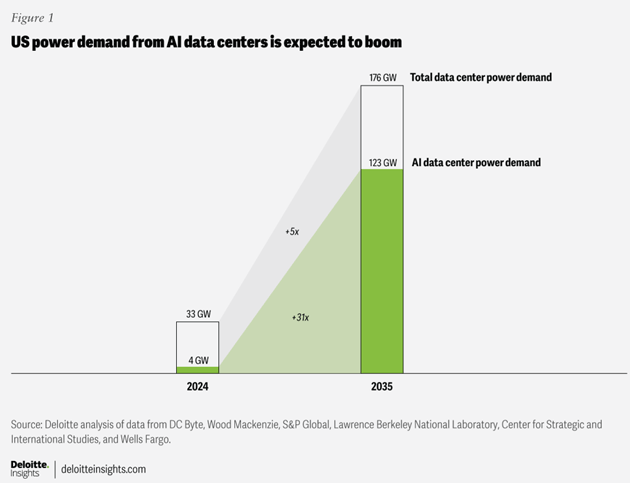
Energy demand from AI data centers is projected to grow thirtyfold within the next decade:
Source: Deloitte Insights
The law of supply and demand will take care of the energy needs, but costs per kWh are going to increase. The question becomes: Who pays for the additional cost?
In most markets, the answer is likely consumers. Not consumers of AI, mind you, but everyone.
Expect to hear more about this as the impact of AI becomes politically charged. It is not without reason or merit. AI will both disintermediate a subset of the population and raise their cost of living due to higher energy costs.
Our energy grid is already feeling the strain. Electricity costs in the US are up 5.8% over the past year. Utility companies are passing higher energy costs on to consumers. New Jersey’s Board of Public Utilities notified customers earlier this year that their bills will go up between 17% and 20% specifically due to data centers.
Data centers will account for up to 12% of our overall electricity consumption as early as 2028.
This wave of AI innovation could turn our default utility model—spreading costs across all ratepayers—into an Industrial Age relic, built for widely shared infrastructure like water mains or rural electrification. When a handful of companies account for most new demand—and their impact will likely cost jobs, not add more jobs in the local market—asking the public to subsidize data center power feels like a fight waiting to happen.
Dominion Energy Virginia proposed a separate “rate class” for data centers, making them pay closer to the true marginal cost of the power they use.
Meanwhile, data center developers are cutting deals for dedicated power delivery, elbowing their way to the front of the grid. Microsoft alone reportedly demands up to 5 gigawatts of power for its expansion plans. Building their own direct sources of electricity, while complex and time-consuming, could avoid much of the tension that is sure to arise around this issue.
AI’s growth is not self-funding. It needs infrastructure. Consumers are generally willing to support progress, but only to the point that it doesn’t undermine their own security.
Picks and Shovels
One thing is clear: We will build more electricity generation. That has led to an anticipatory boom in the stock price of utilities, certain construction and engineering firms, and midstream energy providers.
This is a big, diverse industry, and many smaller-cap companies are providing essential goods and services to the sector. Compared to the average company in the S&P 500, the stocks of many of these companies are cheap.
This is one pocket of the market where we are looking for—and finding—great opportunities to invest.
Finally, there’s an irony here many ignore: AI has the potential to improve energy efficiency and optimize the very grid it now threatens to overload.
I’m impressed by how AI’s capabilities grow seemingly overnight. I can see AI helping engineers design and test better energy infrastructure, from the individual capacitors to large-scale distribution lines. And I can also imagine software engineers using AI to optimize their systems for energy efficiency.
Smarter demand response, AI-enabled forecasting, and predictive maintenance could help lessen the power burden of automation on society.
For all its potential harms, people with new ideas have less of a barrier to market than ever before. For investors, there’s tremendous upside in innovations that can replace our aging power infrastructure or help AI companies run their data centers more efficiently. The question I have for you is how long you think society will continue to pay for an AI-powered future that may not benefit them.
Next week, we’ll take a turn for the optimistic, focusing on the new opportunities that AI will bring to light.
Thanks for reading.
Ed D’Agostino
Publisher & COO
A message from Advisor Perspectives and VettaFi: To learn more about this and other topics, check out some of our webcasts.
© Mauldin Economics
Read more commentaries by Mauldin Economics
 Source: US EIA
 Source:











